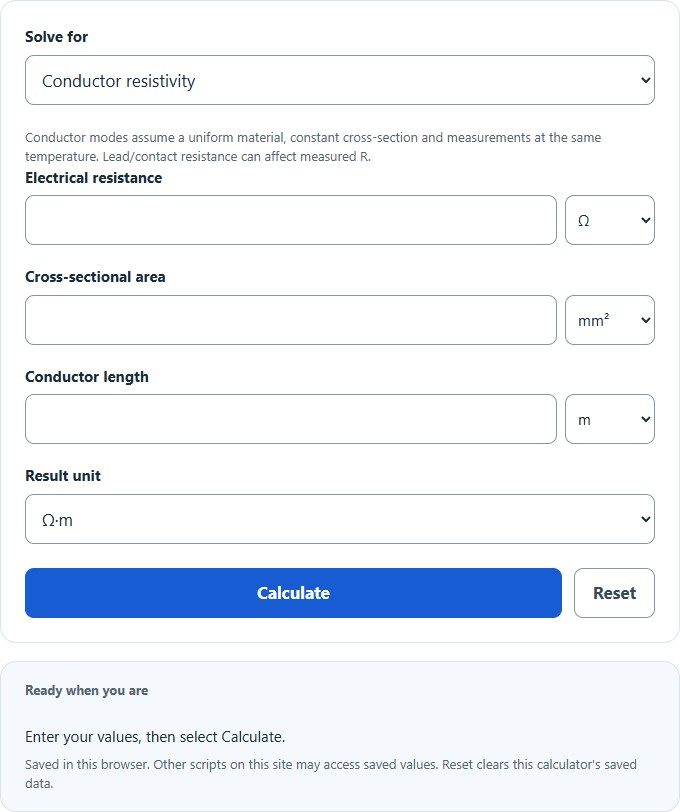
Calculate resistivity, resistance, conductor length, or cross-sectional area from the other three electrical values.
- All Physics Calculators
- Wire Resistance Calculator
- Internal Resistance Calculator
- Resistance Per Meter Calculator
Resistivity Formula
For a homogeneous uniform conductor with a constant current-carrying cross-section, resistivity relates resistance, measured length and cross-sectional area. The four conductor modes solve for any one quantity when the other three are known. Use resistance for the same measured span and temperature; two-terminal lead/contact resistance can affect low-resistance readings. This is a DC/ohmic geometry model, not a general AC impedance solver. See NBS/NIST resistivity measurement guidance.
Common rearrangements are:
| Symbol | Meaning | Typical Unit |
|---|---|---|
| ρ | Resistivity of the material | Ω·m |
| R | Electrical resistance | Ω |
| A | Cross-sectional area | m² |
| L | Conductor length | m |
Corrected Layer Parameter Modes
The three archived layer calculations are retained with corrected physical quantities: transverse layer resistance T = ρh in Ω·m², layer resistivity ρ = T/h in Ω·m, and layer thickness h = T/ρ in m. The earlier apparent-resistivity label for ρh was dimensionally incorrect. For one known uniform layer with ρ = 50 Ω·m and h = 10 m, T = 500 Ω·m², not 500 Ω·m apparent resistivity. These equations do not infer layer parameters from survey apparent-resistivity data and do not perform a Barnes or multilayer inversion. Old layer values/results must be re-entered using the corrected quantities. See the USGS definition of transverse resistance and USGS explanation of resistivity inversion.
Transverse-resistance conversions use squared distance factors: 1 Ω·cm² = 0.0001 Ω·m²; 1 Ω·in² = 0.00064516 Ω·m²; 1 Ω·ft² = 0.09290304 Ω·m². Electrical resistivity conversions use linear distance factors instead.
What Resistivity Means
Resistivity is a material property. It indicates how strongly a material opposes current flow. A low resistivity means current passes more easily; a high resistivity means the material is more resistant to current.
It is important to distinguish resistivity from resistance:
- Resistivity depends primarily on the material and temperature.
- Resistance depends on the material and the object’s geometry.
That is why two wires made from the same material can have different resistances if their lengths or cross-sectional areas are different, while still having the same resistivity.
How to Use the Calculator
- Choose a conductor quantity to solve for and enter its other three values, or choose a corrected layer mode and enter its two known parameters.
- Make sure the selected units match your measurements.
- Click calculate to solve for the missing value.
- Interpret the result in the context of the material and its dimensions.
How Each Variable Affects the Result
- Higher resistance increases calculated resistivity when area and length stay fixed.
- Larger cross-sectional area increases calculated resistivity when resistance and length stay fixed.
- Longer length decreases calculated resistivity when resistance and area stay fixed.
When solving for resistance instead, the relationship is often easier to interpret:
- Longer conductors have more resistance.
- Thicker conductors have less resistance.
- Materials with higher resistivity produce more resistance for the same size and length.
Geometry Notes
If the conductor is round, you may need to calculate its cross-sectional area from the diameter or radius before using the resistivity equation.
Use the area of the conductor perpendicular to current flow. For non-circular conductors, use the actual cross-sectional shape.
Conductivity Relationship
Resistivity and conductivity are inverses of each other. If you know one, you can compute the other.
Here, σ is conductivity. Materials with high conductivity have low resistivity, and vice versa.
Example
Suppose a wire has a resistance of 8 Ω, a cross-sectional area of 0.000002 m², and a length of 4 m. The resistivity is:
This value describes the material itself, assuming the wire is uniform and measured at a consistent temperature.
Unit Awareness
Unit consistency matters. If you mix area, length, and resistance units incorrectly, the result can be off by large factors. Keep these points in mind:
- Area should match the selected area unit exactly.
- Length should be entered in the selected length unit.
- Resistivity units combine resistance and distance, such as Ω·m or Ω·cm.
Common conversions include:
- 1 cm = 0.01 m
- 1 cm² = 0.0001 m²
- 1 Ω·cm = 0.01 Ω·m
Temperature Matters
Resistivity is not perfectly constant. For many conductive materials, resistivity changes with temperature. If temperature rises, resistance often rises as well. This means measured resistivity can vary unless temperature is controlled or specified.
For precision work, compare values only when measurements are taken at the same temperature.
Common Mistakes
- Using diameter in place of area without converting it first.
- Mixing centimeters and meters in the same calculation.
- Confusing resistance with resistivity.
- Using total surface area instead of cross-sectional area.
- Ignoring temperature effects when comparing materials.
Practical Uses
- Estimating material properties from measured wire data
- Checking whether a conductor matches an expected material specification
- Comparing candidate materials in electrical design
- Analyzing wiring losses and conductor sizing
- Supporting lab calculations in physics and electrical engineering
Frequently Asked Questions
Is resistivity the same as resistance?
No. Resistance describes a specific object, while resistivity describes the underlying material.
Why does a longer wire have more resistance?
Because current must travel through more material. In the resistance equation, resistance is directly proportional to length.
Why does a larger area reduce resistance?
A larger cross-sectional area gives current more parallel path space to move through, which lowers resistance for the same material and length.
Can two wires have the same resistance but different resistivities?
Yes. Different combinations of material, length, and area can produce the same resistance.
When should I use resistivity instead of resistance?
Use resistivity when you want to characterize or compare materials. Use resistance when analyzing the electrical behavior of a specific component or conductor.