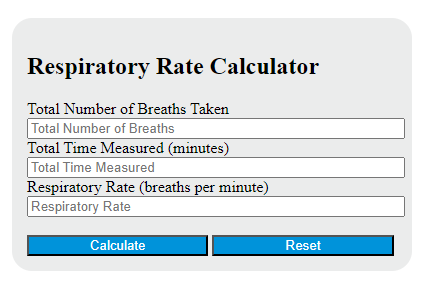
Calculate respiratory rate from complete breaths counted over a known time, or solve one missing value from breaths, time, and rate. Use the result as a measurement summary, not a diagnosis.
Respiratory Rate Formula
Respiratory rate is the number of complete breaths observed during a known time. One complete breath includes one inspiration and one expiration. When time is measured in minutes, the basic equation is:
For an observation measured in seconds, convert seconds to minutes or use the equivalent form:
In these equations, RR is respiratory rate in breaths per minute, B is the number of complete breaths counted, Tmin is observation time in minutes, and Tsec is observation time in seconds. The relationship can also be rearranged: B = RR × Tmin and Tmin = B ÷ RR. A breaths-per-second display, when needed, is RR ÷ 60.
What Is Respiratory Rate?
Respiratory rate describes breathing frequency, not breath depth, airflow, oxygen saturation, or the work required to breathe. Two people may have the same calculated rate while their breathing patterns and clinical circumstances are very different. The number is therefore one observation within a broader assessment.
Breathing rate and breaths per minute usually name the same quantity. A calculation becomes useful only when the count and timing method are clear. Activity, fever, pain, anxiety, medication, altitude, age, sleep, illness, and even awareness of being observed can change the measurement. A single arithmetic result should not be treated as a diagnosis or a universal normal-abnormal boundary.
How to Calculate Respiratory Rate
- When appropriate, allow the person to settle quietly. Record whether the observation was at rest, after activity, during sleep, or under another condition.
- Watch the chest or abdomen and count complete inspiration-expiration cycles. Avoid counting each rise and fall as two separate breaths.
- Measure the observation duration accurately. A full 60-second count is preferred when possible, especially if the rhythm is irregular.
- Enter the whole-number breath count and duration, then select seconds or minutes. The calculator normalizes time before dividing.
- Document the result with its units and measurement conditions. Repeat the observation if the count, timing, or rhythm is uncertain.
When a person changes their breathing because they know it is being counted, the observed rate may not represent their prior pattern. Measurement guidance therefore emphasizes quiet observation when feasible. In children, agitation can also increase variability. A careful technique matters as much as the division performed by the calculator.
Worked Example: Counted Breaths
Suppose 9 complete breaths are counted during 30 seconds. Convert the timed count to a one-minute rate:
The result is an arithmetic estimate of 18 breaths per minute. It is not a health verdict. A doubled 30-second count can differ from a complete 60-second observation, particularly when breathing is irregular or changing.
Worked Example: Solve for Time or Total Breaths
If 30 breaths occur at a constant estimated rate of 15 breaths per minute, solve for time:
The same algebra estimates a breath total. At 18 breaths per minute for 5 minutes, B = 18 × 5 = 90 estimated breaths. That total is modeled from a constant rate; it is not equivalent to directly observing and counting every breath for five minutes.
Why Measurement Conditions Matter
Manual respiratory-rate measurement has several known sources of variation. Short observation periods magnify the effect of a single extra or missed breath. Multiplying a 15-second count by four is mathematically correct, but one counting error also becomes four breaths per minute in the scaled result. A 60-second observation reduces that scaling effect and better reveals an irregular pattern.
Observer technique can introduce digit preference, skipped documentation, or disagreement over where one cycle begins. Movement, talking, crying, recent exertion, fever, discomfort, and anxiety can alter the rate during measurement. Automated monitors and wearables may use different sensors, averaging windows, artifact filters, or definitions, so their displayed value may not match a simultaneous manual count exactly.
How to Interpret a Result Safely
The calculator answers a narrow question: how many complete cycles correspond to one minute, or what missing count or duration follows from the equation. It does not decide whether the result is expected for a particular person. Reference intervals and decision thresholds depend on age, setting, measurement state, clinical pathway, and source. Pediatric thresholds used in a specific fever or pneumonia workflow are not universal normal ranges.
For adults at rest, 12–20 breaths per minute is a commonly cited reference interval, but it should not be converted into an automated verdict. A value just inside or outside that interval cannot diagnose a condition or determine urgency by itself. Trends, symptoms, baseline health, medication effects, oxygenation, work of breathing, and the reliability of the observation all matter. Clinical early-warning systems likewise apply defined rules to defined populations; they are not interchangeable with this calculator.
Common Respiratory-Rate Errors
- Counting an inspiration and expiration as two breaths instead of one complete cycle.
- Entering seconds while the calculator is set to minutes, or the reverse.
- Scaling a very short count when the breathing rhythm is irregular.
- Estimating the count from memory instead of timing and observing it.
- Rounding inputs or outputs without recording what was rounded.
- Comparing two measurements taken under different activity or symptom conditions as if their methods were identical.
When to Seek Care
Do not wait for a calculator result when someone has severe difficulty breathing, blue or gray lips or face, confusion, fainting, chest pain, or unresponsiveness. Those symptoms require immediate emergency assessment. For a new, persistent, or concerning breathing change without emergency symptoms, contact an appropriate health professional. The numerical rate alone cannot determine the cause or urgency.
Frequently Asked Questions
Are breathing rate and breaths per minute different?
Usually no. Respiratory rate is commonly reported in breaths per minute. “Breaths per minute” is the unit, while “respiratory rate” names the measured quantity.
Can I count for 15 or 30 seconds?
The arithmetic can scale either interval, as shown by 4 breaths in 15 seconds equaling 16 breaths per minute. However, shorter counts may differ from a full-minute count and are more affected by one missed breath. Prefer 60 seconds when possible, particularly for children or irregular breathing.
Why might a repeat count be different?
Breathing naturally varies, and posture, awareness, movement, emotion, symptoms, and observer technique can change a result. A repeat count is most comparable when the person and method are in similar conditions.
Will a watch or monitor match a manual count?
Not necessarily. Devices can use different signals and averaging rules, and motion or weak sensor contact may create artifacts. Review the device instructions and the measurement context rather than assuming two methods are interchangeable.
Medical note: This calculator provides educational arithmetic only. It does not diagnose a respiratory disorder, classify a result as normal or abnormal, or determine treatment or urgency.
Primary and current sources: Kallioinen et al., systematic review of respiratory-rate measurement; Takayama et al., 30-second versus one-minute pediatric measurement; Simoes et al., pediatric counting-period study; and the WHO IMCI handbook for context-specific one-minute pediatric measurement technique.