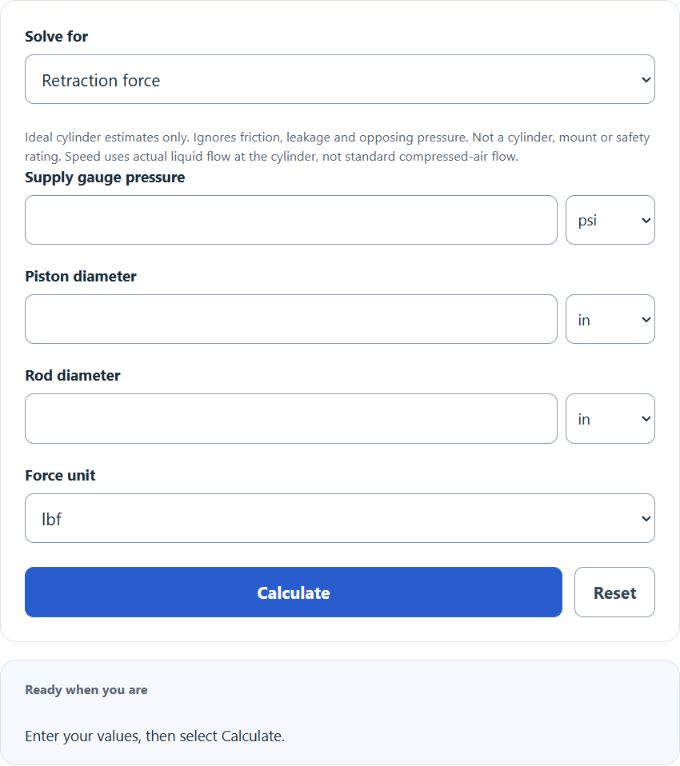
Calculate hydraulic cylinder retraction force from pressure, piston diameter, and rod diameter, plus extension force, speed, and stroke time.
- All Physics Calculators
- All Force Calculators
- Cylinder Force Calculator
- Force From Pressure Calculator
- Pressure Gradient Force Calculator
Retraction Force Formula
The following equation is used to calculate the Retraction Force.
- Where RF is the retraction force (lbf)
- P is the rod-side gauge pressure, assuming zero opposing gauge pressure (psi)
- Dp is the diameter of the piston (in)
- Dr is the diameter of the rod (in)
To calculate the retraction force, subtract the area of the rod from the area of the piston, then multiply by the pressure.
What is a Retraction Force?
Definition:
Retraction force is the ideal available pulling force of a single-rod, double-acting cylinder.
How to Calculate Retraction Force?
Example Problem:
The following example outlines the steps and information needed to calculate the Retraction Force.
First, determine the pressure. For this example, the pressure is 50 psi.
Next, determine the diameter of the piston. In this case, the diameter of the piston is found to be 5 in.
Next, determine the diameter of the rod. For this problem, the diameter of the rod is measured to be 2 in.
Finally, calculate the Retraction Force using the formula above:
RF = P (pi*Dp^2/4 – pi*Dr^2/4)
RF = 50* (3.14159*5^2/4 – 3.14159*2^2/4)
RF = 824.67 lbf
FAQ
What is the significance of the diameter of the piston and rod in calculating retraction force?
The diameters of the piston and the rod are crucial in calculating the retraction force because they determine the surface area on which the pressure acts. The difference in their areas, when multiplied by the pressure, gives the retraction force. A larger piston diameter or a smaller rod diameter increases the area difference, thus increasing the retraction force.
How does pressure affect the retraction force of a pneumatic cylinder?
Pressure directly influences the retraction force; the higher the rod-side pressure, with opposing pressure held at zero gauge, the greater the retraction force. This is because the force is a product of pressure and the difference in the area of the piston and rod. Therefore, for a given piston and rod size, increasing the pressure will proportionally increase the retraction force.
Can the retraction force formula be used for any type of cylinder?
The ideal pressure-times-effective-area formula applies to single-rod hydraulic and pneumatic cylinders. Actual force also depends on opposing pressure, friction and other losses. The speed calculation here uses actual liquid flow at the cylinder; it does not convert standard compressed-air flow.