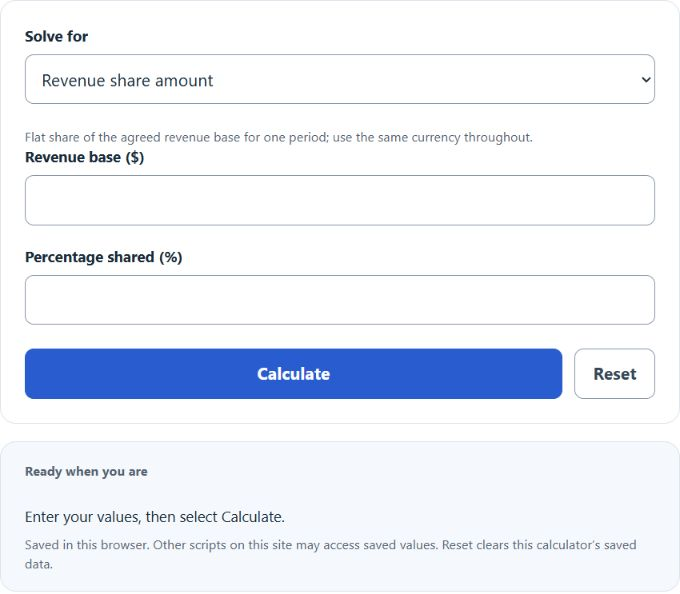
Select revenue share, revenue base or percentage shared, then enter the two requested inputs for one consistent period.
- All Business Calculators
- Profit-Sharing Ratio Calculator
- Profit-Sharing Calculator
- Return on Revenue Calculator
Revenue Share Formula
Revenue share, often called revshare, is the amount paid to a person or partner based on an agreed percentage of total revenue. It is commonly used for affiliate payouts, creator partnerships, licensing deals, sales agreements, marketplace splits, and channel distribution arrangements.
| Variable | Meaning |
|---|---|
| RS | Revenue share amount paid to the individual or partner |
| TR | Eligible revenue base during the measurement period, as defined by the agreement |
| P | Agreed revenue share percentage |
This means the payout equals total revenue multiplied by the agreed share percentage. If the percentage is entered as a whole number, divide it by 100 during the calculation.
How to Calculate Revenue Share
- Determine the total revenue for the period being measured.
- Identify the agreed revshare percentage.
- Multiply the revenue by the percentage expressed as a decimal.
- The result is the revenue share payout.
For example, if revenue is $100,000 and the revshare rate is 2.5%, the payout is:
Reverse Revenue Share Formulas
If you know the payout and percentage, you can solve for total revenue:
If you know the payout and total revenue, you can solve for the percentage:
These reverse formulas require a nonzero denominator. At 0% with zero payout, revenue is not unique; with zero revenue and zero payout, the percentage is not unique. Amounts must be nonnegative and the flat share is limited to 0–100%. Contract terms determine the eligible revenue base.
Example Revenue Share Amounts
| Total Revenue | Share Percentage | Revenue Share |
|---|---|---|
| $12,000 | 15% | $1,800 |
| $85,000 | 4% | $3,400 |
| $250,000 | 7.5% | $18,750 |
| $1,200,000 | 1.25% | $15,000 |
Revenue Share vs. Profit Share
Revenue share is based on top-line revenue, while profit share is based on revenue minus expenses. This distinction matters because the revenue-share base may be gross or net of specified deductions, whereas profit share depends heavily on margins, accounting treatment, and expense allocation.
- Revenue share: based on the agreement’s eligible revenue; tracking complexity and predictability depend on its terms.
- Profit share: more sensitive to costs, overhead, and operational efficiency.
Common Revshare Use Cases
- Affiliate marketing: a partner receives a percentage of sales they refer.
- Content creators and influencers: payout tied to subscription, ad, or product revenue.
- Software and app marketplaces: developers and platforms split subscription or purchase revenue.
- Licensing deals: a creator or rights holder earns a percentage of monetized revenue.
- Sales partnerships: commissions are structured as a percent of booked revenue.
Important Terms to Confirm in a Revshare Agreement
- Gross vs. net revenue: confirm whether deductions are allowed before calculating the share.
- Measurement period: monthly, quarterly, annually, or lifetime revenue can produce very different payouts.
- Payment timing: some agreements pay on invoice, some on cash collection, and some after refunds clear.
- Refunds and chargebacks: clarify whether these reduce the revenue base.
- Tiers and thresholds: the percentage may increase after certain revenue milestones are reached.
- Caps or minimums: some contracts set maximum payouts or guaranteed minimum compensation.
Tiered Revenue Share
Not all agreements use one flat percentage. Some use tiers, where different portions of revenue are paid at different rates. A simple tiered structure might look like this:
| Revenue Band | Share Rate |
|---|---|
| First $50,000 | 5% |
| Next $50,000 | 7% |
| Over $100,000 | 10% |
In a tiered arrangement, the calculator above is best used one tier at a time and then the results are added together.
Tips for Using the Calculator Accurately
- Use the revenue from the correct time period only.
- Make sure the percentage matches the contract exactly.
- Do not confuse a percentage with its decimal form.
- Check whether taxes, refunds, or platform fees are included or excluded.
- Round only at the final step if you want the most accurate payout.
Quick Reference
Use this calculator when you know any two of the three values and need the third:
- Know revenue and percentage? Calculate payout.
- Know payout and percentage? Calculate total revenue generated.
- Know payout and revenue? Calculate the effective revshare rate.
Because revshare arrangements appear in many industries, the formula is simple but the contract details matter. The calculator gives the numerical result quickly, while the agreement determines which revenue base and percentage should be used.