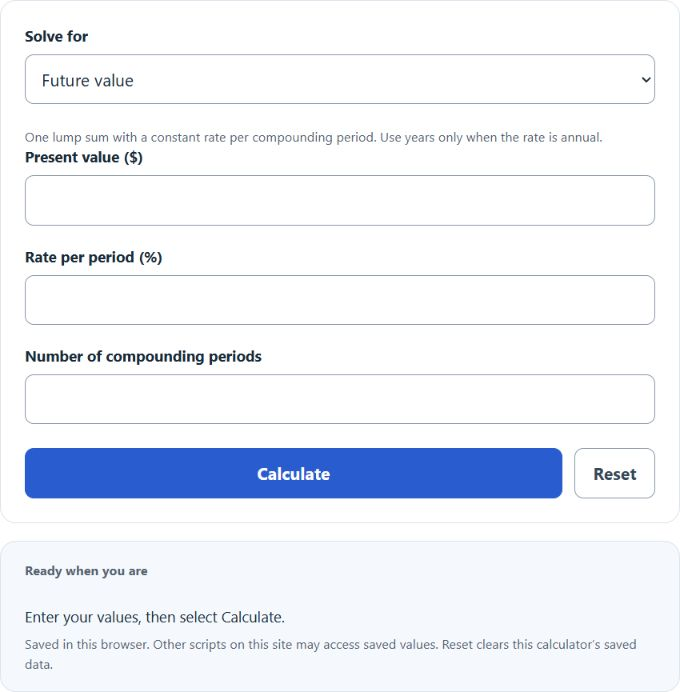
Calculate present value, future value, annual interest rate, or number of periods by choosing a solve mode and entering its compound-growth inputs.
Reverse Present Value Formula
The following equation is used to calculate the Reverse Present Value.
- Where RPV is the reverse present value (future value)
- PV is the present value ($)
- r is the rate of return per compounding period (decimal)
- n is the number of compounding periods
To calculate the reverse present value, multiply the present value by (1 + r) raised to the power of n.
What is a Reverse Present Value?
Definition:
A Reverse Present Value Calculator determines the future cash flow or necessary rate of return required to achieve a particular present value amount. Instead of simply discounting a known future value back to the present, it works in the opposite direction—starting with the investment’s current worth and calculating what final sum or growth rate will match that initial figure over a specified time period.
How to Calculate Reverse Present Value?
Example Problem:
The following example outlines the steps and information needed to calculate the Reverse Present Value.
First, determine the present value. In this example, we have a PV of $1,000.
Next, determine the rate of return. In this case, it is 5% (or .05).
Then, determine the number of compounding periods. For this example, there are 5 compounding periods.
Finally, calculate the Reverse Present Value using the formula above:
RPV = 1000 × (1 + .05)^5
RPV = 1000 × 1.2762815625
RPV = $1276.28 (approximately)
FAQ
How does reverse present value differ from traditional present value calculations?
Traditional present value calculations discount future amounts to arrive at today's value. Reverse present value, on the other hand, starts with a known present value and calculates the future sum or rate of return needed to reach that present amount over time.
When might I use a reverse present value calculation?
You might use it when you know how much capital you have today and want to determine how it needs to grow—or at what rate—to reach a target amount at a future date.
Does the accuracy of reverse present value depend on the inputs used?
Yes. Like any financial projection, the reliability of reverse present value depends on the accuracy of the assumptions made, such as the rate of return and the number of compounding periods.