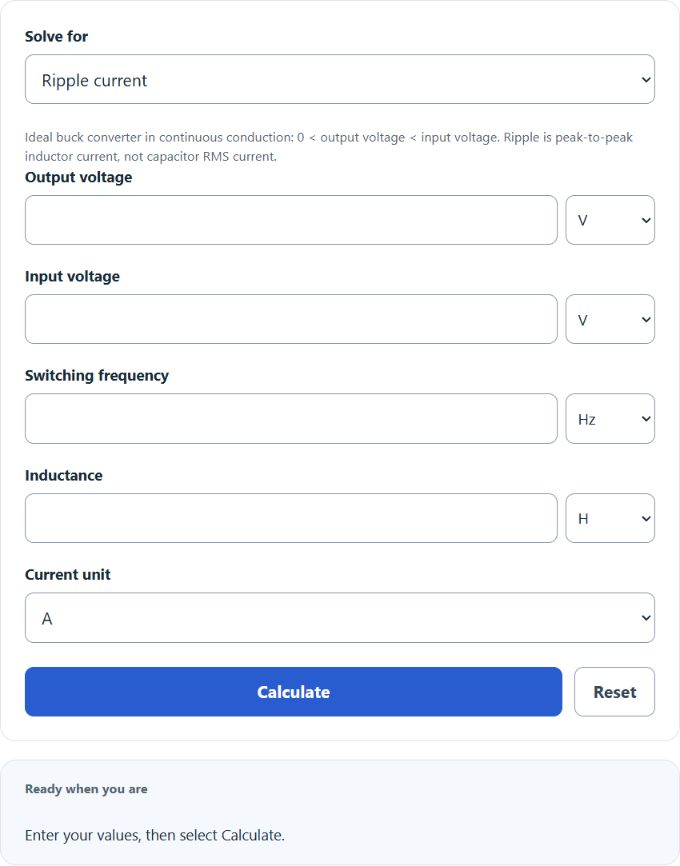
Calculate ripple current, inductance, switching frequency, or input/output voltage for an ideal continuous-conduction buck converter. Select the value to solve; ripple means peak-to-peak inductor current.
- All Physics Calculators
- All Electrical Calculators
- Ripple Voltage Calculator
- Frequency to Voltage Calculator
Ripple Current Formula
The following ideal buck-converter formula estimates peak-to-peak inductor ripple current with 0 < Vo < Vi. It excludes losses, discontinuous conduction and controller limits. Solving for output voltage can give two solutions; both are shown.
- Where Iripple is the Ripple Current (amps)
- Vo is the output voltage (volts)
- Vi is the input voltage (volts)
- Fs is the switching frequency (Hz)
- L is the inductance (H)
How to Calculate Ripple Current?
The following example problems outline how to calculate Ripple Current.
Example Problem #1
- First, determine the output voltage (volts). In this example, the output voltage (volts) is determined to be 10.
- Next, determine the input voltage (volts). For this problem, the input voltage (volts) is measured to be 50.
- Next, determine the switching frequency (Hz). In this case, the switching frequency (Hz) is found to be 2.
- Next, determine the inductance. In this case, this is 4H.
- Finally, calculate the Ripple Current using the formula above:
Iripple = Vo / Vi * (Vi-Vo)/ (Fs*L)
Inserting the values from above and solving yields:
Iripple = 10 / 50 * (50-10)/ (2*4) = 1 (amps)
Example Problem #2
Using the same method as above, determine the variables required by the formula. For this example problem, these are:
output voltage (volts) = 4
input voltage (volts) = 23
switching frequency (Hz) = 5
inductance (H) = 3
Entering these given values into the calculator or the formula above yields:
Iripple = 4 / 23 * (23-4)/ (5*3) = .2203 (amps)