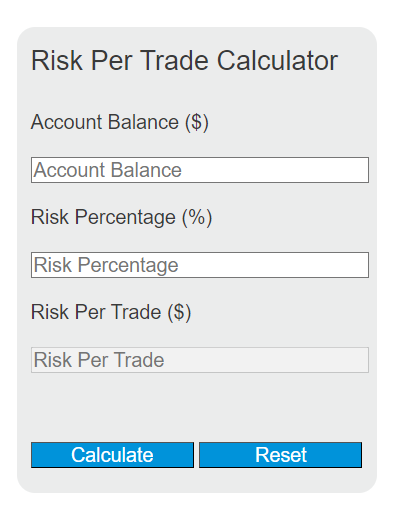
Calculate risk-based position size with stop distance, fees, slippage, and rounding, or model losing-streak drawdown and the recovery gain needed.
Risk Per Trade Formula
Risk per trade is the maximum amount of money you are willing to lose on a single trade. It is a core risk-management input for trading stocks, forex, futures, options, and crypto because it converts a percentage-based rule into a clear dollar limit.
Variables
- RPT = risk per trade in dollars
- AB = account balance or account equity
- RP = percentage of the account risked on one trade
This calculator tells you your dollar risk budget for the trade. Once you know that number, you can use it to choose a position size that fits your stop-loss distance.
How to Calculate Risk Per Trade
- Determine your current account balance or equity.
- Choose the percentage of the account you are willing to risk on one trade.
- Multiply the account balance by the risk percentage.
- Convert the percentage to decimal form by dividing by 100.
Example:
With a $10,000 account and a 2% risk rule, the maximum planned loss on that trade is $200.
Using Risk Per Trade for Position Sizing
Risk per trade is not the same as the amount invested. It is the amount you can afford to lose if the trade reaches your stop. To convert that dollar risk into shares, contracts, or lots, divide by the risk per unit.
Position sizing example:
If your allowed risk is $200 and each share carries $4 of downside risk between entry and stop-loss, the position size is 50 shares.
Quick Reference Table
| Account Balance | 0.5% Risk | 1% Risk | 2% Risk | 3% Risk |
|---|---|---|---|---|
| $5,000 | $25 | $50 | $100 | $150 |
| $10,000 | $50 | $100 | $200 | $300 |
| $25,000 | $125 | $250 | $500 | $750 |
| $50,000 | $250 | $500 | $1,000 | $1,500 |
| $100,000 | $500 | $1,000 | $2,000 | $3,000 |
Why Risk Per Trade Matters
- Capital preservation: A fixed risk rule prevents one bad trade from causing outsized damage.
- Consistency: Each trade follows the same risk framework, making results easier to evaluate.
- Drawdown control: Smaller risk per trade reduces the impact of losing streaks.
- Emotion reduction: Predefined dollar risk helps avoid impulsive oversizing.
- Scalability: As account equity changes, the risk amount automatically adjusts.
Risk Per Trade vs. Position Size
| Concept | What It Means | Typical Unit |
|---|---|---|
| Risk Per Trade | Maximum planned loss on one trade | Dollars |
| Position Size | How many shares, contracts, lots, or units you can trade | Quantity |
| Risk Per Unit | Loss per share, contract, or lot if stop-loss is hit | Dollars per unit |
Practical Guidelines
- Use account equity rather than the original deposit if you want risk to reflect current account size.
- Apply the same risk rule across trades to maintain a disciplined process.
- Smaller percentages generally produce smoother equity curves and lower drawdowns.
- Larger percentages can grow returns faster, but they also amplify losses and emotional pressure.
- For leveraged markets, convert the stop distance into true dollar risk per contract or lot before sizing the trade.
- Include commissions, spread, slippage, and possible gap risk when setting a realistic risk budget.
Common Mistakes
- Confusing the amount invested with the amount risked.
- Choosing position size first and calculating risk second.
- Using a stop-loss that is too wide for the chosen risk budget.
- Ignoring trading costs that increase realized loss.
- Risking different percentages from trade to trade without a defined rule.
- Assuming planned risk and actual loss will always match in fast or illiquid markets.
Frequently Asked Questions
What is a good risk percentage per trade?
Many traders use a small fixed percentage, often in the range of 0.5% to 2% of account equity. Lower percentages are generally more conservative and reduce the damage from consecutive losses.
Should I use account balance or account equity?
Account equity is often the better choice because it reflects the account’s current value after open profits, losses, and prior trades. Using equity keeps your risk model aligned with real capital.
Does this calculator tell me how many shares to buy?
No. This calculator gives you the dollar amount you can risk on one trade. You would then combine that result with your entry price and stop-loss distance to determine position size.
Can I risk the same dollar amount on every trade?
You can, but many traders prefer a percentage-based approach because the dollar risk automatically scales up or down as the account changes in size.
Can actual losses exceed planned risk per trade?
Yes. Slippage, overnight gaps, low liquidity, and volatile conditions can cause exits to occur beyond the intended stop-loss level.