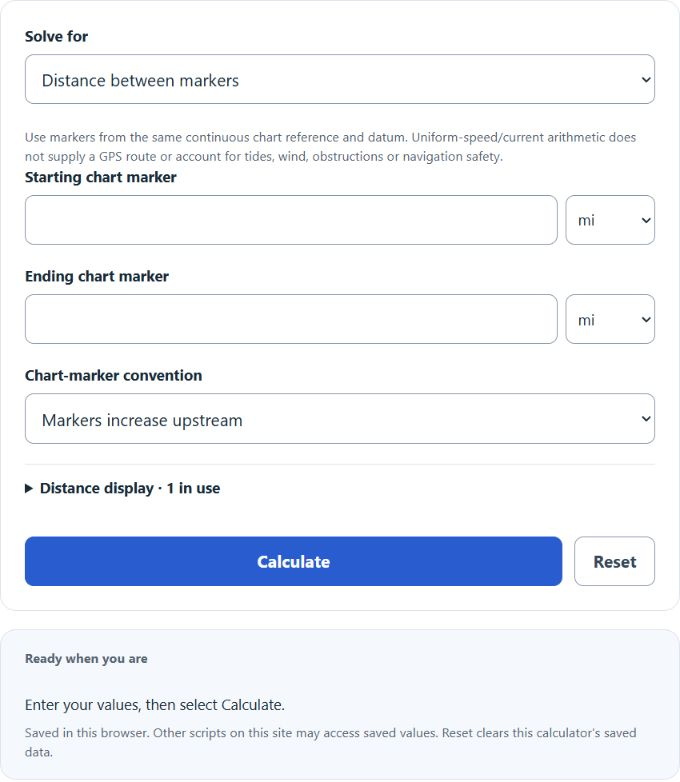
Find distance between compatible river markers, estimate trip time, solve required speed, or estimate distance from speed and moving time. Convert statute miles, kilometers and nautical miles, with optional uniform along-route current, stops and moving fuel use. These arithmetic estimates do not establish a safe or navigable route.
River Miles Formula
For a continuous marker scale on the same chart reference and river reach, marker separation is |ending marker − starting marker|. Separately, trip distance can be estimated from average speed over ground and moving time using:
Variables:
- RM is estimated trip distance; use miles for statute miles traveled
- V is average speed over ground while moving, in distance units per hour
- V in mph gives miles; km/h gives kilometers; knots give nautical miles
- T is moving time in hours, excluding the entered stop or portage time
For the trip-distance task, multiply ground speed by moving time. Moving time is total elapsed time minus stops. With a steady current directly along the route, ground speed = still-water boat speed + aiding current, or still-water boat speed − opposing current. Angled or variable currents require a more detailed model. Fuel here equals the entered burn rate times moving hours; it excludes fuel during stops, idling and reserves.
What Are River Miles?
The term river miles can mean a charted river reference or distance traveled on a river. Marker origins and numbering directions vary by river and chart; they are not universally measured from the mouth or numbered upstream. Use markers from the same reference and continuous scale, verify their units and choose the stated numbering convention. Marker differences estimate separation along that chart reference, not a GPS route, navigation clearance or the distance of detours. This calculator offers both marker-based and speed/time trip estimates.
How to Calculate River Miles?
Choose the task that matches the available inputs. For marker distance, subtract compatible markers and take the absolute value; equal markers give zero separation without a travel direction. For trip time use distance / positive ground speed, then add stops. Required-speed mode uses distance / (total time − stops), then reverses the selected current adjustment. For the speed/time trip-distance task, follow these steps:
- First, enter average ground speed (V), or still-water boat speed and a uniform along-route current.
- Next, enter total elapsed time and subtract stop or portage time to obtain moving time (T).
- Use RM = V * T with compatible ground-speed and moving-time units.
- Multiply average ground speed (V) by moving time (T) to estimate trip distance.
- After inserting the variables and calculating the result, check your answer with the calculator above.
Example Problem :
Use the following variables as an example problem to test your knowledge.
Average speed over ground (V) = 10 miles per hour, with no current adjustment.
Total elapsed time = 5 hours and stops = 0, so moving time (T) = 5 hours. RM = 10 × 5 = 50 statute miles traveled. This estimates distance traveled; it does not assign a new charted river-mile marker.