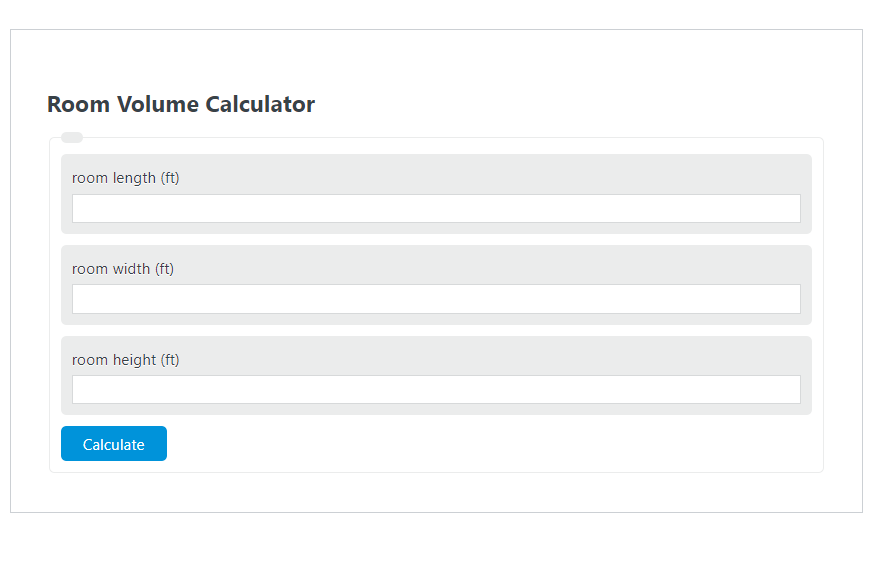
Calculate room volume or a missing length, width, or height from any three values, with conversions among cubic feet, cubic meters, cubic yards, liters, and gallons.
- All Construction Calculators
- All Volume Calculators
- Attic Volume Calculator
- Box Volume Calculator
- Liquid Volume Calculator
Room Volume Formula
Use room volume when you need to know how much three-dimensional space is inside a room. This is useful for HVAC sizing, ventilation estimates, humidifier and dehumidifier planning, storage calculations, and any project where ceiling height matters in addition to floor size.
For a rectangular room, volume is found by multiplying the interior length, width, and height measured in the same unit.
| Variable | Meaning | Common Units |
|---|---|---|
| RV | Room volume | cubic feet, cubic meters, liters, gallons |
| RL | Room length | feet, meters, inches, centimeters |
| RW | Room width | feet, meters, inches, centimeters |
| RH | Room height | feet, meters, inches, centimeters |
Solving for a Missing Dimension
If you know the room volume and two dimensions, the missing dimension can be found by dividing the volume by the product of the other two measurements.
How to Calculate Room Volume
- Measure the interior length of the room.
- Measure the interior width of the room.
- Measure the interior height from floor to ceiling.
- Make sure all three measurements use the same unit.
- Multiply length, width, and height to get the room volume.
If you are using the calculator to solve for one unknown value, enter any three known values and the calculator will compute the missing variable.
Example Calculations
| Scenario | Calculation | Result |
|---|---|---|
| Bedroom with dimensions 12 ft by 10 ft by 8 ft | RV = 12 × 10 × 8 |
960 cubic feet |
| Office with dimensions 5 m by 4 m by 2.6 m | RV = 5 × 4 × 2.6 |
52 cubic meters |
| Find ceiling height when volume is 1,200 cubic feet and the floor is 15 ft by 10 ft | RH = (1200) / (15 × 10) |
8 feet |
Room Volume vs. Floor Area
Floor area measures the two-dimensional footprint of a room. Room volume includes ceiling height, so it represents the total enclosed space. If you already know the floor area, volume is the floor area multiplied by the room height.
Common Unit Conversions
| Conversion | Formula |
|---|---|
| Cubic feet to liters | 1 ft³ = 28.3168 L |
| Cubic feet to gallons | 1 ft³ = 7.48052 gal |
| Cubic meters to liters | 1 m³ = 1000 L |
| Cubic meters to cubic feet | 1 m³ = 35.3147 ft³ |
Tips for More Accurate Results
- Measure from the inside surfaces of the walls, not from exterior dimensions.
- Use the same unit system for all inputs before multiplying.
- Round only after the final calculation if you want a more precise result.
- For rooms with beams, columns, closets, or alcoves, decide whether those spaces should be included based on your application.
- If the ceiling height changes, split the room into simpler sections and add the volumes together.
Irregular or L-Shaped Rooms
For rooms that are not perfect rectangles, break the space into smaller rectangular sections, calculate each section separately, and then add them together.
This approach gives a much better estimate for L-shaped rooms, rooms with bump-outs, and layouts with partial partitions or offset walls.
When Room Volume Is Most Useful
- Estimating airflow and ventilation needs
- Sizing humidifiers, dehumidifiers, and air purifiers
- Comparing the air space in different rooms
- Planning storage or occupancy layouts
- Evaluating conditioned space for heating and cooling