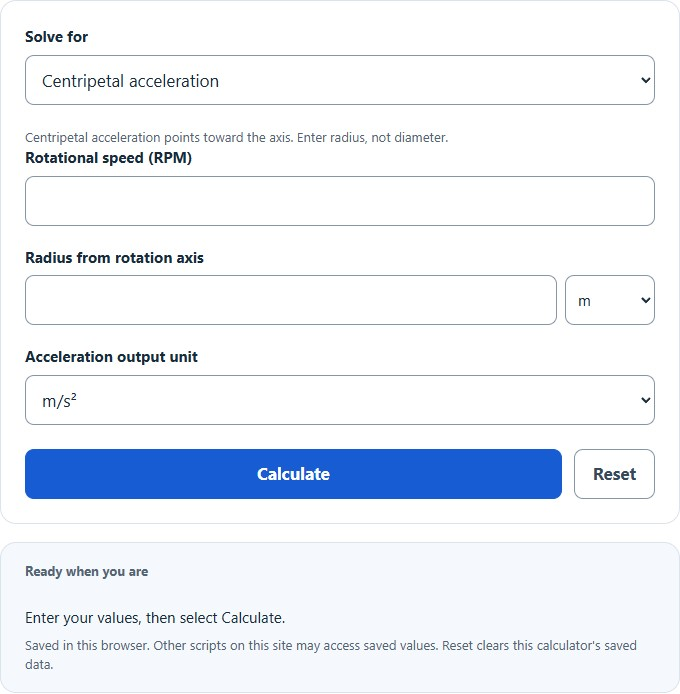
Calculate centripetal acceleration, g-force, angular velocity and rim speed from RPM and radius, or reverse-solve RPM or radius in common units.
- All Physics Calculators
- All Acceleration Calculators
- RPM to Angular Velocity Calculator
- Radial Acceleration Calculator
- HP to Acceleration Calculator
- RPM to Distance Calculator
Acceleration From RPM Formula
This calculator finds centripetal acceleration, also called radial acceleration, from a rotating system’s RPM and radius. In circular motion, the acceleration points inward toward the center of rotation. Even when RPM is constant, this inward acceleration still exists because the direction of motion is continuously changing.
- a = centripetal acceleration
- RPM = rotational speed in revolutions per minute
- r = radius measured from the center of rotation to the point of interest
- ω = angular velocity in radians per second
| Input | Meaning | Typical Units | Important Note |
|---|---|---|---|
| RPM | Rotational speed | rev/min | Higher RPM increases acceleration very quickly because RPM is squared in the formula. |
| Radius | Distance from the center of rotation | m, cm, mm, in, ft | Use radius, not diameter. |
| Acceleration | Inward radial acceleration | m/s2, ft/s2, g | Choose the acceleration output unit independently of radius. For inverse modes, select the target acceleration unit. |
How to Calculate Acceleration From RPM
- Enter the rotational speed in RPM.
- Enter the radius from the center of rotation to the object or measurement point.
- Convert RPM to angular velocity in radians per second.
- Square the angular velocity and multiply by the radius.
The relationship is important:
- Doubling RPM increases acceleration by a factor of 4.
- Tripling RPM increases acceleration by a factor of 9.
- Doubling radius doubles acceleration.
Example
If a rotating part spins at 500 RPM and the radius is 0.24 m, the acceleration is:
The result is approximately 657.97 m/s2. That is a large inward acceleration, which shows why moderate RPM can still create substantial loads when the radius is not small.
What the Result Means
The output is not linear speed and it is not tangential acceleration. It specifically represents the inward acceleration needed to keep an object moving in a circular path.
If you need the acceleration caused by a changing rotational speed, you need angular acceleration, not just RPM.
Here, at is tangential acceleration and α is angular acceleration. If RPM is steady, tangential acceleration is zero, but centripetal acceleration can still be very large.
Units and g-Force Conversion
The calculator converts radius to meters internally and lets you choose acceleration in m/s2, ft/s2 or multiples of standard gravity (g), independently of the radius unit.
To express the result as multiples of standard gravity:
This conversion is useful in centrifuges, rotating machinery, test rigs, tire analysis, and high-speed rotor applications.
Common Mistakes
- Using diameter instead of radius.
- Assuming the result is linear speed rather than acceleration.
- Mixing unit systems without converting them properly.
- Using RPM alone to estimate tangential acceleration.
- Forgetting that small increases in RPM can create very large increases in radial load.
Where This Calculation Is Used
- Motor shafts and couplings
- Flywheels and rotors
- Centrifuges and separators
- Wheels, tires, and drivetrain analysis
- Fans, turbines, and impellers
- Mechanical design and safety checks for rotating parts
Quick Interpretation Tips
- If the radius is zero, the acceleration is zero.
- Large-radius rotating systems generate more acceleration at the same RPM than small-radius systems.
- Very high acceleration values often indicate significant stress on components, bearings, fasteners, and material interfaces.