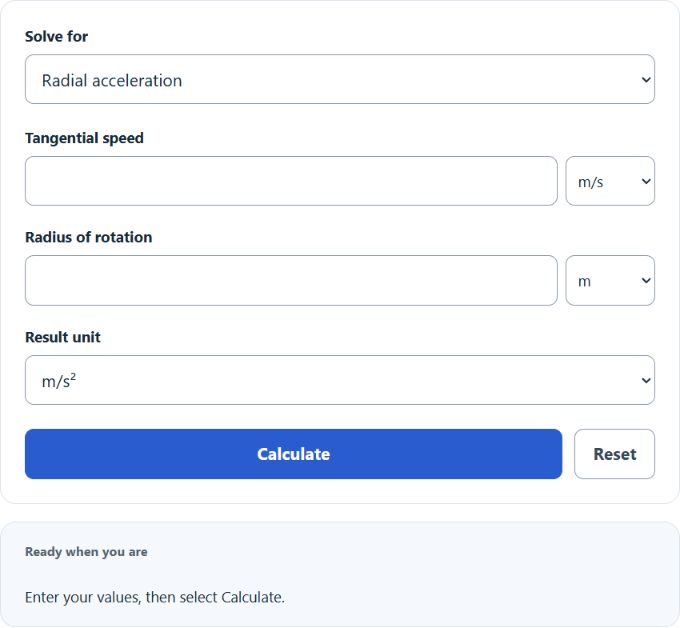
Select radial acceleration magnitude, tangential speed, or radius to calculate from the other two values. Choose input and result units separately.
- All Physics Calculators
- All Acceleration Calculators
- Tangential Acceleration Calculator
- RPM to Acceleration Calculator
- Radial Distance Calculator
Radial Acceleration Formula
Radial acceleration, also called centripetal acceleration, is the inward acceleration required to keep an object moving along a curved or circular path. This calculator finds the magnitude of that acceleration from tangential velocity and radius.
- ar = radial acceleration
- v = tangential velocity
- r = radius of rotation
The relationship is highly sensitive to speed because velocity is squared. If speed doubles, radial acceleration becomes four times larger. If the radius doubles while speed stays the same, radial acceleration is cut in half.
What radial acceleration means
Whenever an object travels in a circle, its velocity is constantly changing direction even if its speed stays constant. That directional change creates an inward acceleration toward the center of the circle. The calculator reports that inward acceleration as a positive magnitude.
This concept appears in many real systems, including:
- cars turning around curves
- roller coasters and amusement rides
- satellites and orbital motion
- rotating shafts, gears, and turbines
- particles moving in magnetic or mechanical circular paths
How to calculate radial acceleration
- Measure or determine the tangential velocity.
- Measure the radius from the center of rotation to the object.
- Square the velocity.
- Divide by the radius.
If an object moves at 20 m/s around a circle of radius 5 m, then:
If another object moves at 12 m/s with a radius of 3 m, then:
Rearranging the formula
The same equation can be solved for speed magnitude or radius. Radius must be positive. Zero speed gives zero radial acceleration; zero speed and zero acceleration do not determine a unique radius.
These forms are useful when designing safe turn speeds, estimating curve radius, or checking whether a rotating system stays within allowable acceleration limits.
Other equivalent formulas
Radial acceleration can also be written using angular velocity, frequency, or period.
- ω = angular velocity
- f = frequency
- T = period
These equivalent forms are especially useful in rotational mechanics when speed is not given directly but RPM, angular speed, or cycle time is known.
Units for radial acceleration
Radial acceleration uses any acceleration unit formed as distance per time squared. Common units include:
- m/s²
- ft/s²
- km/h²
- mile/h² (miles per hour squared, equivalent to mph per hour)
For the formula to work correctly, velocity and radius must be expressed in compatible units. For example:
- if velocity is in m/s, radius should be in meters
- if velocity is in ft/s, radius should be in feet
This calculator converts mixed input units to SI automatically before applying the formula. The mile/h² acceleration unit means mph per hour, not velocity squared.
How radial and tangential acceleration differ
Radial acceleration points inward and changes the direction of motion. Tangential acceleration acts along the path and changes the speed of the object. In circular motion, an object may have one, the other, or both.
| Type | Primary effect | Formula |
|---|---|---|
| Radial acceleration | Changes direction of velocity | aᵣ = (v²) / (r) |
| Tangential acceleration | Changes speed along the path | aₜ = (dv) / (dt) |
When both are present, the total acceleration is the vector combination of the two components.
Practical interpretation
A larger radial acceleration means a tighter or more aggressive turn. This can translate into greater tire forces on a vehicle, larger structural loads in rotating equipment, or stronger inward force requirements in mechanical and orbital systems.
For fixed speed:
- smaller radius → larger radial acceleration
- larger radius → smaller radial acceleration
For fixed radius:
- higher speed → much larger radial acceleration
- lower speed → much smaller radial acceleration
Common mistakes
- Using diameter instead of radius
- Mixing unit systems without converting first
- Confusing radial acceleration with tangential acceleration
- Forgetting that velocity is squared
- Entering a radius of zero, which is not physically valid in this formula
Quick reference
| Find | Use |
|---|---|
| Radial acceleration | aᵣ = (v²) / (r) |
| Tangential velocity | v = √(aᵣ r) |
| Radius of rotation | r = (v²) / (aᵣ) |
| Using angular velocity | aᵣ = ω² r |
FAQ
Is radial acceleration the same as centripetal acceleration?
Yes. In most introductory physics and engineering contexts, the terms are used interchangeably when referring to the inward acceleration in circular motion.
Can radial acceleration exist if speed is constant?
Yes. A constant speed object moving in a circle still has radial acceleration because its direction changes continuously.
Does radial acceleration always point inward?
Yes. For circular motion, the acceleration component described by this formula is directed toward the center of curvature.
Why does the result increase so quickly with speed?
Because velocity is squared in the equation, even a modest increase in speed can produce a much larger radial acceleration.