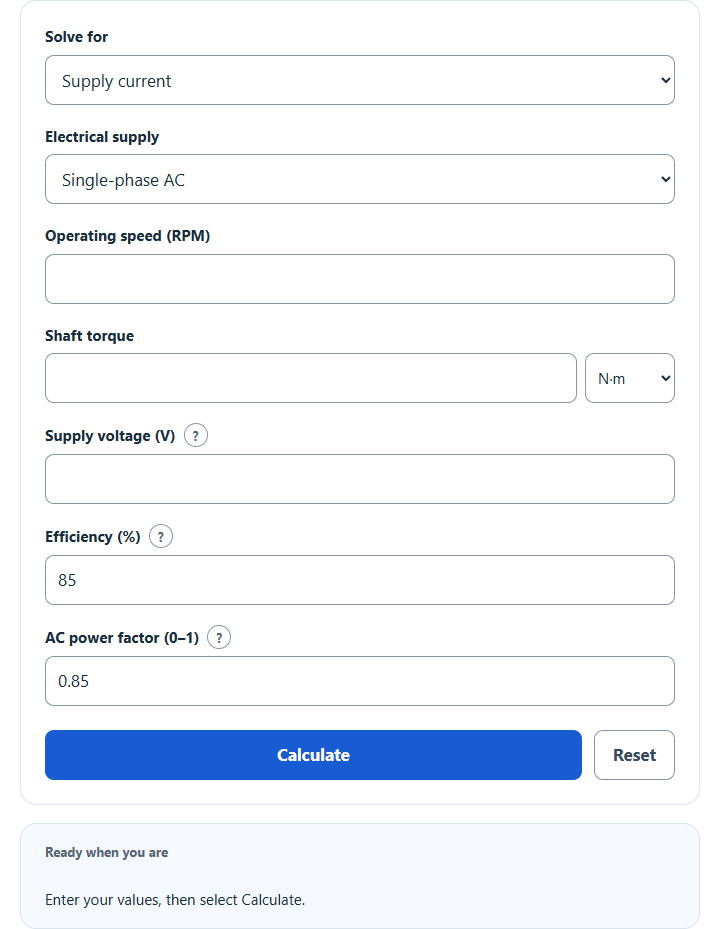
Calculate motor amps from RPM and shaft torque at your supply voltage, with typical efficiency and power factor filled in, or solve torque or RPM.
- All Unit Converters
- Electricity, Magnetism, & Electronics Unit Converters
- RPM to Voltage Calculator
- RPM To kW Calculator
- HP to Amps Calculator (Motor Current from HP or kW)
RPM to Amps Formula
RPM alone cannot determine motor current. First calculate shaft power from torque and speed, then use the supply type, voltage, efficiency and AC power factor:
Variables:
- I is supply current in amperes; AC values are RMS and three-phase uses line current
- RPM is the revolutions per minute
- V is supply voltage in volts (RMS for AC); three-phase uses line-to-line voltage VLL
- PF is AC real power divided by apparent power; eta is efficiency as a fraction; T is shaft torque in N·m
Use torque and RPM at the same shaft, and efficiency and power factor at the operating load. The steady running model excludes startup, stall, no-load, regeneration, acceleration and unbalanced supplies. Motor winding current can differ from drive supply current; PWM drive waveforms need a more detailed model.
| RPM | Voltage (V) | Power Factor (PF) | Amps (A) |
|---|---|---|---|
| 100 | 120 | 0.90 | 1.08 |
| 200 | 120 | 0.90 | 2.15 |
| 300 | 120 | 0.90 | 3.23 |
| 400 | 120 | 0.90 | 4.31 |
| 500 | 120 | 0.90 | 5.39 |
| 600 | 120 | 0.90 | 6.46 |
| 750 | 120 | 0.90 | 8.08 |
| 900 | 120 | 0.90 | 9.70 |
| 1,000 | 120 | 0.90 | 10.77 |
| 1,200 | 120 | 0.90 | 12.93 |
| 1,300 | 120 | 0.90 | 14.01 |
| 1,400 | 120 | 0.90 | 15.08 |
| 1,500 | 120 | 0.90 | 16.16 |
| 1,725 | 120 | 0.90 | 18.58 |
| 1,750 | 120 | 0.90 | 18.85 |
| 1,800 | 120 | 0.90 | 19.39 |
| 2,000 | 120 | 0.90 | 21.55 |
| 2,500 | 120 | 0.90 | 26.93 |
| 3,000 | 120 | 0.90 | 32.32 |
| 3,600 | 120 | 0.90 | 38.79 |
| Rounded to 2 decimals. These are estimates at fixed torque and stated efficiency, not universal RPM-to-amps conversions. I = torque × RPM × 2π / (60 × efficiency × RMS voltage × PF). | |||
What is RPM to Amps Conversion?
RPM and shaft torque determine mechanical output power. With operating-point efficiency, voltage, supply type and AC power factor, that power can estimate steady running supply current. Motors at the same RPM can draw very different currents because their loads and losses differ.
How to Calculate Amps from RPM?
The following steps outline how to estimate the current from RPM.
- First, determine the voltage (V) supplied to the motor.
- Next, determine efficiency (mechanical output divided by real electrical input) and, for AC, power factor (real input divided by apparent input). These are different quantities.
- Measure RPM and shaft torque at the same operating point.
- Calculate shaft power from torque and RPM, divide by efficiency to find real electrical input, then use the appropriate DC, single-phase or balanced three-phase current equation.
- After inserting the variables and calculating the result, check your answer with the calculator above.
Example Problem :
Use the following variables as an example problem to test your knowledge.
Single-phase AC voltage (V) = 220 V RMS; shaft torque T = 10 N·m; efficiency = 90%
Power Factor (PF) = 0.85
RPM = 1500 revolutions per minute. Shaft power is 1570.80 W and estimated RMS supply current is 1570.80 / (220 × 0.90 × 0.85) ≈ 9.33 A.