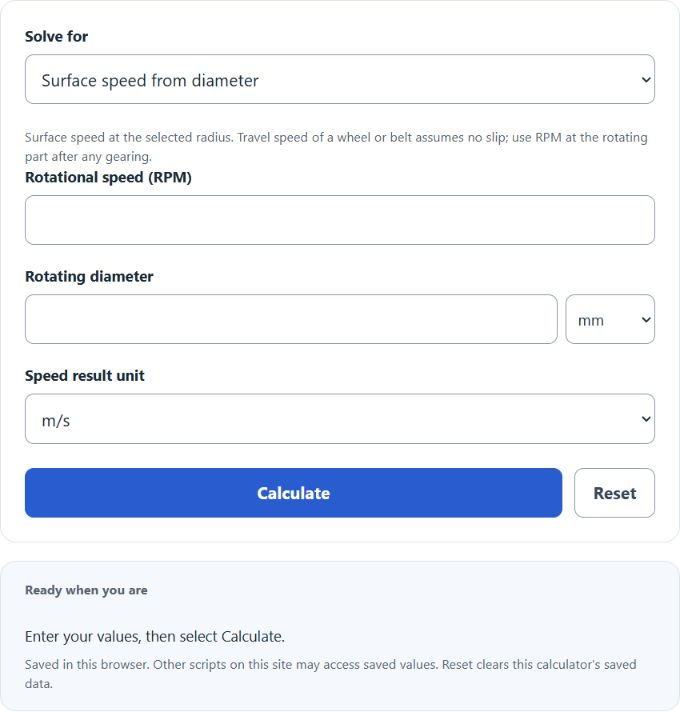
Convert RPM to surface speed using the rotating part’s radius or diameter, or solve for RPM or size with metric and imperial units. Wheel or belt travel speed assumes no slip; use RPM after any gearing.
RPM to m/s Formula
v = (2π r × RPM) / (60) RPM = (60 v) / (2π r)
To convert RPM to m/s, multiply RPM by the circumference (2πr) and divide by 60. To convert m/s to RPM, multiply by 60 and divide by 2πr. Ensure radius is in meters and linear speed is in m/s for direct use of the formulas.
| RPM | Radius (m) | Speed (m/s) | Speed (mph) |
|---|---|---|---|
| 10 | 1.0000 | 1.0472 | 2.3425 |
| 30 | 1.0000 | 3.1416 | 7.0275 |
| 60 | 1.0000 | 6.2832 | 14.0551 |
| 120 | 1.0000 | 12.5664 | 28.1102 |
| 300 | 1.0000 | 31.4159 | 70.2754 |
| 600 | 1.0000 | 62.8319 | 140.5509 |
| 1000 | 1.0000 | 104.7198 | 234.2514 |
| 3000 | 1.0000 | 314.1593 | 702.7543 |
| * v = 2πr·(RPM/60). mph = m/s ÷ 0.44704. Values rounded to 4 decimals. Table shown for r = 1 m. | |||
Example Problem
Use the following example problem to compare with the output from the calculator above and confirm the results.
- Given RPM = 120 rpm and radius r = 0.25 m.
- Use the formula v = 2πr·(RPM/60).
- Plug in values: v = 2π(0.25)·(120/60) = 2π(0.25)·2 = π ≈ 3.1416 m/s.
- The result is 3.1416 m/s.