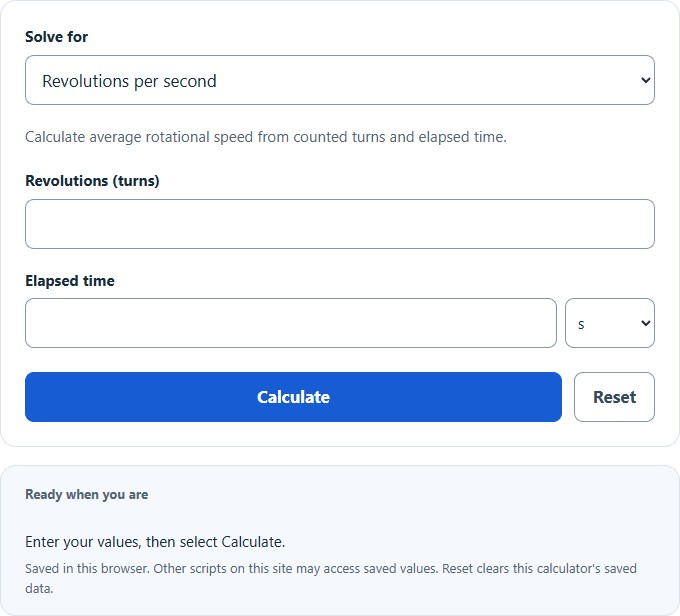
Calculate revolutions per second from turns and elapsed time, or solve for turns or time. Separately labelled request-workload modes estimate requests per second, virtual users and steady test volume.
Related Calculators
- Turns Per Second Calculator
- Hz to RPM Calculator
- RPM to Angular Velocity Calculator
- Angular Frequency Calculator
- Frequency of Oscillation Calculator
- Cycles Per Minute to Hertz Calculator
- All Statistics Calculators
RPS Formula
The following formula is used to calculate the revolutions per second (RPS).
Variables:
- RPS is the revolutions per second
- Revolutions is the number of turns or cycles
- Time is the duration in seconds over which the revolutions are counted
To calculate RPS, divide the number of revolutions by the time in seconds.
What is RPS?
RPS stands for revolutions per second, which is a measure of rotational speed. It indicates how many complete turns an object makes in one second. This unit is commonly used in various applications such as measuring the speed of motors, turbines, and other rotating machinery.
The separate request-workload modes use requests/s, not revolutions/s. They assume sequential requests and stable mean cycle timing: request rate = users × requests per cycle / (requests per cycle × mean response seconds + think seconds). Unused virtual-user allocation is a planning scenario, not measured server capacity. Test volume is a rounded-down steady-state estimate, not a guaranteed completed count.
How to Calculate RPS?
The following steps outline how to calculate the Revolutions Per Second.
- First, determine the total number of revolutions completed.
- Next, determine the time in seconds over which the revolutions were counted.
- Use the formula RPS = Revolutions / Time.
- Finally, calculate the Revolutions Per Second (RPS).
- After inserting the variables and calculating the result, check your answer with the calculator above.
Example Problem :
Use the following variables as an example problem to test your knowledge.
Revolutions = 120 turns
Time = 60 seconds. Average speed = 120 / 60 = 2 revolutions per second, or 120 RPM.