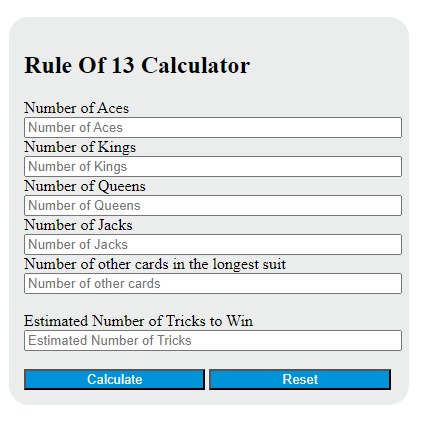
Calculate estimated bridge tricks using the Rule of 13 from counts of aces, kings, queens, jacks, and other cards in your longest suit.
Related Calculators
- Odds Calculator (Success/Failure)
- Empirical Probability Calculator
- Compound Probability Calculator
- Law of Total Probability Calculator
- Chances of Winning Calculator
- All Personal Finance Calculators
Rule Of 13 Formula
The Rule of 13 is a quick card-hand evaluation method that combines top honors with useful suit length. This calculator adds your aces, kings, queens, jacks, and the number of non-honor cards in your longest suit, then subtracts that total from 13.
In this formula, ET is the Rule of 13 result, A is the number of aces, K is the number of kings, Q is the number of queens, J is the number of jacks, and LS is the number of other cards in the longest suit. Lower results generally indicate a hand with more honor strength and suit support, while higher results suggest less immediate trick-taking strength.
Variable Definitions
| Variable | Meaning | How to Count It |
|---|---|---|
| A | Aces | Count each ace in your hand once. |
| K | Kings | Count each king in your hand once. |
| Q | Queens | Count each queen in your hand once. |
| J | Jacks | Count each jack in your hand once. |
| LS | Other cards in the longest suit | Count only the remaining cards in your longest suit that are not already counted as A, K, Q, or J. |
| ET | Rule of 13 result | The final output after subtracting the total from 13. |
How to Calculate the Rule Of 13
- Count the total number of aces in your hand.
- Count the total number of kings.
- Count the total number of queens.
- Count the total number of jacks.
- Identify your longest suit.
- Within that suit, count only the cards that are not aces, kings, queens, or jacks.
- Add all five values together.
- Subtract that total from 13 to get the Rule of 13 result.
Example
If a hand contains 2 aces, 1 king, 3 queens, 0 jacks, and 4 other cards in the longest suit, the calculation is:
That means the Rule of 13 result is 3. Because the combined honor-and-length total is relatively high, the remaining value after subtracting from 13 is low.
How to Interpret the Result
- Lower ET value: usually reflects more honor cards and/or more usable length in the longest suit.
- Higher ET value: usually reflects fewer top honors or less support from suit length.
- Best use: quick hand comparison, rough strength screening, and fast estimation before deeper analysis.
The Rule of 13 should be treated as a shortcut, not a complete prediction model. Actual trick-taking potential can also be influenced by distribution, suit texture, intermediate cards, partnership fit, and the overall auction or game situation.
Common Input Mistakes
- Double-counting honors in the longest suit: aces, kings, queens, and jacks are counted separately, so they should not also be included in LS.
- Using total suit length for LS: only the non-honor cards in the longest suit belong in that field.
- Forgetting to identify the longest suit first: count the extra cards from your longest suit, not from multiple suits combined.
- Assuming the result is exact: this is an estimate designed for quick evaluation rather than perfect forecasting.
When This Calculator Is Useful
This calculator is most helpful when you want a fast, repeatable way to evaluate hand strength using both honors and suit length. It is especially useful for comparing similar hands, checking whether a hand is stronger or weaker than it first appears, and creating a more structured decision process instead of relying only on intuition.
Frequently Asked Questions
Does LS include aces, kings, queens, or jacks in the longest suit?
No. Those honors are already counted in A, K, Q, and J. LS should include only the remaining cards in the longest suit.
What if two suits are tied for longest?
Use one of the tied longest suits consistently and count the non-honor cards from that suit only.
Is the Rule of 13 enough by itself?
No. It is a quick evaluation aid. Broader judgment still matters when assessing the real playing strength of a hand.