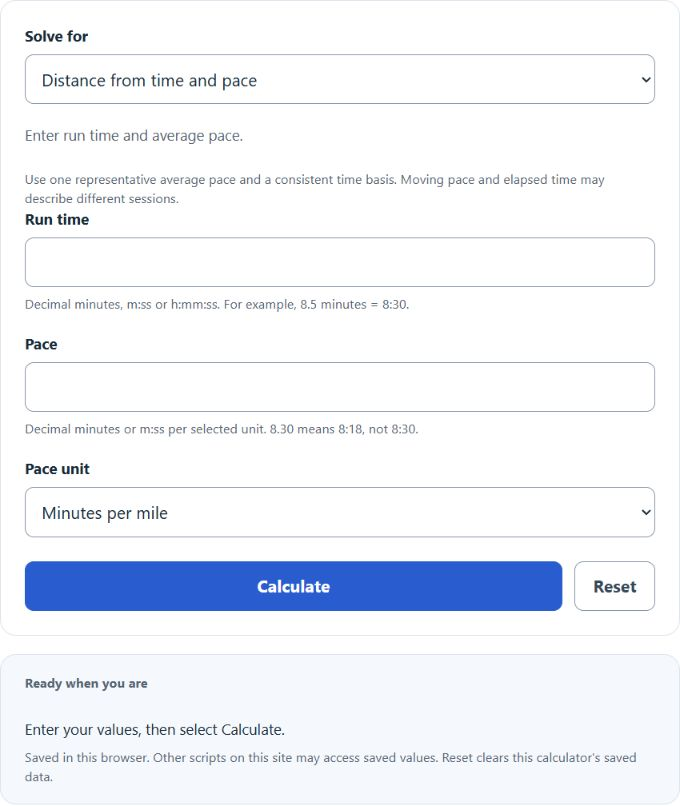
Calculate run distance, finish time, or pace from the other two values with mile and kilometer conversions.
Run Distance Formula
The run distance calculator estimates how far you travel when you know your average pace and total time. The key is unit consistency: if pace is entered in minutes per mile, the result will be in miles; if pace is entered in minutes per kilometer, the result will be in kilometers.
- D = total run distance
- T = total run time
- P = average pace in time per unit distance
This relationship is most useful for steady runs, treadmill sessions, race planning, and checking whether your pacing strategy matches a target distance.
Converting Minutes and Seconds
The calculator accepts decimal minutes or m:ss for time and pace; run time also accepts h:mm:ss. It converts clock entries before calculating. For example, 8.5 decimal minutes equals 8:30, while 8.30 equals 8:18. Select the pace unit and distance unit that match your inputs.
You can also calculate directly from total seconds.
How to Calculate Run Distance
- Determine your average pace in min/mi or min/km.
- Record your total running time.
- Convert both values to decimal minutes or total seconds.
- Divide total time by pace.
- Round the result to a practical precision, such as two decimals.
Example 1
A runner holds an average pace of 8:30 per mile for 42:00.
The total distance covered is 4.94 miles.
Example 2
A runner holds an average pace of 5:15 per kilometer for 1:10:00.
The total distance covered is 13.33 kilometers.
Quick Distance Reference
The table below shows how much distance is covered at common paces. Distances are in the same unit as the pace selected.
| Pace | 30 min | 45 min | 60 min | 90 min |
|---|---|---|---|---|
| 12:00 / unit | 2.50 | 3.75 | 5.00 | 7.50 |
| 10:00 / unit | 3.00 | 4.50 | 6.00 | 9.00 |
| 9:00 / unit | 3.33 | 5.00 | 6.67 | 10.00 |
| 8:00 / unit | 3.75 | 5.63 | 7.50 | 11.25 |
| 7:30 / unit | 4.00 | 6.00 | 8.00 | 12.00 |
| 6:00 / unit | 5.00 | 7.50 | 10.00 | 15.00 |
Common Input Mistakes
- Mixing miles and kilometers: a pace entered in min/km returns distance in kilometers, not miles.
- Using 8.30 to mean 8:30: 8.30 decimal minutes is not the same as 8 minutes 30 seconds.
- Combining moving pace with elapsed time: pauses, traffic lights, and walk breaks can change the result.
- Rounding pace too aggressively: small pace differences become large distance differences over long runs.
- Using an inconsistent average pace: the formula assumes one representative average pace for the full session.
Run Distance and Speed
Pace and speed describe the same effort in opposite ways. Pace is time per unit distance, while speed is distance per unit time. If you want to convert pace into speed in units per hour, use:
When P is in minutes per mile, S is miles per hour. When P is in minutes per kilometer, S is kilometers per hour. The speed formula requires a positive pace. Zero run time does not define an observed average speed; the calculator labels that speed undefined.
When This Calculator Is Most Useful
- Estimating how far a timed run will take you
- Planning treadmill sessions by duration instead of distance
- Checking long-run mileage from an expected pace band
- Comparing training sessions with different durations
- Projecting race splits from a target average pace
FAQ
Can I use this calculator for walking or hiking?
Yes. The same math works for walking, hiking, jogging, or running as long as the pace and time units match.
Why does my watch show a slightly different distance?
Small differences usually come from pace rounding, GPS drift, auto-pause settings, or whether your device uses moving time versus elapsed time.
Is average pace or current pace better for this calculation?
Average pace is usually the better input because the formula estimates total distance over the full session, not a single moment within the run.
What happens if my pace changes during the run?
Use total time divided by total distance for the overall average pace. An unweighted average of split paces can be misleading when the split distances differ. Match moving time with moving pace, or elapsed time with an average that includes the same pauses.
Should I calculate in miles or kilometers?
Use whichever unit matches your training plan and pace data. The calculator works equally well in either system as long as you stay consistent from start to finish.