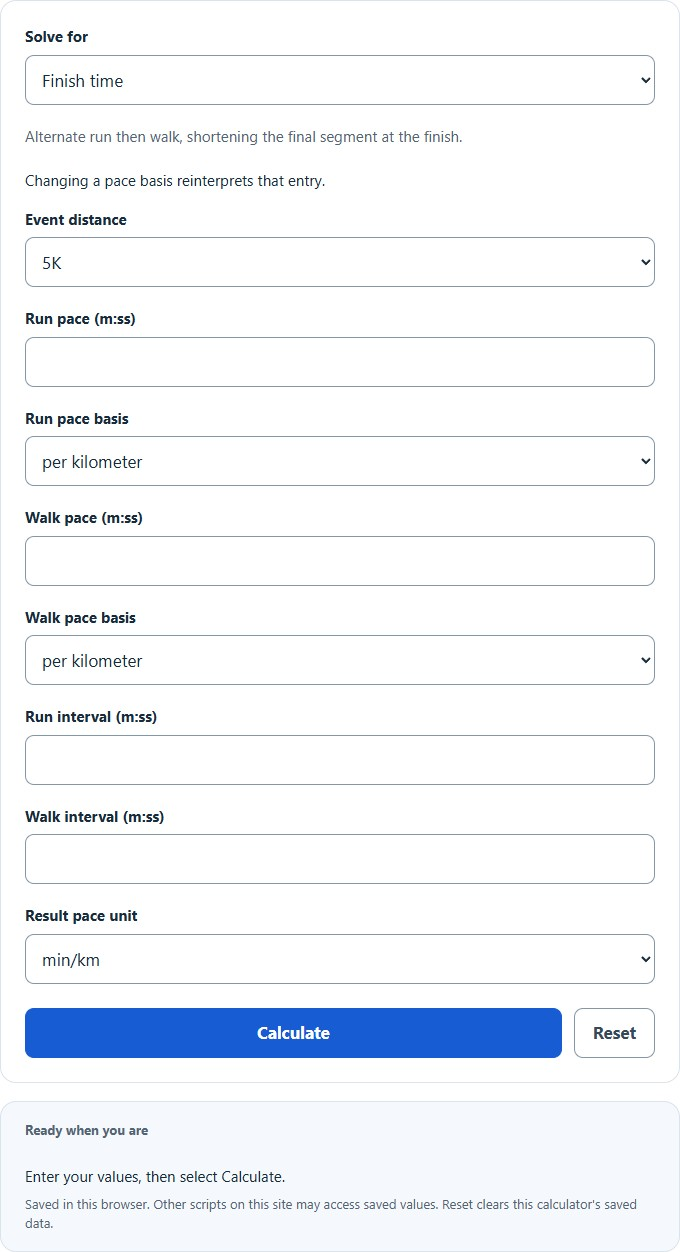
Estimate a finish for a repeating run/walk plan or solve the run or walk pace needed for a target time.
How the Run Walk Interval Calculator Works
The calculator follows alternating segments in their real order rather than using only a weighted average. It counts full cycles, then the final run or walk, making the segment counts and any final partial segment explicit.
Each full run or walk duration is converted to distance from its pace. If the next segment would cross the finish, only the exact time needed for the remaining distance is added.
Run/Walk Segment Simulation
Formula: segment distance = segment duration / pace seconds per meter
Reverse modes repeatedly evaluate the plan while bisecting the unknown pace: 2:00–20:00/km for running or 3:00–30:00/km for walking. The run must remain faster than the walk. If the distance finishes before any walk, the goal does not determine a walk pace.
Choosing the Right Inputs
Select the event distance or enter a custom distance. Enter paces and interval durations as m:ss, such as 5:00, using each displayed pace basis. Every mode starts with a run interval; reverse modes add a finish-time goal in h:mm:ss, such as 0:27:30.
| Segment | Duration | Distance | Share of cycle time | Cumulative cycle distance |
|---|---|---|---|---|
| Run | 4:00 | 800 m | 80% | 800 m |
| Walk | 1:00 | 100 m | 20% | 900 m |
| Full cycle | 5:00 | 900 m | 100% | 900 m |
Understanding Your Results
The finish or required pace appears first, followed by average pace, component paces, full segment counts, final partial segment, total run/walk time, and cycle distance.
The finish can fall during a partial run or walk or exactly at the end of a full segment. A full segment at the finish is counted as full.
Worked Example
At 5:00/km for four minutes and 10:00/km for one minute, one cycle covers 900 meters. A 5K ends during a partial run and takes about 27:30.
Common Mistakes
Do not assume an integer number of cycles, place the walk segment first, or compare pace numbers without converting their kilometer or mile basis.
Assumptions and Limitations
The model assumes each run and walk segment holds the entered pace and ignores acceleration, terrain, stops, fatigue, weather, and course measurement error.
Sources
Jeff Galloway. The Run-Walk-Run Method. Third edition.
Kuno Hottenrott and colleagues. Does a Run/Walk Strategy Decrease Cardiac Stress During a Marathon in Non-Elite Runners? Journal of Science and Medicine in Sport, 2016.