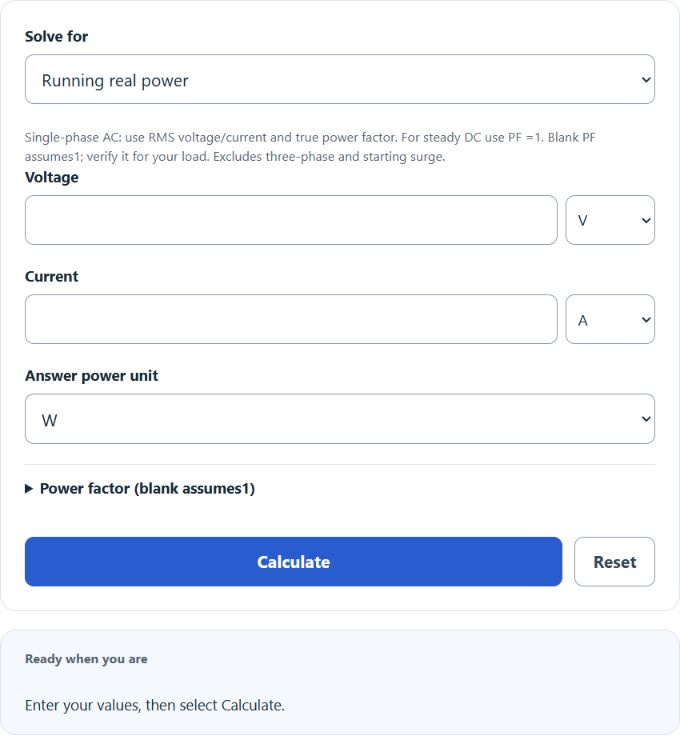
Choose running real power, voltage or current, then enter the known quantities. Single-phase AC uses RMS volts/amps and true power factor; steady DC uses PF =1. Blank PF explicitly assumes 1. This excludes three-phase and starting surge.
- All Sports and Fitness Calculators
- Watts Per Pound Calculator
- Speed To Watts Calculator
- Watts Per Kilo Calculator
Running Watts Formula
The following formula is used to calculate the running watts (real power) for a single-phase AC load (using RMS volts and amps) or for DC/resistive loads (where PF = 1):
Variables:
- RW is the running watts (W), also called real power
- V is the RMS AC voltage or steady DC voltage (V)
- I is the RMS AC current or steady DC current (A)
- PF is the true power factor (unitless, 0 to 1 for this load-consumption model). Blank assumes 1; zero is valid for direct power calculation but can make inverse solutions nonunique or impossible.
To calculate the running watts, multiply the voltage by the current and then multiply by the power factor (PF). If PF = 1 (common for DC and purely resistive loads), the formula reduces to RW = V × I.
What are Running Watts?
Running watts, also known as continuous watts, refer to the amount of real power a device or appliance needs to operate under normal conditions. This value is commonly used when sizing generators, though generators may also be rated in volt-amps (VA) or kVA (apparent power). For DC or purely resistive loads, running watts can be found using W = V × I. For AC loads where the power factor is not 1, real power is W = V × I × PF, and V × I by itself represents apparent power (VA). For example, if a device operates at 120 volts and draws 10 amperes at PF = 1, it uses 1200 W; at PF = 0.9 it uses 1080 W. It’s also important to note that some devices may require more power to start up (known as starting watts or peak watts) than they do to continue running.
How to Calculate Running Watts?
The following steps outline how to calculate the Running Watts.
- First, determine the voltage (V) of the appliance.
- Next, determine the current (I) drawn by the appliance.
- Next, determine the power factor (PF) (for AC loads). If unknown and you only have volts and amps, you are calculating apparent power (VA) rather than real power (W).
- Finally, calculate the Running Watts (real power) using RW = V × I × PF (for DC or resistive loads, PF = 1).
- After inserting the variables and calculating the result, check your answer with the calculator above.
Example Problem :
Use the following variables as an example problem to test your knowledge.
voltage (V) = 120
current (I) = 5
power factor (PF) = 0.9
running watts (RW) = 120 × 5 × 0.9 = 540 W