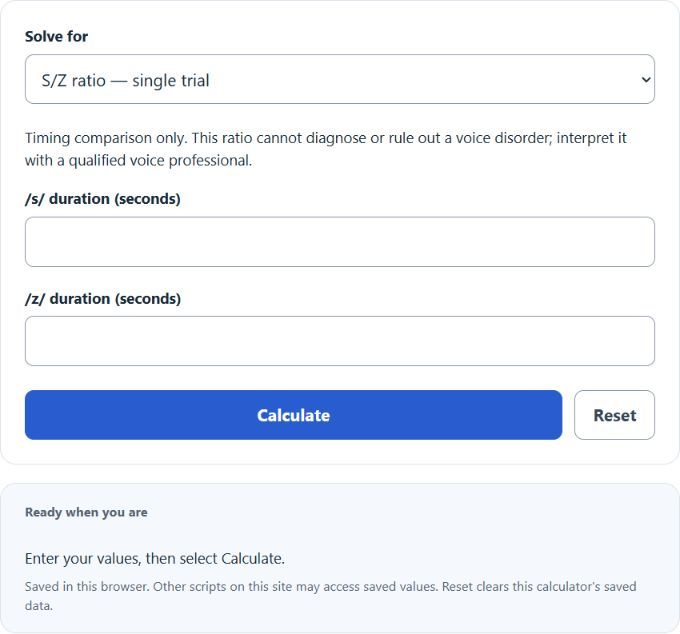
Calculate the S/Z voice ratio from sustained /s/ and /z/ durations, compare single or three-trial results, identify the longest times, or solve for either duration.
Related Calculators
- Type-Token Ratio (TTR) Calculator
- Gender Diversity Ratio Calculator
- Adjusted Odds Ratio Calculator
- Content Validity Ratio Calculator
- All Statistics Calculators
S/Z Ratio Formula
The S/Z ratio compares how long you can sustain the sound “s” to how long you can sustain the sound “z.” Both durations must be measured in seconds.
- S/Z = S/Z ratio
- S = duration of the sustained “s” sound, in seconds
- Z = duration of the sustained “z” sound, in seconds
If you need to solve for one of the durations instead, the formulas are:
- S = calculated “s” duration, in seconds
- Z = calculated “z” duration, in seconds
- S/Z = known S/Z ratio
The calculator assumes both sounds are measured under the same conditions. The ratio has no unit because seconds divide by seconds. Both durations must be positive. Best-of-three uses the longest /s/ and longest /z/ independently; it does not average the ratios. Inverse solves are arithmetic, not recommended duration targets.
S/Z Ratio Reference Tables
Use these tables as general context. S/Z ratio results are commonly used as a voice screening measure, not as a diagnosis by themselves.
| S/Z ratio | General interpretation |
|---|---|
| About 1.0 | S and Z durations are similar. |
| Less than 1.0 | Z was sustained longer than S. |
| Greater than 1.0 | S was sustained longer than Z. |
| Around 1.4 or higher | A historical screening cutoff, not a diagnostic boundary. Ratios above or below it require interpretation with other voice measures. |
| Measurement tip | Why it matters |
|---|---|
| Use one deep breath before each sound. | Keeps the two trials more comparable. |
| Sustain each sound as steadily as possible. | Large changes in loudness can affect timing. |
| Record the longest clean attempt. | A single poor trial can distort the ratio. |
| Measure both sounds in seconds. | The formula requires matching time units. |
Example and Notes
If your S duration is 18 seconds and your Z duration is 15 seconds, the calculation is:
S/Z = 18 / 15 = 1.20
This means the “s” sound lasted 1.2 times as long as the “z” sound. If your result seems unusual, repeat the timing and compare consistent attempts. For clinical use, interpret the result with other voice measures and a qualified professional’s judgment.