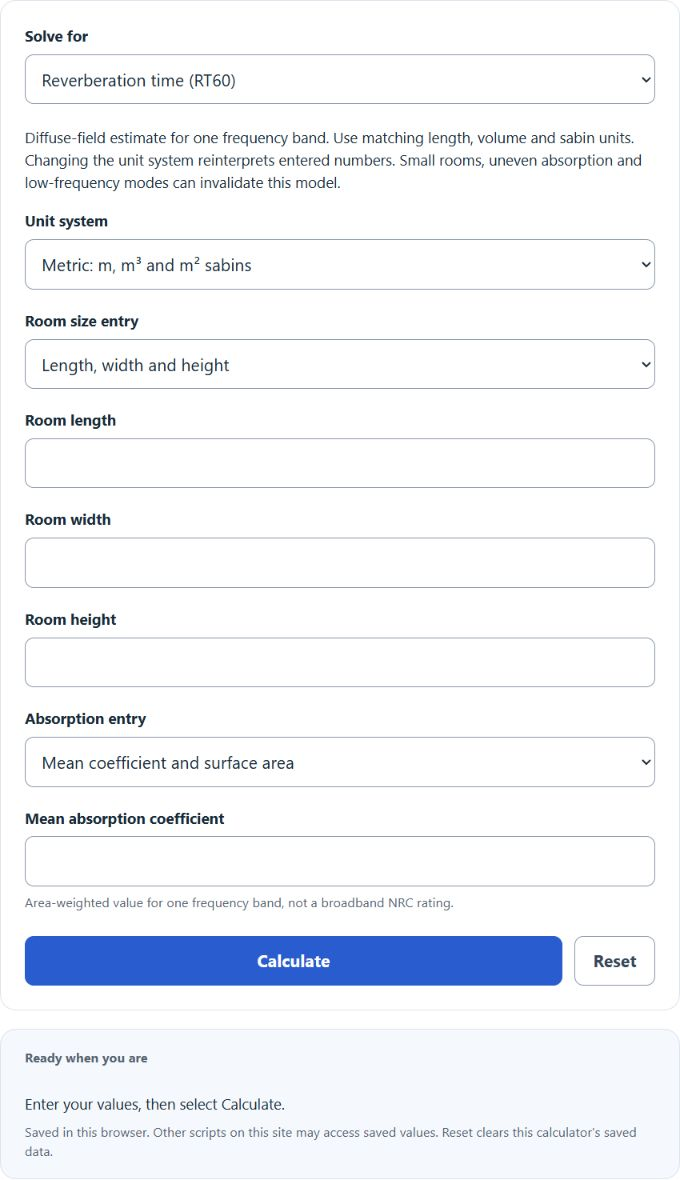
Calculate the reverberation time (RT60) of a room with the Sabine formula, or solve for the absorption in sabins needed to reach a target RT60.
Sabine Reverberation Time Formula
RT60 = 0.161 * V / A (metric)
RT60 = 0.049 * V / A (imperial)
A = a1*S1 + a2*S2 + ... + an*Sn
- RT60 is the reverberation time in seconds, the time it takes the sound level in the room to decay by 60 dB after the source stops
- V is the room volume, in cubic meters (metric) or cubic feet (imperial)
- A is the total absorption of the room in sabins, in square-meter sabins (metric) or square-foot sabins (imperial)
- a1, a2 ... an are the absorption coefficients of each surface material (0 to 1)
- S1, S2 ... Sn are the areas of those surfaces, in square meters or square feet
The calculator applies this formula in three directions. In the reverberation time mode, you enter the room size and its absorption, either as a total in sabins or as an average coefficient times the surface area, and it returns RT60 = 0.161*V/A (or 0.049*V/A in feet). In the absorption mode, it rearranges the formula to A = 0.161*V/RT60 and tells you how many sabins the room needs to hit a target reverberation time; if you also enter your current RT60 or current absorption, it reports the shortfall and converts it into an approximate number of standard 2 ft by 4 ft acoustic panels. In the volume mode, it solves V = RT60*A/0.161 from a measured time and a known absorption. Calculation details include the Eyring estimate, RT60 = -k*V/(S*ln(1 - a)), when surface area is known and 0 < a < 1, plus approximate critical distance for an omnidirectional source (Q = 1). Both remain statistical diffuse-field estimates. Metric k is 0.161; imperial k is 0.049.
Illustrative RT60 Ranges and Absorption Assumptions
Reverberation time targets depend on what the room is for. Speech needs a short decay so syllables stay distinct, while orchestral music benefits from a longer one. The mid-frequency ranges below are broad illustrations, not universal recommendations or proof of compliance. Appropriate targets depend on room volume, frequency, occupancy, use and applicable criteria.
| Room type | Illustrative RT60 range (s) |
|---|---|
| Vocal booth / recording studio | 0.2 - 0.4 |
| Home theater / control room | 0.3 - 0.5 |
| Classroom | 0.4 - 0.6 |
| Conference room / open office | 0.5 - 0.8 |
| Lecture hall | 0.8 - 1.1 |
| Multipurpose auditorium | 1.2 - 1.8 |
| Concert hall (orchestral) | 1.8 - 2.2 |
| Church / cathedral | 2.0 - 5.0+ |
The next table answers the practical question the formula alone does not: how many sabins a real object adds to the room. The values are illustrative mid-frequency assumptions, not product ratings. Actual absorption depends on frequency, product, mounting and occupancy; use tested band-specific data. Divide an absorption shortfall by the net sabins added per item, accounting for any surface it replaces.
| Item added to the room | Absorption added (ft² sabins) | (m² sabins) |
|---|---|---|
| Acoustic panel, 2 ft x 4 ft x 2 in | 7.6 | 0.71 |
| Acoustic panel, 2 ft x 4 ft x 4 in | 8.0 | 0.74 |
| Heavy velour curtain, per 10 ft² draped | 5.5 | 0.51 |
| Carpet on pad, per 10 ft² of floor | 5.7 | 0.53 |
| Upholstered chair, unoccupied | 3.0 | 0.28 |
| Adult person, seated | 4.5 | 0.42 |
Sabine Reverberation Time Example Problems
Example 1. A classroom measures 10 m long, 7 m wide and 3 m high, and its mixed surfaces average an absorption coefficient of 0.20. The volume is V = 10*7*3 = 210 m³ and the total surface area is S = 2*(70 + 30 + 21) = 242 m², so the total absorption is A = 0.20*242 = 48.4 m² sabins. The reverberation time is RT60 = 0.161*210/48.4, which is about 0.70 seconds. This exceeds the illustrative 0.6-second comparison. At that selected target, Sabine requires 56.35 m² sabins, or 7.95 m² sabins more than the assumed 48.4. A modeled difference alone does not establish classroom compliance.
Example 2. A home theater has a volume of 2,400 ft³ and currently measures an RT60 of 0.9 seconds, and you want 0.4 seconds. The required absorption is A = 0.049*2400/0.4 = 294 ft² sabins. The current absorption is 0.049*2400/0.9, or about 130.7 ft² sabins. The modeled shortfall is about 163.3 ft² sabins. Assuming each 2 ft by 4 ft panel adds its full 8 ft² face area times a 0.95 band coefficient gives 7.6 ft² sabins per panel and a rounded-up estimate of 22. This illustrative count does not account for the covered surface or product-specific mounting and is not a purchasing specification.
FAQ
When should you use Eyring instead of Sabine? Sabine and Eyring both assume a diffuse sound field. Low mean absorption, often below about 0.2 to 0.3, helps the Sabine approximation, but does not by itself establish a diffuse field. In heavily treated rooms Sabine overestimates the reverberation time, because it predicts a nonzero RT60 even for a room that absorbs everything. The Eyring formula, RT60 = -0.161*V/(S*ln(1 - a)), accounts for the discrete loss of energy at each reflection and correctly approaches zero as absorption approaches total. The two converge at low mean absorption. Higher absorption can make their predictions diverge, but Eyring is not automatically reliable in a small, non-diffuse room or at frequencies dominated by room modes. Compare band-specific measurements or a suitable acoustic model.
What exactly is a sabin? A sabin is the absorption provided by one square unit of a perfect absorber, equivalent to an open window of that size, through which all sound leaves and none returns. One square-foot sabin corresponds to 1 ft² at a coefficient of 1.0, and one square-meter sabin (also called a metric sabin) to 1 m². Since 1 m² equals 10.76 ft², multiply metric sabins by 10.76 to convert to imperial. Real surfaces contribute their area times their coefficient, so 10 m² of material at 0.3 contributes 3 metric sabins.
Why does the calculated RT60 differ from a measured one? Absorption coefficients vary strongly with frequency, so a single mid-band calculation is only a summary; carpet that absorbs well at 2 kHz does little at 125 Hz, which is why measured low-frequency decay is often much longer than the Sabine estimate. Furniture, people, air absorption in large halls, and uneven distribution of absorption all shift the result as well. For serious work, run the calculation separately per octave band with band-specific coefficients and treat the output as a design estimate, not a measurement.