Estimate sandblasting time, abrasive media, labor and equipment cost, and total cost per area for a planned job.
- All Construction Calculators
- Sand Filling Quantity + Coverage Calculator
- Cement to Sand Ratio Calculator
Sandblasting Formula
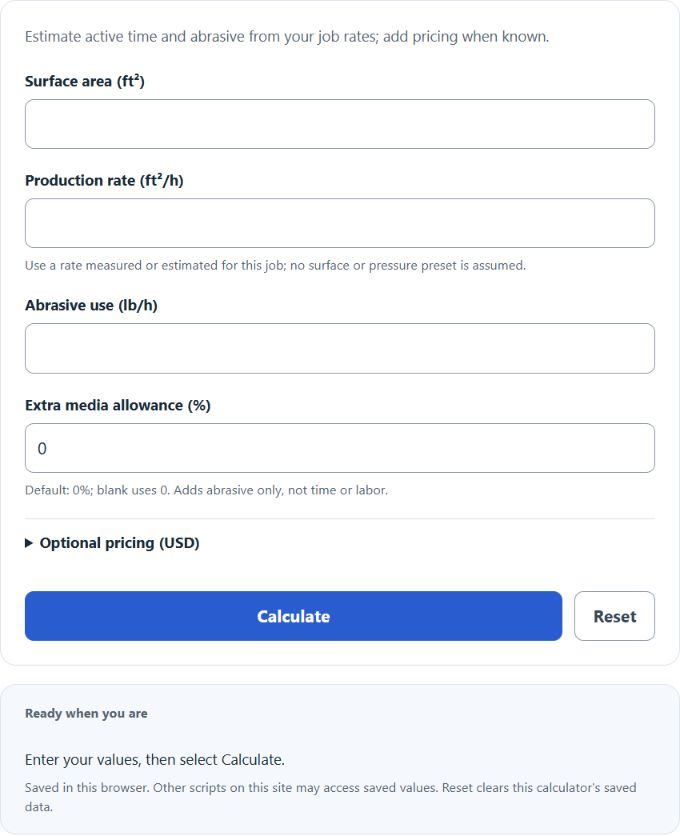
This calculator estimates one active-blasting job from entered area, production and abrasive-use rates. It does not contain a nozzle-air or compressor-sizing mode. Unknown prices may be left blank; time and abrasive remain available, while a total cost requires both prices. Enter 0 only for a known zero cost.
Let F = 1 + w/100 be the extra-media multiplier. The allowance affects abrasive only; it does not increase area or blasting time.
- A = entered surface area in ft²; P = entered production rate in ft²/h; H = active blasting hours
- R = abrasive use in lb/h; w = extra-media allowance in percent; M = required abrasive in lb
- p = abrasive price in USD/lb; q = combined labor/equipment price in USD/h
- Cm and Ch = abrasive and hourly costs; C = their unrounded total in USD; U = USD/ft²
The nozzle table below is separate reference information, not part of this calculator. Its last column is only the arithmetic comparison Q = 1.25 × N, rounded to whole CFM:
- N = new-nozzle air demand at 100 psi from the referenced chart
- Q = an illustrative 1.25× arithmetic value, not a compressor specification or a sufficient reserve recommendation
- For other pressures, use the manufacturer’s chart rather than a universal linear multiplier.
- Complete-system sizing also depends on nozzle wear and auxiliary air demand; use the equipment manufacturer’s requirements.
Enter production and media-use rates for the actual job; the calculator does not infer them from a surface, nozzle or pressure. It models active blasting only. Add setup, containment, cleanup, disposal, fixed charges and taxes separately unless included in the supplied rates. USD displays round to cents using the unrounded component calculations.
Reference Tables
Historical illustrative production and quote assumptions are retained below. They are not verified field averages or current market prices, and the calculator does not apply these as presets or contractor-price inputs:
| Surface | Rate (sq ft/hr) | Illustrative quote (USD/ft²) |
|---|---|---|
| Light rust / old paint | 75 | $2–$4 |
| Heavy rust / mill scale | 35 | $4–$8 |
| Concrete prep | 150 | $2–$3.50 |
| Wood restoration | 20 | $3–$6 |
| Fine detail | 15 | $6–$12 |
New-nozzle air demand at 100 psi, matching the Clemtex compressed-air consumption chart. The 1.25× column is arithmetic reference only; it is not the complete-system air requirement:
| Nozzle | CFM @ 100 psi | Arithmetic 1.25× demand |
|---|---|---|
| 1/8 in (#2) | 20 | 25 CFM |
| 3/16 in (#3) | 45 | 56 CFM |
| 1/4 in (#4) | 81 | 101 CFM |
| 5/16 in (#5) | 137 | 171 CFM |
| 3/8 in (#6) | 196 | 245 CFM |
| 7/16 in (#7) | 254 | 318 CFM |
| 1/2 in (#8) | 338 | 423 CFM |
Worked Example & FAQ
Example: A 25 ft × 20 ft deck has 500 ft². For illustration, enter 35 ft²/h production, 300 lb/h abrasive use, 10% extra abrasive, USD 0.25/lb abrasive price and USD 150/h combined labor/equipment price. These are example inputs, not recommended rates.
- Active time = 500 ÷ 35 ≈ 14.285714 h; the allowance does not change this time.
- Abrasive = 300 × (500 ÷ 35) × 1.10 ≈ 4,714.285714 lb.
- Abrasive cost ≈ USD 1,178.57; labor/equipment cost ≈ USD 2,142.86.
- Total from unrounded components ≈ USD 3,321.43; cost per ft² ≈ USD 6.64.
Why does a worn nozzle matter so much? In the referenced 100 psi table, nominal 1/4 in and 5/16 in nozzles use 81 and 137 CFM, about a 69% difference. A worn orifice can therefore increase demand; inspect and replace it according to the equipment manufacturer’s limits, rather than treating that comparison as a universal wear rule.
Does pressure really change rates? Pressure can affect performance, but the calculator does not predict that relationship. Use equipment data and a job-appropriate production estimate rather than assuming a universal percentage loss or operating pressure.
How much abrasive should I buy? The result is pounds of abrasive including the entered allowance. Divide by the actual package weight and round up to whole packages; the calculator does not select a bag size. Avoid adding the same allowance twice.