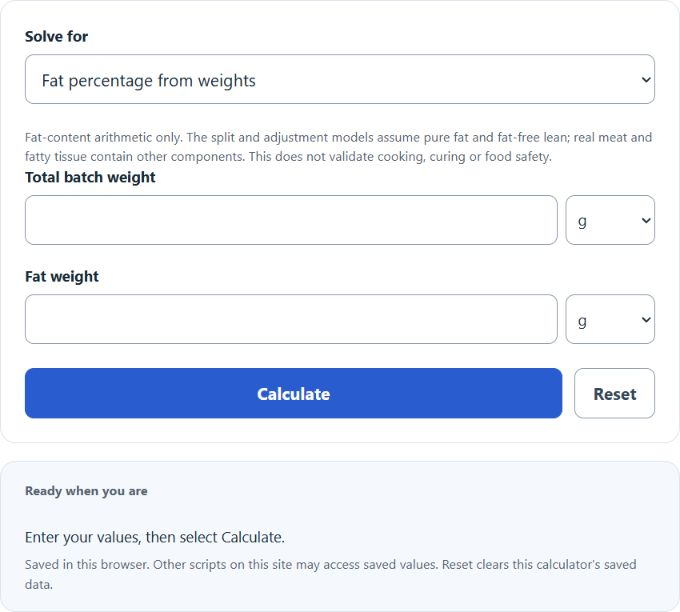
Calculate sausage fat percentage, lean and fat weights, or how much lean meat or pure fat to add for a target batch ratio and split.
- All Ratio Calculators
- Meat Ratio Calculator
- All Food and Cooking Calculators
- Meat Per Person Calculator
- Meat Shrinkage Calculator
Sausage Ratio Formula
The following formula gives fat as a percentage of total batch weight. The split and target-adjustment modes assume pure fat and fat-free lean; actual ingredient composition must be accounted for separately.
- Where SAR is the Sausage Ratio (%)
- W is the total weight of the sausage (g)
- F is the total weight of fat in the sausage (g)
To calculate a sausage ratio, divide the total weight of fat in the sausage by the total weight of the sausage, then multiply by 100.
Fat Ratios by Sausage Type
Different sausage styles demand different fat percentages. The fat content directly determines texture, moisture retention, and flavor intensity. Below is a reference of target fat percentages for common sausage types, along with the lean-to-fat part ratio and USDA maximum fat limits where applicable.
| Sausage Type | Target Fat % | Lean:Fat Ratio | USDA Max Fat |
|---|---|---|---|
| Chicken/Turkey Sausage | 10-15% | 6:1 to 9:1 | N/A |
| Fresh Pork Breakfast | 30-50% | 1:1 to 7:3 | 50% |
| Italian Sausage (sweet or hot) | 25-30% | 7:3 to 3:1 | 35% |
| Bratwurst | 25-30% | 7:3 to 3:1 | Product-standard dependent |
| Kielbasa (Polish) | 25-30% | 7:3 to 3:1 | Product-standard dependent |
| Andouille | 20-25% | 3:1 to 4:1 | Product-standard dependent |
| Chorizo (Spanish/Mexican) | 30-40% | 3:2 to 7:3 | N/A |
| Merguez | 25-30% | 7:3 to 3:1 | N/A |
| Frankfurter/Hot Dog | 25-30% | 7:3 to 3:1 | 30% |
| Bologna (emulsified) | 25-30% | 7:3 to 3:1 | 30% |
| Salami (dry cured) | 25-35% | 2:1 to 3:1 | N/A |
| Summer Sausage (semi-dry) | 20-30% | 7:3 to 4:1 | Product-standard dependent |
| Mortadella | 25-30% | 7:3 to 3:1 | Product-standard dependent |
| Boudin Blanc | 20-30% | 7:3 to 4:1 | N/A |
USDA standards limit finished-product fat to 50% for fresh pork sausage and breakfast sausage, 35% for Italian sausage products, and 30% for the cooked sausages defined by 9 CFR 319.180, including frankfurters and bologna. The last category also has a separate 40% combined fat-and-added-water limit. A style name alone does not establish which standard applies; these limits are not recommended recipe targets.
Why Fat Percentage Matters in Sausage
Fat performs three structural roles in sausage: lubrication, binding, and moisture retention. When meat proteins (primarily myosin) are extracted by salt during mixing, they form a sticky protein matrix. Fat particles become trapped in this matrix, and during cooking they melt and release juices that the coagulated protein network holds in place. This is why a sausage with too little fat (below about 15%) tends to be dry, crumbly, and lacking in flavor. The fat does not simply add calories. It is a functional ingredient that controls mouthfeel and juiciness.
In emulsified sausages like frankfurters and bologna, fat plays an even more critical role. These products use a forcemeat made at a 5:4:3 ratio (5 parts lean meat, 4 parts fat, 3 parts ice/water). The lean protein, when processed with salt at very low temperatures, emulsifies the fat into a stable, smooth paste. If the mixture temperature exceeds about 15 °C (59 °F) during processing, the emulsion breaks and fat separates out during cooking, resulting in a greasy, grainy product.
Fat Types Used in Sausage Making
Not all animal fat behaves the same during grinding and cooking. The firmness and melting point of the fat source directly affect how well it holds up during processing and how it renders during cooking.
| Fat Source | Firmness | Melting Point | Best Use |
|---|---|---|---|
| Pork Back Fat | Very firm | 30-40 °C (86-104 °F) | General purpose, coarse-ground sausage, salami |
| Pork Jowl Fat | Firm | 30-38 °C (86-100 °F) | Premium sausage, visible fat specks in salami |
| Pork Belly | Soft | 28-35 °C (82-95 °F) | Fresh sausage, breakfast sausage |
| Pork Leaf Lard | Very soft | 43-48 °C (110-118 °F) | Pastry, not ideal for sausage (crumbly texture) |
| Beef Suet | Very firm | 45-50 °C (113-122 °F) | Beef sausage, mixed with pork for firmer texture |
| Lamb Tail Fat | Firm | 38-44 °C (100-111 °F) | Merguez, Middle Eastern sausages |
Pork back fat is the standard in sausage making because of its neutral flavor, white color, and high melting point. Back fat holds its shape during grinding, which creates the distinct fat particles visible in coarse-ground sausages. Jowl fat is considered equal or superior to back fat and is especially valued for dry-cured salami where visible fat specks are desirable. Belly fat is softer and more prone to smearing during grinding, so it works best in fresh sausage where a uniform texture is acceptable.
Common Fat Calculation Mistake
The most frequent error in sausage making math is confusing “percentage of lean” with “percentage of total.” For example, if you have 10 lbs of lean meat and want 30% fat, the instinct is to calculate 10 x 0.30 = 3 lbs of fat. But this gives you 13 lbs total, and 3/13 = 23% fat, not 30%.
The correct formula for fat needed when targeting a specific fat percentage from fat-free lean and pure fat is (use the target as a decimal fraction):
Using the same example: 10 / (1 – 0.30) – 10 = 10 / 0.70 – 10 = 14.29 – 10 = 4.29 lbs of fat. Total batch = 14.29 lbs, and 4.29 / 14.29 = 30.0%. The calculator above handles this math automatically in the Target fat adjustment mode.
Sausage Classification by Processing Method
Sausages are broadly grouped into four categories based on how they are processed, and each category has distinct fat ratio requirements.
Fresh sausage is raw ground meat stuffed into casings and sold uncooked. Examples include Italian sausage, bratwurst, and breakfast sausage. Fat content typically ranges from 20-50%. These are ground through plates ranging from 3/16″ (coarse) to 1/8″ (medium) and should be kept below 4 °C (40 °F) during processing.
Cooked/emulsified sausage is processed into a fine paste and then cooked using a validated process. For home cooking of raw sausage, USDA recommends 160 °F (71.1 °C) for ground red meat and 165 °F (73.9 °C) for any poultry, verified with a food thermometer. Frankfurters, bologna, and mortadella fall into this group. The 5:4:3 forcemeat ratio (lean:fat:ice) is standard, and the emulsion must stay below 15 °C (59 °F) during chopping. Fat content in the finished product is usually 25-30%.
Smoked/cooked sausage is stuffed, smoked, and then fully cooked. Kielbasa, andouille, and many regional specialties belong here. Fat content is typically 20-30%, and the smoking step adds flavor compounds while also acting as a partial preservative through surface dehydration.
Dry and semi-dry sausage relies on fermentation and extended drying rather than cooking. Salami, pepperoni, and summer sausage are the most common examples. Starting fat percentage is typically 25-35%, but weight loss during drying (usually 25-40% of the original weight) concentrates both fat and protein in the final product. A salami that starts at 30% fat may finish at 38-42% fat by weight after curing.
Temperature Control and Fat Smear
Fat smear occurs when fat softens and coats the lean meat particles during grinding, preventing the protein from forming a proper bind. The result is a sausage that is greasy, crumbly, and releases pools of rendered fat during cooking. To avoid this, the meat and fat should be partially frozen (about -2 °C / 28 °F) before grinding, and the grinder plates and blades should be sharp. Dull blades tear rather than cut, generating friction heat that accelerates smearing. For emulsified sausages, adding crushed ice during chopping keeps the bowl temperature below the critical 15 °C threshold.
A practical test: after grinding, squeeze a handful of the sausage mix. It should feel tacky and stick together. If it feels greasy and falls apart, the fat has smeared and the batch will not bind properly in the casing.