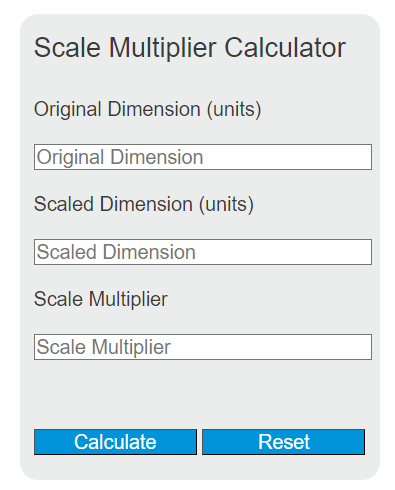
Find a scale multiplier, resize dimensions, or convert between 1:N drawing scales. See percentage change plus area and volume scaling effects.
- All Unit Converters
- Combined Scale Factor Calculator
- 1 8 1 Scale Calculator
- Scale Factor Dilation Calculator
- Scale To Inches Calculator
Scale Multiplier Formula
The scale multiplier compares a new dimension to an original dimension. It tells you exactly how much an object, drawing, model, map, or image has been enlarged or reduced relative to its starting size.
Where:
- SM = scale multiplier
- SD = scaled dimension
- OD = original dimension
If you already know the multiplier and need to find a missing dimension, use either rearranged form below.
How to Interpret the Scale Multiplier
- Greater than 1: the object is enlarged.
- Equal to 1: the size stays the same.
- Between 0 and 1: the object is reduced.
This makes the scale multiplier useful for quickly answering questions like:
- How much larger is the new model than the original?
- What factor was used to shrink a blueprint or image?
- What new dimension will result from a given scaling factor?
How to Calculate Scale Multiplier
- Measure or identify the original dimension.
- Measure or identify the scaled dimension.
- Divide the scaled dimension by the original dimension.
- Interpret the result as an enlargement or reduction.
When calculating by hand, both dimensions should use the same unit before dividing. For example, compare inches to inches or centimeters to centimeters.
Examples
Example 1: Enlarging a part
An original part is 50 mm long and the scaled part is 150 mm long.
The scaled part is 3 times the original size.
Example 2: Reducing a drawing
An original width is 200 cm and the reduced drawing width is 40 cm.
The drawing is 20% of the original size, which means it has been reduced.
Example 3: Finding the scaled dimension
If the original height is 12 in and the multiplier is 1.5, the scaled height is:
The new height is 18 inches.
Scale Multiplier vs. Scale Ratio
A scale can be written as a decimal multiplier or as a ratio. Both describe the same relationship, but the format depends on the field.
- A multiplier of 0.5 means the object is half-size.
- A multiplier of 2 means the object is doubled.
- A reduction ratio such as 1:50 means the scaled object is much smaller than the original.
- An enlargement ratio such as 4:1 means the scaled object is much larger than the original.
For reductions written as a ratio, the multiplier is often the reciprocal of the ratio’s second number.
For enlargements written with the scaled size first, the multiplier matches the enlargement factor.
Percent Increase or Decrease from the Multiplier
If you want to convert the multiplier into percent change, subtract 1 and multiply by 100%.
- If SM = 1.25, the object is increased by 25%.
- If SM = 0.80, the object is reduced by 20%.
Linear Scale vs. Area and Volume Scale
This calculator works with linear dimensions such as length, width, height, diameter, or distance. If every linear dimension changes by the same multiplier, area and volume change at different rates.
This matters when scaling floor plans, photographs, 3D prints, models, containers, and manufactured parts.
Common Uses for a Scale Multiplier
- Architecture and drafting: resizing plans while preserving proportions
- Engineering: enlarging or shrinking component drawings and prototypes
- Cartography: relating map distances to real-world distances
- 3D printing and fabrication: resizing parts before production
- Graphic design and imaging: scaling visuals without changing proportions
- Model building: converting between full-size objects and miniature versions
Common Mistakes to Avoid
- Reversing the dimensions: dividing original by scaled gives the inverse of the true multiplier.
- Mixing units: convert units first if you are calculating manually.
- Confusing multiplier with percent change: a multiplier of 1.2 means 120% of the original, not a multiplier of 20%.
- Applying linear scale to area or volume directly: area uses the square of the multiplier and volume uses the cube.
- Rounding too early: keep extra decimals until the end for better accuracy.
Quick Reference
| Multiplier Range | Meaning |
|---|---|
| Greater than 1 | Enlargement |
| Equal to 1 | No size change |
| Between 0 and 1 | Reduction |
Frequently Asked Questions
Can a scale multiplier be less than 1?
Yes. Any value between 0 and 1 indicates the new object is smaller than the original.
Does the scale multiplier have units?
No. Because it is a ratio of one dimension to another, the units cancel when both measurements are expressed consistently.
Can this calculator find a missing dimension?
Yes. If you know any two of the three values, you can solve for the third using the formulas above.
Why is my answer incorrect when the numbers seem right?
The most common reasons are reversed input order, inconsistent units, or confusing a ratio scale with a decimal multiplier.