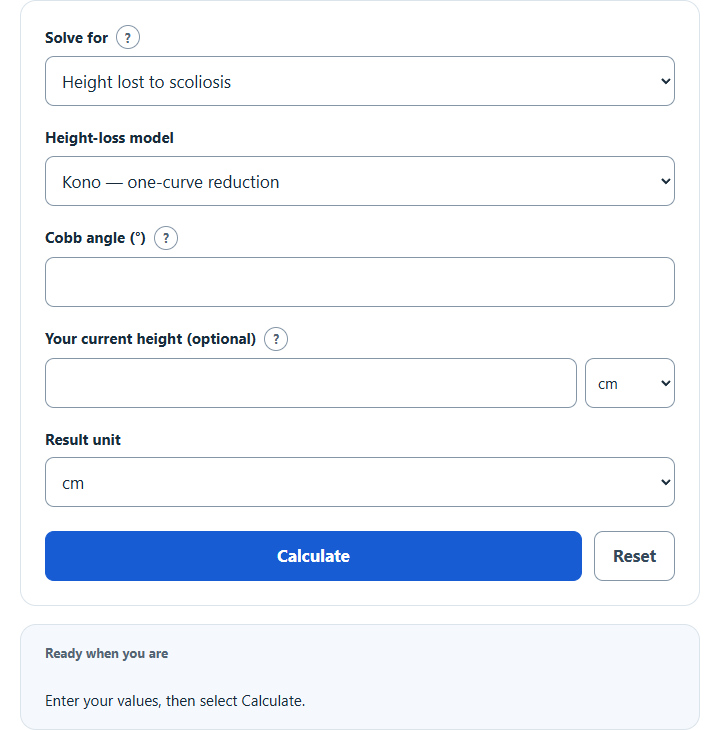
Estimate how much height scoliosis takes from your Cobb angle, and how tall you would be without the curve, using published models in cm or inches.
- All Health and Medical Calculators
- Thigh To Height Ratio Calculator
- Tibia Length To Height Calculator
Scoliosis Height Loss Formula
The displayed default formula is the one-curve reduction of Kono. Full original Kono uses Σ(Cobbᵢ − 30), subtracting 30 for each included curve; one major angle cannot represent the full multi-curve model. The Stokes option is its original single-curve polynomial, while Bjure uses the major curve. These population regressions differ and do not establish an individual’s actual height loss. Inversion is educational algebra, not a measured or clinically validated diagnostic Cobb prediction; the Stokes single-curve inverse can have two positive solutions, which the calculator reports together. Optional measured height is added only to show a model-adjusted height, not true stature or achievable treatment gain.
Variables:
- HL is the estimated height loss (cm)
- CA is the selected curve angle in degrees: one curve for the retained Kono and Stokes options, or the major curve for Bjure.
What is Scoliosis Height Loss?
Scoliosis height loss refers to the reduction in a person's measured height due to curvature of the spine. The Cobb angle is a standard measure of curvature severity and can be used in research-based equations to estimate how much height may be “lost” from spinal curvature. This can help with general understanding and support discussions with a clinician.
How to Calculate Scoliosis Height Loss?
The following steps outline how to estimate the Scoliosis Height Loss.
- First, obtain the relevant clinician-measured Cobb angle in degrees and select the matching curve model. This calculator retains >0–180° as a mathematical guard and ≥30° for its one-curve Kono option; these are not claimed as clinically validated ranges.
- For the Kono one-curve option, use HL (cm) = [0.6 × (CA – 30) + 2.6] ÷ 10.
- For optional model-adjusted height, add the modeled loss to measured height. This arithmetic sum does not predict gain from surgery, bracing or exercise.
- Finally, convert the result into your preferred unit if needed.
- After inserting the variables and calculating the result, check your answer with the calculator above.
Example Problem :
Use the following variables as an example problem to test your knowledge.
Kono one-curve example: Cobb angle (CA) = 40 degrees
Measured height = 170 cm
Estimated height loss (HL) ≈ 0.86 cm
Model-adjusted height ≈ 170.86 cm. This is not an expected treatment result.