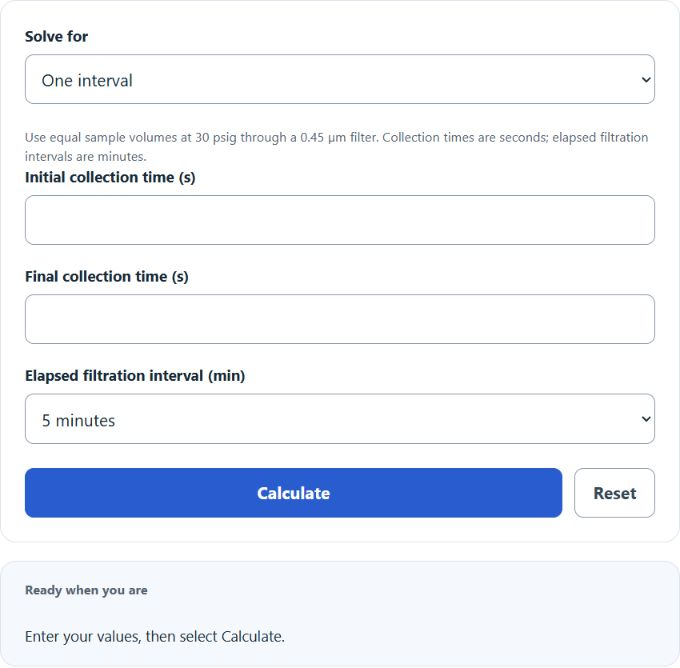
Calculate silt density index (SDI) from initial and final times, with 5-, 10-, and 15-minute results, plugging factor, and interpretation.
Related Calculators
- RO Efficiency Calculator
- Moles To mg/L Calculator
- Salt Brine Calculator
- Solution Density Calculator
- All Chemistry Calculators
SDI Formula
The following formula is used to calculate a silt density index.
- Where SDI is the silt density index (%/min)
- ti is the initial time in seconds to collect the specified filtrate volume (normally 500 mL)
- tf is the later collection time in seconds for the same volume, measured at elapsed interval T
- T is elapsed filtration time in minutes from the start, typically 5, 10, or 15 minutes; it is not tf minus ti.
To calculate the silt density index, subtract the value of the initial time over the final time from 1, multiply the result by 100, then finally divide by the time between tests.
SDI Definition
What is SDI?
SDI, short for silt density index, is a measure of the fouling capacity of water in reverse osmosis systems.
The SDI measures the rate at which a filter is plugged when subjected to constant water pressure. In other words, as water flows through the filter, how fast does the filter clog with solids?
This test typically uses a 0.45 micrometer filter at 30 psig with stable temperature. For accurate measurements, plugging must not exceed 75%; otherwise repeat at a shorter interval. Membrane acceptance limits depend on the supplier and system, not a universal good/poor band.
Example Problem
How to calculate Silt Density Index?
First, determine the initial time it takes to fill a 500 mL sample of water as it passes through the filter. For this example, the initial collection takes 30 seconds.
Keep filtration running. At 15 minutes from the start, measure another 500 mL collection; in this example it takes 60 seconds.
Finally, calculate the SDI using the formula above:
SDI = [(1- (ti/tf) ) * 100] / T
SDI = [(1- (30/60) ) * 100] / 15
SDI = 3.333 % / min