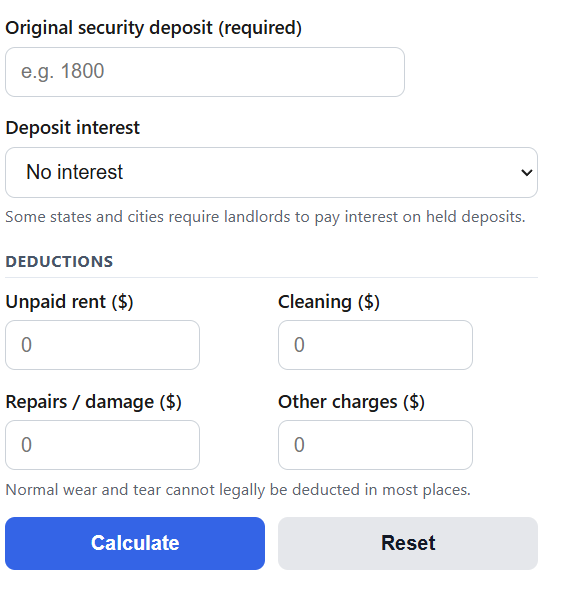
This security deposit return calculator estimates how much of your deposit you get back after interest and lawful deductions for cleaning, repairs, and rent.
Security Deposit Return Formula
The amount a landlord must return is the original deposit, plus any interest owed, minus the allowable deductions:
Returned = Deposit + Interest - Total Deductions
Where interest is required, it is usually simple interest on the amount held:
Interest = Deposit * Rate * (Months / 12)
Variables:
- Deposit is the original security deposit collected at move-in
- Rate is the annual interest rate, if your state or city requires interest
- Months is how long the deposit was held
- Total Deductions is the sum of unpaid rent, cleaning, repairs beyond normal wear, and any other lawful charges
If the deductions add up to more than the deposit plus interest, the result is negative, which means you may owe the landlord the difference rather than receiving money back. Landlords generally must provide an itemized list of any deductions.
What Can and Cannot Be Deducted
Landlords can charge for damage beyond ordinary use, but not for normal wear and tear. Knowing the difference is the key to getting your deposit back.
| Usually deductible | Usually NOT deductible (normal wear) |
|---|---|
| Unpaid rent and utilities | Faded paint and small nail holes |
| Broken windows, doors, or fixtures | Lightly worn or matted carpet |
| Large stains, holes, or pet damage | Loose hinges or minor scuffs |
| Cleaning to return the unit to move-in condition | Routine dusting and light cleaning |
| Removing trash or abandoned items | Worn grout and minor appliance aging |
Most states also set a deadline, often 14 to 30 days after move-out, for the landlord to return the balance with an itemized statement. Missing that deadline can carry penalties in the tenant’s favor.
Example Problems
Example 1: A deposit with cleaning and repair charges.
The deposit was $1,800 with no interest required. The landlord deducts $150 for cleaning and $250 for a damaged door. Total deductions are $400, so the amount returned is 1,800 – 400 = $1,400.
Example 2: A deposit that earned interest.
The same $1,800 deposit was held 12 months in a city that requires 2% simple interest. Interest is 1,800 * 0.02 * (12/12) = $36, so the gross is $1,836. After the same $400 in deductions, the tenant receives 1,836 – 400 = $1,436.
Frequently Asked Questions
How much of my security deposit should I get back?
You should get back the full deposit, plus any required interest, minus lawful deductions for unpaid rent and damage beyond normal wear and tear. If you leave the unit clean and undamaged and owe no rent, you are generally entitled to the entire amount. Landlords must usually itemize any deductions in writing.
Can a landlord keep my deposit for normal wear and tear?
No. Normal wear and tear, such as faded paint, minor scuffs, and lightly worn carpet from ordinary living, cannot be charged against your deposit in most states. Deductions are meant for actual damage, excessive filth, or unpaid amounts. If you think a charge is really for wear and tear, you can dispute it in writing.
How long does a landlord have to return my deposit?
It depends on your state, but the window is commonly 14 to 30 days after you move out. Many states require the landlord to send an itemized statement of deductions along with the remaining balance. If the landlord misses the deadline or withholds money without cause, some states let you recover extra damages.