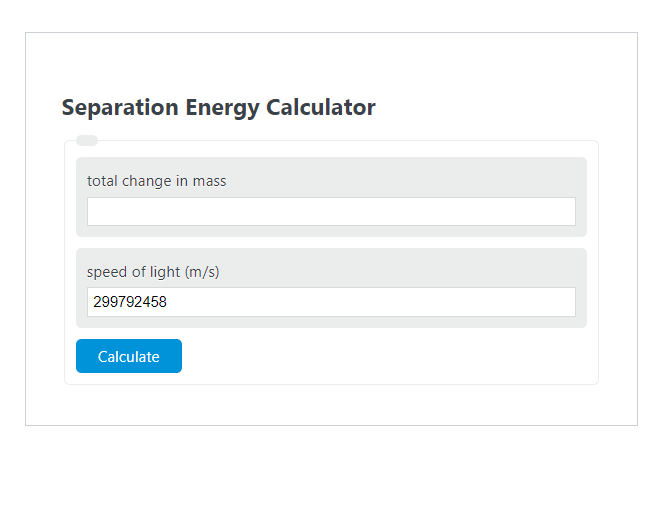
Calculate separation energy, mass, or speed of light from E=mc² with unit conversions by entering any two values in kg, lb, tonne, J, kJ, or MJ.
Related Calculators
- Thermal Energy Calculator
- Speed to Energy Calculator
- Magnitude of Force Calculator
- Deceleration Force Calculator
- All Physics Calculators
Understanding Separation Energy
Separation energy is the amount of energy required to break a bound system into its individual parts. In mass-energy terms, that energy is determined by the change in mass between the bound state and the separated components. Because mass and energy are equivalent, a very small mass difference can produce an extremely large energy value.
Separation Energy Formula
If you use the standard speed of light, the relationship becomes a direct mass-to-energy conversion:
| Symbol | Meaning | Typical Unit |
|---|---|---|
| SE | Separation energy | J |
| Δm | Total change in mass | kg |
| c | Speed of light | m/s |
How to Use the Calculator
- Enter the total change in mass for the system.
- Enter the speed of light. For standard physics calculations, use 299,792,458 m/s.
- Select the correct units for mass and speed.
- Calculate the missing value. If mass is entered in kilograms and speed in meters per second, the result is returned in joules.
Rearranged Forms
The calculator can solve for any missing variable when the other two are known:
What the Result Means
- A larger separation energy means the system is more tightly bound.
- A positive result represents energy that must be supplied to separate the parts.
- If you use a sign convention that makes the mass change negative, the result may appear negative, which indicates energy release rather than energy input.
- This calculation is based on mass-energy equivalence, so even tiny mass differences can correspond to large energies.
Unit Guidance
- Mass: The calculator accepts kg, lb, and tonne. Be sure the entered value is the change in mass, not the total mass of the object.
- Speed: The calculator accepts m/s, km/s, and cm/s. The most common scientific input is m/s.
- Energy: Results can be shown in J, kJ, or MJ depending on the scale of the problem.
- Consistency matters: The equation only works correctly when the units are interpreted consistently throughout the calculation.
Example Calculation
If the mass change is 0.002 kg and the speed of light is 299,792,458 m/s, then:
This gives approximately 1.7975 × 10¹⁴ J. The example highlights why separation energy values are often very large relative to the mass change that produces them.
Common Input Mistakes
- Entering total mass instead of mass difference.
- Using inconsistent units for speed and mass.
- Forgetting that separation energy is tied to the magnitude of the mass defect.
- Expecting small everyday-scale energy values from a mass-energy conversion problem.
Why Separation Energy Matters
Separation energy is widely used in nuclear and particle calculations to evaluate stability, compare bound states, and estimate how much energy is needed to remove a particle or split a system apart. In practical terms, it helps connect measurable mass differences to physically meaningful energy requirements.