Calculate thermal energy with Q = m × c × ΔT from mass, temperature change and a material’s typical specific heat, or solve for mass, c or ΔT.
Thermal Energy Formula
The following constant-specific-heat relation describes sensible heat transfer for a temperature change without a phase change.
- Where Q is signed heat transfer (J): positive when heat is added to the material, negative when heat is removed
- m is the positive mass (kg when using SI units)
- c is the positive specific heat capacity (J/(kg·K) in SI), appropriate to the material, process and temperature range
- ΔT is the change in temperature
To calculate sensible heat transfer, multiply mass by specific heat capacity and by ΔT = final temperature minus initial temperature. A temperature drop gives negative Q; zero temperature change gives zero sensible heat. Select the desired solve mode rather than leaving an arbitrary field blank. For inverse mass or specific heat, Q = 0 and ΔT = 0 give no unique positive value, while nonzero Q with ΔT = 0 has no finite solution.
Thermal Energy Definition
Heat is energy transferred because of a temperature difference; it is not a substance containing energy. This calculator estimates a sensible-heat transfer using Q = m × c × ΔT, rather than the total internal energy stored in a system.
Thermal Energy Example
How to calculate thermal energy?
- First, determine the mass.
Measure the mass of the object, typically in units of kilograms.
- Next, determine the specific heat.
Use a specific heat appropriate to the material, process and temperature interval; the calculation treats it as constant and excludes phase changes.
- Next, determine the change in temperature.
Use final temperature minus initial temperature. Keep the sign: cooling gives a negative change. Temperature differences in °C and K have equal magnitude; a °F difference uses a factor of 5/9 with no offset.
- Finally, calculate the thermal energy.
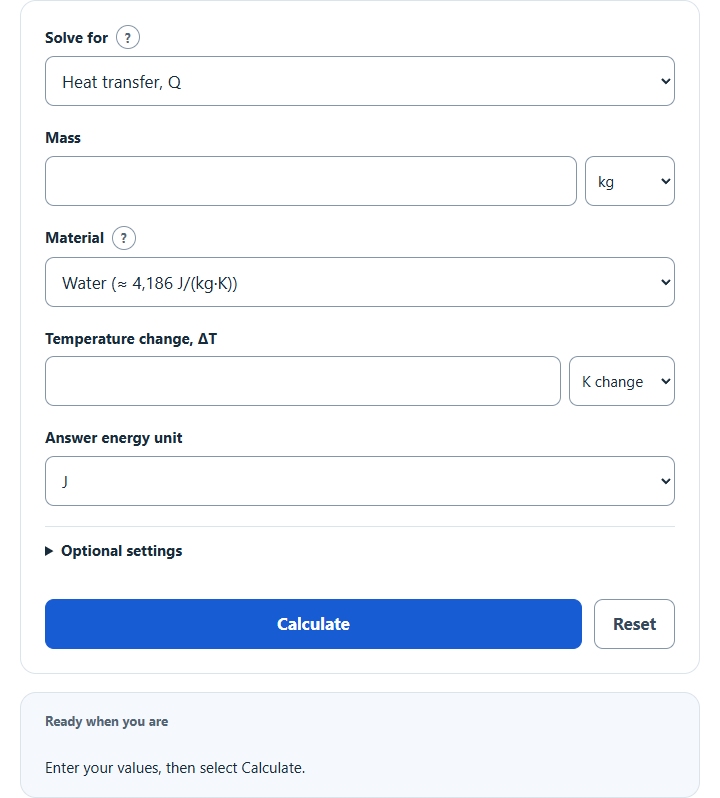
Choose the quantity to solve for, enter the three visible source values and select Calculate. The answer appears separately and does not fill a fourth input.
FAQ
Thermal energy concerns microscopic contributions to a system’s internal energy. Heat transfer is energy crossing a boundary because of a temperature difference. The Q calculated here is a signed sensible-heat transfer under a constant-specific-heat model, not a calculation of all stored internal energy.