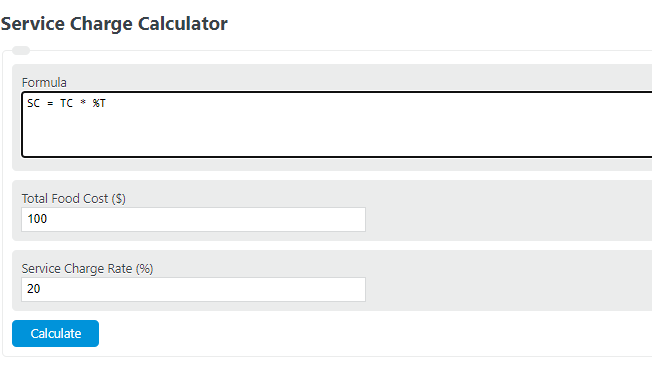
Calculate service charge from food cost and rate, or find the total bill and per-person split with optional sales tax included for dining.
Service Charge Formula
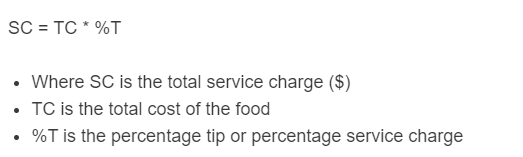
The following formula is used to calculate a service charge.
- Where SC is the total service charge ($)
- TC is the total cost before the service charge
- R is the service charge rate (%)
What Is a Service Charge
A service charge is a mandatory fee added to a bill by a business, most commonly in restaurants, hotels, and event venues. Unlike a voluntary tip left at a customer’s discretion, a service charge is set by the establishment and automatically applied. The charge covers operational costs such as staffing, equipment, insurance, and administrative overhead. Because it is mandatory, it belongs legally to the business, not to the employee who provided the service.
Service Charge Rates by Industry
Service charge percentages vary significantly depending on the industry and context. The following are typical ranges used across the United States.
| Industry / Context | Typical Rate | Notes |
|---|---|---|
| Restaurant (large party, 6+) | 18% to 22% | Often called auto-gratuity; mandatory for groups |
| Restaurant (general) | 15% to 20% | Applied in lieu of voluntary tipping at some establishments |
| Hotel room service | 15% to 18% | May also include a flat delivery fee on top |
| Hotel banquet / event | 20% to 25% | Covers setup, staffing, and breakdown |
| Off-premise catering | 18% to 25% | Higher end covers transport, equipment, and logistics |
| Delivery / takeout | 5% to 15% | Separate from driver tip; covers packaging and handling |
| Private dining | 20% to 22% | Standard for reserved spaces with dedicated staff |
Service Charge vs. Tip vs. Gratuity
These three terms are often used interchangeably, but they have distinct legal and financial meanings.
A tip is a voluntary payment from a customer to a service worker. The customer decides whether to leave one and how much. Because it is voluntary, the IRS classifies tips as belonging to the employee. Employees must report tips exceeding $20 per month to their employer for tax withholding purposes.
A gratuity is functionally the same as a tip when it is voluntary. However, the term automatic gratuity refers to a mandatory charge added by the business, typically for large parties. Despite the name, the IRS ruled in Revenue Ruling 2012-18 that automatic gratuities are service charges, not tips.
A service charge is any mandatory fee set and controlled by the business. It is classified as revenue to the employer, not as a tip to the employee. The business decides how (or whether) to distribute it to staff.
| Factor | Tip | Service Charge |
|---|---|---|
| Voluntary or mandatory | Voluntary | Mandatory |
| Set by | Customer | Business |
| Legally belongs to | Employee | Employer |
| IRS classification | Tip income | Wages (non-tip) |
| Subject to payroll withholding | Yes, if reported | Yes, always |
| Employer can retain portion | No | Yes |
Tax Treatment of Service Charges
For tax purposes, the IRS treats service charges as regular wages, not as tip income. This distinction has several practical effects. Employers must withhold federal income tax, Social Security tax, and Medicare tax on distributed service charges. The amounts appear on the employee’s W-2 as wages. Employers cannot claim FICA tip credits on service charge amounts. Service charges are also subject to state and local taxes in jurisdictions that tax restaurant or hospitality services. In most U.S. states, the service charge itself is taxable as part of the bill, meaning sales tax applies to the service charge amount in addition to the food or service cost.
Service Charges Around the World
Service charge practices vary widely by country and region. In Singapore, a 10% service charge is standard at most restaurants and hotels, and additional tipping is not expected. In the United Kingdom, restaurants may add a 10% to 12.5% discretionary service charge, which the customer can technically ask to remove. In many European countries like France, Italy, and Spain, a service component is built into menu prices rather than added as a separate line item. Japan has no tipping culture and rarely applies service charges except at high-end hotels. In Malaysia, a 10% service charge is common at hotels and upscale restaurants, alongside a 6% government service tax. In the United States, service charges are most common for large party dining, catering, and hotel events, while individual restaurant dining still relies primarily on voluntary tipping.
How Service Charges Are Distributed to Staff
Because a service charge legally belongs to the employer, distribution to employees is at the business’s discretion. Some establishments pass 100% of the service charge to front-of-house staff. Others split it between front-of-house and back-of-house employees, including kitchen staff who typically do not receive tips. A portion may also be retained by the business to cover operational costs. The specific breakdown varies and is rarely disclosed to customers. Employees should ask their employer for a written policy on service charge distribution, as there is no federal requirement for employers to pass any portion of a service charge to workers.
Service Charge Example
How to calculate a service charge?
- First, determine the total bill amount.
Add up the cost of all items or services before any additional charges. For this example, a catering order totals $1,000.00.
- Next, identify the service charge rate.
Check the contract or menu for the stated service charge percentage. Catering service charges typically range from 18% to 25%. In this case, the rate is 20%.
- Finally, calculate the service charge.
Multiply the total by the rate and divide by 100. $1,000 x 20 / 100 = $200.00 service charge. The total bill becomes $1,200.00 before tax.
FAQ
The standard service charge at restaurants ranges from 15% to 22% depending on the establishment. Catering companies typically charge 18% to 25%. Hotel banquet events often apply 20% to 25%.
It depends on the establishment. If a service charge is already applied, an additional tip is not expected. However, if the service charge does not go directly to your server, you may choose to leave a small cash tip for exceptional service.
In the United States, if a service charge is clearly disclosed before ordering (on the menu or contract), it is legally enforceable and must be paid. In the UK, a discretionary service charge can be removed upon request, though this is uncommon.
Yes. In most U.S. states, service charges are subject to sales tax because they are considered part of the total bill. For employees, distributed service charges are taxed as wages, with federal income tax, Social Security, and Medicare withheld.