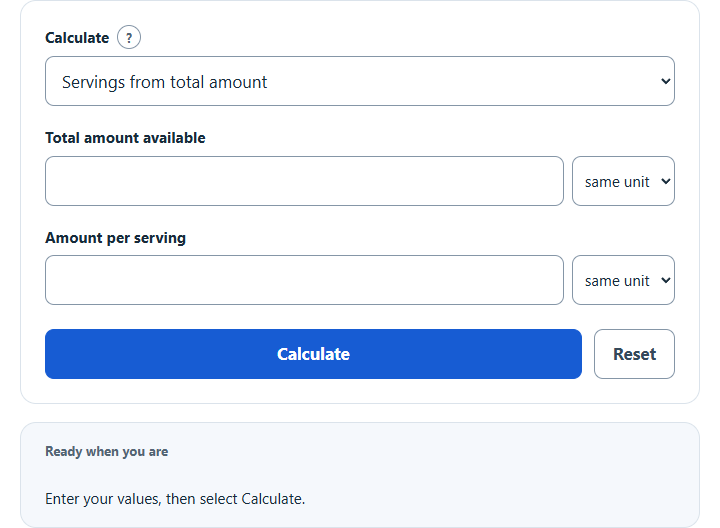
Calculate how many servings a total amount of food makes, find the serving size for a set number of servings, or scale a recipe up or down.
Servings Formula
The following formula calculates servings from a total amount and portion size, using the same unit for both amounts. For recipe scaling, use desired servings divided by original servings as the multiplier for each ingredient quantity.
Labeling context (optional): Nutrition-label servings per container depend on regulated serving sizes and rounding rules. This calculator reports the arithmetic portion count and does not apply those labeling rules. For the FDA’s labeling context (not unit conversions or food densities), see: U.S. Food & Drug Administration – 21 CFR § 101.9(b)(8).
Variables:
- S is the number of servings
- T is the total amount of food or drink available
- P is the portion size for one serving
To calculate the number of servings, divide the total amount of food or drink available by the portion size for one serving. Use matching units for both amounts; for example, 200 g divided by 25 g per portion equals 8 servings. A fractional answer includes part of a serving.
How to Calculate Servings?
The following steps outline how to calculate the number of servings using the formula S = T / P.
- First, determine the total amount of food or drink available (T).
- Next, determine the portion size for one serving (P).
- Next, gather the formula from above = S = T / P.
- Finally, calculate the number of servings (S).
- After inserting the variables and calculating the result, check your answer with the calculator above.
Example Problem:
Use the following variables as an example problem to test your knowledge.
Total amount of food or drink available (T) = 200
Portion size for one serving (P) = 25, in the same unit as the total. Therefore, S = 200 / 25 = 8 servings.