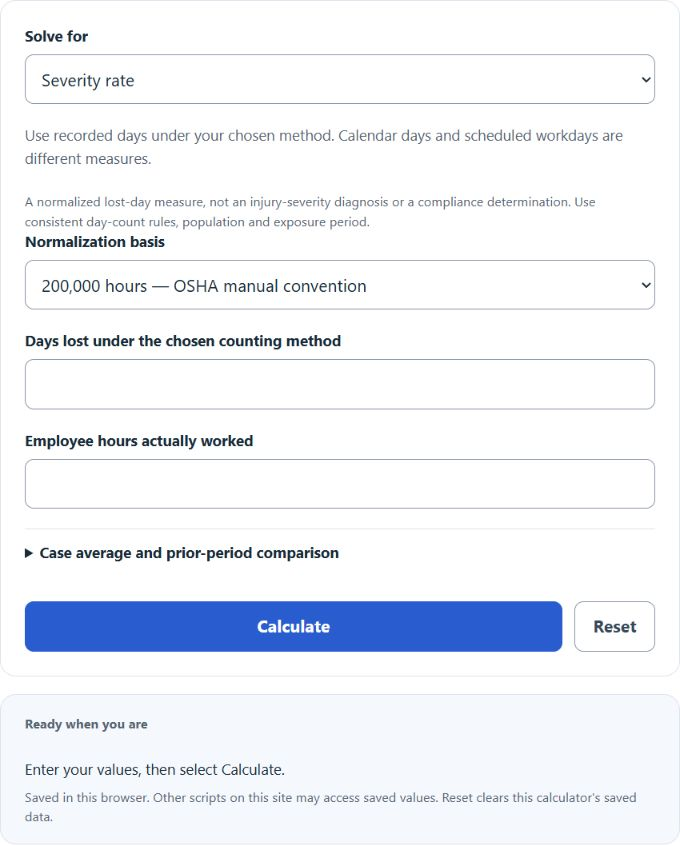
Calculate a normalized lost-day severity rate on a 200,000-hour, million-hour or custom basis, or reverse-solve a day budget for a target rate. Use consistent day-count rules and matching exposure hours.
Related Calculators
- Lost Time Incident Rate Calculator
- Accident Frequency Rate Calculator
- Lost Work Day Calculator
- Accident Free Man Hours Calculator
- Cumulative Safe Man Hours Calculator
- All Business Calculators
Severity Rate Formula
The following formula is used to calculate a severity rate.
- Where SR is the severity rate
- DL is the number of lost days counted under the chosen statistical or recordkeeping method
- EHW is the employee total hours worked
To calculate a severity rate, multiply the number of work days lost by 200,000, then divide by the total employee hours worked.
The 200,000-hour base represents 100 equivalent full-time workers at 40 hours per week for 50 weeks. It normalizes the result; your observed period need not be a year or contain 100 workers. Match the covered days, cases and actual hours to the same population and reporting method. OSHA’s Technical Manual describes a days-based severity convention; this is distinct from case-based OSHA/BLS incidence and DART rates. See the OSHA Technical Manual and BLS incidence-rate guidance.
The million-hour option follows the ILO temporary-incapacity convention. The 16,667-hour option is a custom reference scale approximately equal to 200,000/12; it is not a required base for monthly observations. Always divide by actual employee hours worked. For OSHA-derived data, calendar days begin after the injury day, include nonscheduled days when the employee cannot work, and follow the rule’s cap and case-year provisions. See ILO occupational-injury statistics, paragraphs 14–19 and 29 CFR 1904.7. This calculator does not determine reportability or legal compliance.
For a target rate, the inverse is days = target × actual hours ÷ reference hours. It also shows the greatest whole-day count at or below the target, rounded down using exact entered decimals. Optional case metrics require the cases represented by the lost-day total. Prior-period comparisons require the same base, population and day-count rules.
Severity Rate Definition
A severity rate is defined as a safety metric used to analyze the severity of workplace injuries by using the number of lost days of work and the total hours worked over a time period.
How to calculate severity rate?
Example Problem #1:
First, determine the number of workdays lost. For this problem, we are looking at a manufacturing company that had a few accidents over the year. This resulted in 5 workdays lost.
Next, determine the total number of hours worked over that same time period. For this example, there were 500,000 work hours.
Finally, calculate the severity rate of the accidents using the formula:
SR = (DL *200,000) / EHW
= (5*200,000) / 500,000
= 2
The result is 2 lost days per 200,000 employee hours worked. This rate alone does not show that the injuries were minor; interpreting it requires the case counts, time lost per case and consistent counting definitions.
Example Problem #2:
In this next problem, the number of workdays lost was found to be much higher at 25 days. However, the total number of hours worked by employees was also higher at 1,000,000 hours.
Using the formula as we did in example #1:
SR = (DL *200,000) / EHW
= (25*200,000) / 1,000,000
= 5.
The result is 5 lost days per 200,000 hours, or 2.5 times the normalized lost-day burden in the first example. This can reflect case frequency, days lost per case or both. It does not prove that the individual accidents were more severe.