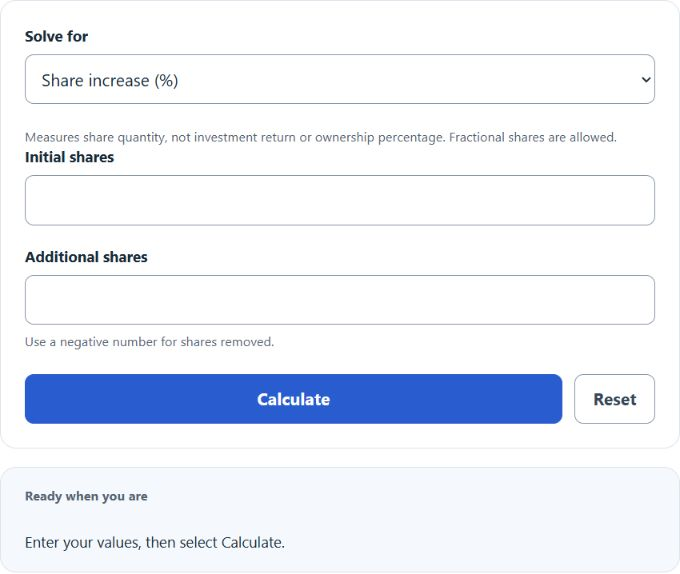
Calculate initial shares, additional shares, or share increase (%) by entering any two values and finding the missing share figure.
Share Increase Formula
The share increase calculator finds how much your share count grew relative to your starting number of shares. This is useful for portfolio tracking, stock grants, option exercises, reinvestment plans, and any situation where you want to measure growth in units of shares rather than in dollar value.
Where:
- SI = share increase percentage
- AS = additional shares acquired
- IS = initial shares held before the increase
If you also want the new total number of shares after the increase, use:
And the growth multiplier of your share count is:
How to Calculate Share Increase
- Identify the number of shares you started with.
- Determine how many shares were added.
- Divide the additional shares by the initial shares.
- Multiply by 100 to convert the result into a percentage.
This percentage tells you how large the increase was compared with your original holding, not how much the shares are worth in dollars.
Example
If you begin with 1,000 shares and later add 200 shares:
Your share count increased by 20%.
Your new total is 1,200 shares.
What This Calculator Measures
This calculator measures the percentage change in share quantity. It does not automatically measure:
- profit or loss
- market value change
- ownership percentage of a company
- dilution impact from new shares issued to others
For example, your personal share count can increase while your ownership percentage stays flat or even declines if the company issues a large number of new shares overall.
Share Increase vs. Ownership Increase
A higher number of shares does not always mean a larger ownership stake. If total shares outstanding change, ownership must be evaluated separately.
Ownership before an increase can be written as:
Ownership after an increase can be written as:
- SH = shares you hold
- SO = total shares outstanding
- b = before
- a = after
If only your holdings increase while total shares outstanding stay the same, your ownership percentage rises. If both increase, you need both values to know the real effect.
Common Use Cases
- Investor purchases: measuring how much a position grew after buying more shares.
- Dividend reinvestment: tracking the percentage increase from reinvested dividends.
- Employee compensation: evaluating growth in holdings from vested RSUs or exercised options.
- Capital raises: estimating how many new shares were added relative to a prior amount.
- Portfolio reporting: comparing changes in share count across different periods.
Quick Reference Table
| Initial Shares | Additional Shares | Calculation | Share Increase | New Total Shares |
|---|---|---|---|---|
| 100 | 25 | ((25) / (100)) × 100 = 25 |
25% | 125 |
| 500 | 50 | ((50) / (500)) × 100 = 10 |
10% | 550 |
| 1,000 | 200 | ((200) / (1000)) × 100 = 20 |
20% | 1,200 |
| 2,000 | 1,000 | ((1000) / (2000)) × 100 = 50 |
50% | 3,000 |
Important Notes
- The initial share amount should be greater than zero, or the percentage increase is undefined.
- If additional shares are zero, the share increase is 0%.
- If shares were removed rather than added, the result is a decrease, not an increase.
- This calculator is based on share counts only and does not include price per share.
Common Mistakes
- Using the new total shares in the denominator instead of the initial shares.
- Confusing share increase with return on investment.
- Ignoring whether total shares outstanding also changed.
- Mixing fractional shares and whole shares inconsistently.
Frequently Asked Questions
Does a 50% share increase mean my investment value increased by 50%?
No. It only means the number of shares increased by 50%. Investment value also depends on the market price per share.
Can this calculator be used with fractional shares?
Yes. As long as your starting shares and added shares are measured in the same units, fractional shares work correctly.
What if my shares doubled?
If your new total is twice your starting shares, then the additional shares equal your initial shares and the increase is 100%.
Is this useful for company share issuance analysis?
Yes, as a quick measure of how much the share count changed. However, for dilution analysis you should also compare ownership percentages before and after issuance.