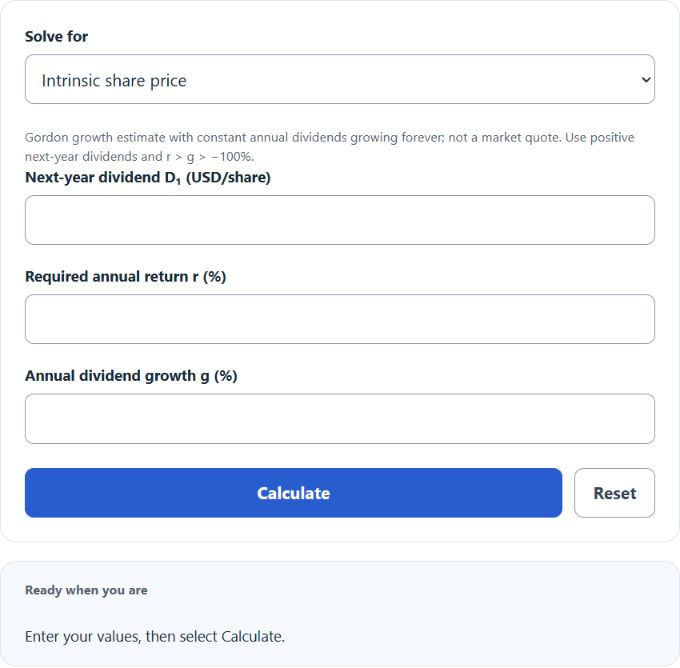
Calculate share price, dividend growth, required return, or next year’s dividend with the Gordon Growth Model from any three inputs.
- All Business Calculators
- All Price Calculators
- Stock Calculator (Profit Calculator)
- Cost Per Share Calculator
Share Price Formula
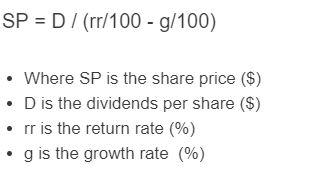
The share price calculator uses the Gordon Growth Model, also called the constant-growth dividend discount model. It estimates the intrinsic value of a share based on next year’s dividend, the required rate of return, and the expected dividend growth rate.
- P0 = intrinsic share price today
- D1 = dividend per share expected next year
- r = required rate of return, entered as a percent but used as a decimal in the formula
- g = dividend growth rate, entered as a percent but used as a decimal in the formula
If you enter any three values, the missing value is calculated by rearranging the same formula:
The calculator converts percentage inputs to decimals before calculating. For example, 9% is used as 0.09. For the share price calculation to work, the required rate of return must be greater than the dividend growth rate. If r is equal to or less than g, the denominator is zero or negative, which makes the Gordon Growth Model invalid.
Common Dividend Valuation Inputs
Select inputs for the company and a consistent annual period and currency. The model assumes constant dividend growth forever; these are not universal market benchmarks.
| Input | Input Selection | What It Means |
|---|---|---|
| Dividend per share, D1 | Varies by company | The expected dividend over the next year, not the dividend just paid. |
| Required return, r | Estimate for the stock’s risk | The return investors require for the risk of holding the stock. |
| Dividend growth rate, g | Sustainable long-term rate below r | The expected long-term annual growth rate of dividends. |
Interpreting the Calculated Share Price
| Result Compared With Market Price | Possible Interpretation |
|---|---|
| Intrinsic price is higher than market price | The stock may be undervalued based on your dividend and return assumptions. |
| Intrinsic price is close to market price | The stock may be fairly valued under those assumptions. |
| Intrinsic price is lower than market price | The stock may be overvalued based on the inputs used. |
Example Calculations
Example 1: Calculate intrinsic share price
Suppose a stock is expected to pay a dividend of $3.00 next year. Your required rate of return is 9%, and the dividend growth rate is 4%.
The estimated intrinsic share price is $60.00.
Example 2: Calculate the required rate of return
Suppose the share price is $50.00, the next expected dividend is $2.50, and the dividend growth rate is 3%.
The required rate of return is 8.00%.
FAQ
What does the share price from this calculator represent?
It represents an estimated intrinsic value based on dividends. It is not automatically the current market price. The result depends heavily on the dividend estimate, required return, and long-term growth rate you enter.
Why must the required rate of return be greater than the dividend growth rate?
The Gordon Growth Model divides the next dividend by r – g. If the growth rate is equal to or higher than the required return, the denominator becomes zero or negative. That produces an invalid or unrealistic valuation.
When is this share price formula most useful?
It is most useful for mature companies with stable dividends and a reasonable long-term dividend growth rate. It is less useful for companies that do not pay dividends, have irregular dividends, or are expected to grow at unusually high rates for a long time.