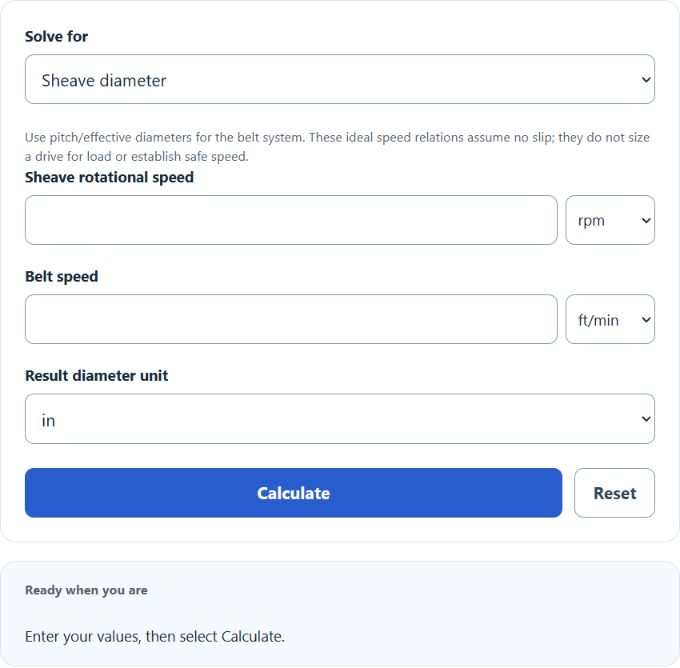
Select the value to solve: sheave pitch diameter, belt speed, rotational speed, or any driver/driven speed or pitch diameter from N1 × D1 = N2 × D2. The ideal relations assume no belt slip.
- All Construction Calculators
- Sheave Ratio Calculator
- Belt Frequency Calculator
- Belt Speed Calculator
Sheave Diameter Formula
The following formula is used to calculate the sheave diameter.
Variables:
- D is the sheave pitch/effective diameter (inches)
- V is the belt speed (feet per minute)
- RPM is the revolutions per minute of the sheave
To calculate the sheave diameter, divide the belt speed by the RPM adjusted for units (RPM multiplied by π and divided by 12 to convert to feet).
What is a Sheave Diameter?
Sheave diameter is a critical dimension in belt drive systems. It is the diameter of the sheave, or pulley, over which a belt runs. Pitch/effective diameter and RPM determine ideal belt speed and the driver/driven speed ratio. These kinematic formulas do not determine efficiency, transmitted power, minimum safe sheave size or maximum rated speed; consult the belt and sheave manufacturer. Proper sheave sizing is essential for optimal performance and longevity of the belt and sheave.
How to Calculate Sheave Diameter?
The following steps outline how to calculate the Sheave Diameter.
- First, select Sheave diameter, determine belt speed V and choose its unit.
- Next, determine the RPM (revolutions per minute) of the sheave.
- Next, gather the formula from above = D = V / (π * RPM / 12).
- Finally, select the result diameter unit and Calculate. For 1000 ft/min at 1200 rpm, D ≈ 3.1831 in.
- After inserting the variables and calculating the result, check your answer with the calculator above.
Example Problem :
Use the following variables as an example problem to test your knowledge.
belt speed (V) = 1000 feet per minute
RPM (revolutions per minute) = 1200 RPM