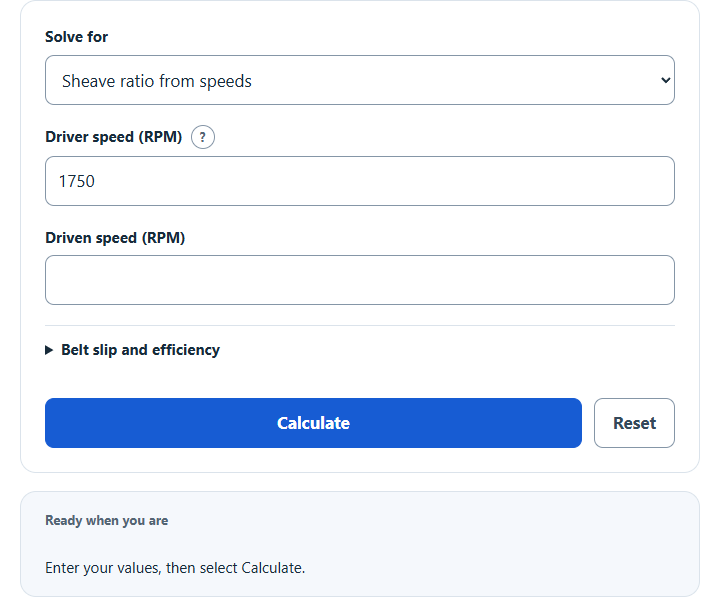
Calculate a sheave (pulley) ratio from motor and driven speeds, or find the driven RPM, motor RPM or sheave diameter you need for a belt drive.
Calculator Functions
| Function | What it does | What it requires |
|---|---|---|
| Sheave ratio from speeds | Finds the sheave ratio as driver speed divided by driven speed | Requires the driver speed and the driven speed in RPM |
| Driven (output) RPM | Finds how fast the driven sheave turns for a given pair of sheaves | Requires the driver speed and both sheave pitch diameters |
| Driven sheave diameter | Finds the driven sheave pitch diameter that gives a target driven speed | Requires the driver speed, the driven speed and the driver sheave pitch diameter |
| Driver sheave diameter | Finds the driver sheave pitch diameter that gives a target driven speed | Requires the driver speed, the driven speed and the driven sheave pitch diameter |
| Driver (input) RPM | Finds the motor speed needed to reach a target driven speed | Requires the driven speed and both sheave pitch diameters |
Driver speed starts at 1,750 RPM and can be changed to the motor nameplate speed. Diameters can be entered in inches, millimeters or centimeters. Two optional settings apply to every function: belt slip, which is 0% when left blank, and drive efficiency, which is 95% when left blank [2] and only affects the torque multiplier. The four diameter and speed functions also report the sheave ratio, belt speed and torque multiplier.
Sheave Ratio Formulas
| N₁ | Driver (motor) sheave speed (RPM) |
| N₂ | Driven sheave speed (RPM) |
| D₁ | Driver sheave pitch diameter |
| D₂ | Driven sheave pitch diameter |
| s | Belt slip as a decimal, so 2% is 0.02 |
| η | Drive efficiency as a decimal |
The two diameters only need to be in the same unit. With no slip, the speed ratio N₁ ÷ N₂ equals the diameter ratio D₂ ÷ D₁, so a driven sheave 2.5 times the size of the driver turns 2.5 times slower.
Sheave ratio from speeds
A 1,750 RPM motor driving a shaft at 700 RPM has a ratio of 1,750 ÷ 700 = 2.5 : 1. A ratio above 1 is a speed reduction and a ratio below 1 is a speed increase. This function also gives the pitch-diameter ratio, which is the speed ratio × (1 − s), and the torque multiplier, which is the speed ratio × η. At 95% efficiency the 2.5 : 1 drive multiplies torque by 2.375.
Driven (output) RPM
A 4 in driver sheave at 1,750 RPM turning a 10 in driven sheave gives 1,750 × 4 ÷ 10 = 700 RPM. With 2% belt slip the driven speed drops to 700 × 0.98 = 686 RPM.
Driven sheave diameter
To turn a shaft at 700 RPM from a 1,750 RPM motor with a 4 in driver sheave, the driven sheave needs a pitch diameter of 1,750 × 4 ÷ 700 = 10 in. The answer is given in the unit chosen for the driver sheave.
Driver sheave diameter
With a 10 in driven sheave, a 1,750 RPM motor and a 700 RPM target, the driver sheave needs a pitch diameter of 700 × 10 ÷ 1,750 = 4 in. The answer is given in the unit chosen for the driven sheave.
Driver (input) RPM
A 700 RPM driven shaft with a 10 in driven sheave and a 4 in driver sheave needs a driver speed of 700 × 10 ÷ 4 = 1,750 RPM.
Belt speed and torque multiplier
Belt speed v is in m/s when D₁ is in meters, and 1 m/s is 196.85 ft/min. A 4 in (0.1016 m) driver sheave at 1,750 RPM runs the belt at 9.310 m/s, or about 1,832.6 ft/min. The torque multiplier is (D₂ ÷ D₁) × η ÷ (1 − s): the driven shaft gains torque in proportion to the speed it gives up, less the power lost in the drive.
Limits of This Estimate
- Pitch diameter is the diameter at which the belt rides in the sheave groove, and it is the dimension drive calculations need [1]. An outside diameter gives only a rough result.
- V-belts transmit power by friction and slip under load. A V-belt drive can be 95% efficient or better when installed and can lose as much as 5% if the belt is not retensioned, while synchronous (toothed) belts run without slip [2]. Leave slip blank for a toothed belt.
- The torque multiplier is an estimate from the entered efficiency. It does not check the belt rating, belt speed limits or the minimum sheave diameter for a belt section, so confirm those with the belt manufacturer.
Sources
- U.S. Department of Energy, Improving Fan System Performance: A Sourcebook for Industry: driven speed from driver speed and sheave diameters, and the meaning of pitch diameter
- U.S. Department of Energy, Motor Systems Tip Sheet #5, Replace V-Belts with Notched or Synchronous Belt Drives: V-belt efficiency, slip and synchronous belts