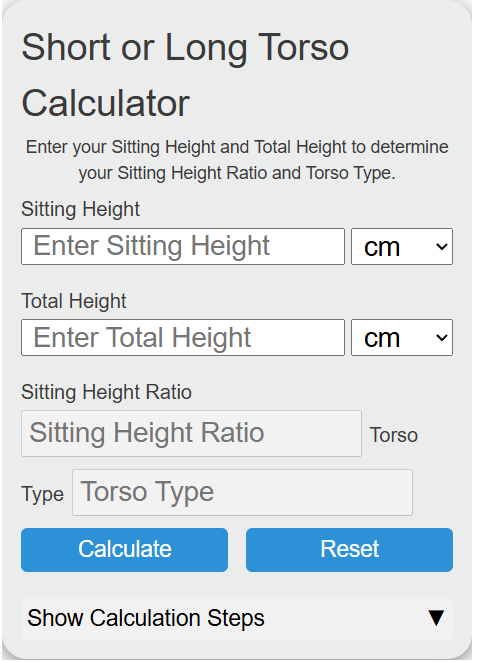
Calculate your Cormic Index from sitting height or leg length to see whether your torso is short, balanced, or long relative to your height in inches or centimeters.
Related Calculators
- Bathing Suit Size Calculator
- Collar Size Calculator
- Pillow Height Calculator
- Braid Length Calculator
- All Everyday Life and Education Calculators
Sitting Height Ratio Formula (Cormic Index)
The sitting height ratio, formally known as the Cormic Index, is the primary anthropometric measure for classifying torso-to-leg proportions:
A ratio of 0.52 or below indicates a short torso relative to leg length. A ratio above 0.52 indicates a long torso. Most adults fall between 0.50 and 0.54, with the precise value influenced by sex, ancestry, and age.
Population Averages by Ancestry
The Cormic Index varies significantly across global populations, reflecting genetic differences in limb and trunk proportions shaped over thousands of years of adaptation to different climates and environments. European populations average approximately 0.52. East Asian populations tend toward 0.53 to 0.54, reflecting proportionally shorter legs relative to trunk length. African-descent populations average closer to 0.51, indicating proportionally longer legs. Australian Aboriginal populations have been measured between 0.45 and 0.49, representing some of the longest relative leg lengths documented in any population. These differences are well-established in anthropometric literature and have practical implications for everything from clinical growth assessment to ergonomic design standards that vary by region.
Sex and Age Differences
Women tend to have a slightly higher Cormic Index than men of the same ancestry, meaning a proportionally longer torso (or shorter legs) on average. This difference is small but consistent across populations and becomes relevant in contexts like seated workspace design and vehicle ergonomics.
The Cormic Index also changes through development. In infancy, sitting height accounts for roughly two-thirds of total length, because leg growth has not yet accelerated. Through childhood and puberty, leg growth outpaces spinal growth, driving the ratio down to its minimum around age 12 to 15. After puberty, the index rises slightly as trunk growth continues briefly after leg growth plates close, then stabilizes in adulthood. In older adults, spinal compression from disc degeneration and osteoporosis can reduce sitting height, gradually lowering the ratio over decades.
How to Measure Sitting Height Accurately
Accurate sitting height measurement requires a flat, hard surface. Sit on the floor against a wall with your legs extended straight in front of you. Your buttocks, back, shoulders, and head should all contact the wall, with eyes looking directly forward. Place a rigid flat object (a hardcover book or box) on top of your head so it is level, and have someone mark the wall at the bottom edge of the object. The distance from the floor to that mark is your sitting height. Do not sit on a soft surface or cushion, as this compresses and introduces error. Measure total standing height using the same wall and marking method while standing barefoot. Both measurements should be taken at the same time of day, since spinal disc compression throughout the day can reduce height by 1 to 2 cm from morning to evening.
Torso Proportions and Strength Training
Torso-to-leg ratio has a measurable effect on barbell lifting mechanics. Individuals with a long torso and relatively short legs tend to maintain a more upright posture during the squat, reducing shear force on the lumbar spine and often allowing deeper squat depth with less mobility demand at the ankle. Conversely, those with a short torso and long femurs must lean further forward to keep the barbell over the midfoot, increasing the moment arm at the hip and placing greater demand on the posterior chain.
In the deadlift, a long torso increases the horizontal distance between the hip joint and the shoulder at the start position, requiring the spinal erectors to work harder to maintain a neutral back. Research on anthropometric determinants of deadlift performance suggests that individuals with longer torsos relative to their legs may benefit from a sumo stance, which positions the torso more upright and shortens the effective moment arm. Those with a short torso, long arms, and long legs tend to have a natural mechanical advantage in conventional deadlifts. Studies have found that when the torso exceeds approximately 32% of total body length, it can begin to affect deadlift technique meaningfully.
Clothing Fit and Torso Proportions
Knowing whether you have a short or long torso directly affects how clothing fits. With a short torso, the natural waistline sits higher, which means standard-length shirts tend to be too long and high-waisted pants can ride above the natural waist. V-neck, scoop, and square necklines create a visual lengthening effect for shorter torsos. Drop-waist styles and longer tops can visually shorten a long torso for a more balanced silhouette. For those with a long torso, regular-rise pants and tucked shirts tend to work better, while crop tops and shorter jackets help break the visual line of the trunk.
Backpack and Gear Sizing
Backpack manufacturers size packs by torso length rather than overall height, because two people of the same height can have significantly different trunk measurements. The standard measurement for backpack fitting runs from the C7 vertebra (the prominent bone at the base of the neck) to the iliac crest (the top of the hip bones). Typical size ranges are: extra-small up to 15.5 inches, small 16 to 17.5 inches, medium/regular 18 to 19.5 inches, and large/tall 20 inches and above. Choosing based on overall height alone frequently results in a poor fit, especially for those whose sitting height ratio falls well above or below 0.52. If you have a short torso (long legs), you will likely need a shorter pack than someone of the same height with a long torso.
Ergonomics and Seated Design
Sitting height ratio is one of the key variables in ergonomic seat design for vehicles, aircraft, and office furniture. Two individuals of the same stature may need very different seat-pan depths, headrest positions, and steering wheel distances depending on how their height is distributed between trunk and legs. Individuals with longer torsos and shorter legs face elevated risk of back and neck strain when workspace geometry assumes average proportions, because their eye height and reach envelope differ from someone leg-dominant at the same total height. Vehicle seat design standards in different regions account for population-level differences in the Cormic Index, which is one reason seat geometry varies between cars designed for European, East Asian, and North American markets.
Clinical Significance
In pediatric medicine, the sitting height ratio is used to screen for disproportionate growth disorders. Children growing below the 3rd percentile for height are evaluated using age-, sex-, and population-specific reference charts for the Cormic Index to differentiate conditions affecting limb growth (such as skeletal dysplasias that shorten the extremities) from those primarily affecting the spine (such as scoliosis). An abnormally high ratio for age may suggest a limb-shortening condition, while an unusually low ratio could indicate spinal pathology. The ratio is also used in pulmonary medicine: lung function prediction equations increasingly incorporate sitting height or leg length rather than total height alone, because lung volume correlates more closely with trunk size than with overall stature. This adjustment improves diagnostic accuracy across populations with different average body proportions.
Sport-Specific Advantages
Competitive swimming favors longer torsos and shorter legs, which lower the center of mass in a prone position and increase the surface area of the body’s propulsive core relative to the drag-producing limbs. Distance running tends to favor longer legs and a shorter torso, reducing the metabolic cost of the swing phase and improving stride efficiency. Rowing performance correlates with longer arms and legs relative to trunk, while gymnastics and diving favor compact proportions with a balanced or slightly long torso for rotational control. Cycling time-trial position optimization depends heavily on the torso-to-femur ratio, as it determines how aggressively a rider can achieve an aerodynamic tuck without compromising hip angle and power output.