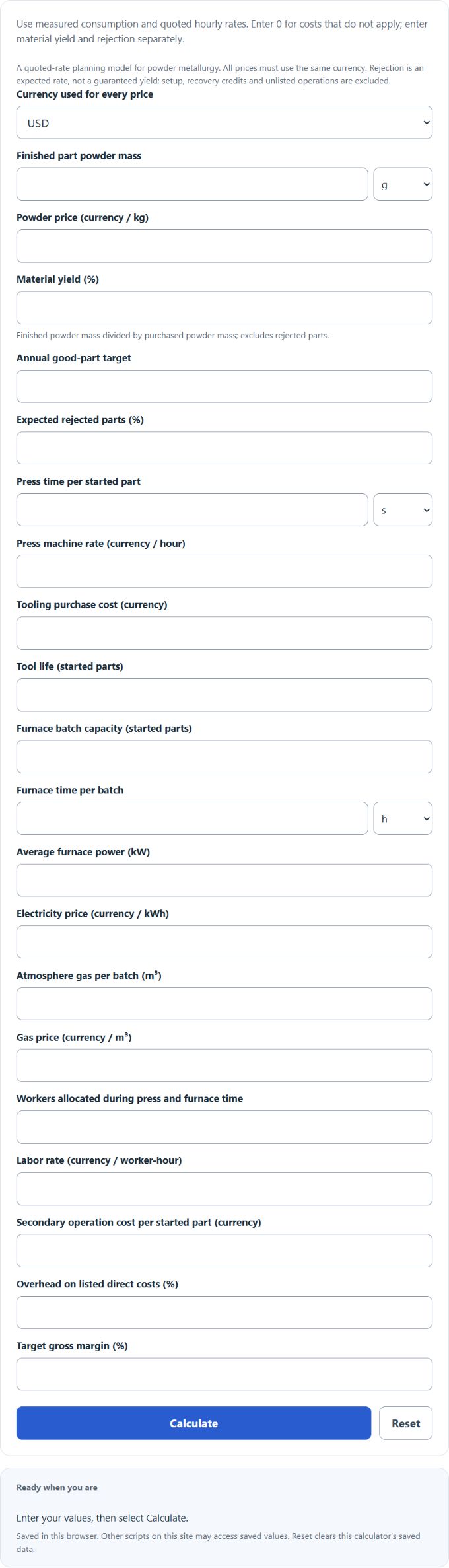
Estimate the manufacturing cost of press-and-sinter parts from powder consumption, production losses and quoted operating rates. The calculator turns an annual good-part target into a process cost breakdown and a selling price at your chosen gross margin.
How the cost model works
Starts = ceiling(good target / (1 − reject fraction)). Furnace batches = ceiling(starts / batch capacity), so a partial batch incurs a full batch cost. Purchased powder = starts × finished powder mass / material yield.
Press time, furnace electricity, atmosphere gas, allocated labor, tooling amortization and secondary operations are added to powder cost. Overhead is applied once to the listed direct costs. Cost per good part = annual cost / good target; selling price = cost per part / (1 − gross margin fraction).
Material yield represents powder use before rejection; rejection represents started parts that do not become good parts. Enter measured consumption and quoted rates. If a machine rate includes labor, enter only additional allocated labor to avoid charging it twice. Price sensitivities change one price while holding production quantities fixed; the +25% good-part-target scenario recomputes starts and furnace batches with unchanged rates.
Worked example
For 1,000 good parts with no rejection, 10 g powder per part at 10 USD/kg and 100% material yield cost 100 USD. A 3.6-second press cycle at 100 USD/hour adds 100 USD. Tool allocation adds 10 USD; one furnace batch adds 1 USD electricity and 2 USD gas. Labor adds 40 USD and secondary work adds 100 USD. Direct cost is 353 USD; 10% overhead gives 388.30 USD annually, or 0.3883 USD per good part. At 20% gross margin, the modeled selling price is 0.4854 USD.
Frequently asked questions
Is gross margin the same as markup?
No. A 20% gross margin uses cost / 0.8, rather than cost × 1.2.
Does tooling cost mean a cash purchase?
The model allocates tooling cost over its rated life. It does not schedule whole-tool purchases or financing.
Can this choose furnace temperature or powder?
No. Process selection and product quality require separate technical assessment. The cost model uses the consumption and capacity you supply.
Process reference: Metal Powder Industries Federation: conventional powder metallurgy. All financial rates are user-supplied.