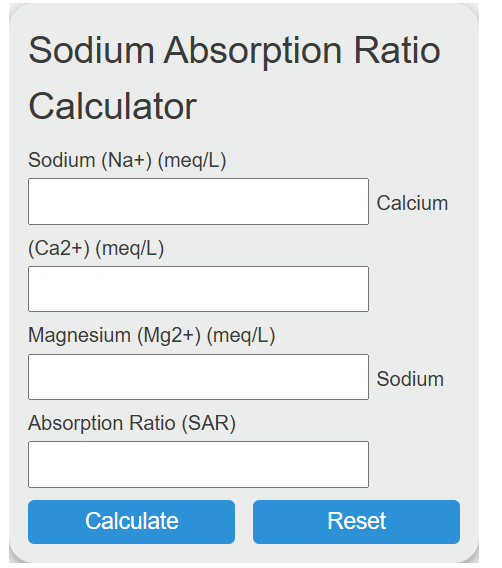
Calculate sodium adsorption ratio from Na, Ca, and Mg in meq/L or mg/L, reverse-solve sodium for a target SAR, and review transparent ion conversions.
Related Calculators
- Molarity Calculator
- Ppb To Mol/L Calculator
- Mol/L To G/L Calculator
- Water Dilution Calculator
- All Chemistry Calculators
Sodium Absorption Ratio Formula
The following equation is used to calculate the Sodium Absorption Ratio.
- Where SAR is the Sodium Absorption Ratio
- Na+ is the sodium concentration (meq/L)
- Ca2+ is the calcium concentration (meq/L)
- Mg2+ is the magnesium concentration (meq/L)
To calculate the Sodium Absorption Ratio, divide the sodium concentration by the square root of half the sum of the calcium and magnesium concentrations.
What is a Sodium Absorption Ratio?
Definition:
The Sodium Absorption Ratio (SAR) is an index used to measure the relative concentration of sodium to calcium and magnesium in water, which is critical for assessing its suitability for irrigation. High SAR values can adversely affect soil structure and permeability.
How to Calculate Sodium Absorption Ratio?
Example Problem:
The following example outlines the steps and information needed to calculate the Sodium Absorption Ratio.
First, determine the sodium concentration. In this example, it is 10 meq/L.
Next, determine the calcium concentration. In this example, it is 4 meq/L.
Then, determine the magnesium concentration. In this example, it is 2 meq/L.
Finally, calculate the SAR using the formula above:
SAR = Na+ / sqrt((Ca2+ + Mg2+)/2)
SAR = 10 / sqrt((4 + 2)/2)
SAR = 10 / sqrt(3) ≈ 5.7735
FAQ
Why is the Sodium Absorption Ratio important?
SAR is critical for assessing irrigation water quality because high sodium levels relative to calcium and magnesium can lead to soil dispersion and reduced water infiltration.
How can high SAR affect soil health?
High SAR values can cause soil particles to disperse, adversely affecting soil structure and permeability, which in turn can impact plant growth and water retention.
Can SAR levels be modified in irrigation practices?
Yes, blending water sources with lower SAR values or using soil amendments like gypsum can help mitigate high SAR levels and improve soil conditions for irrigation.