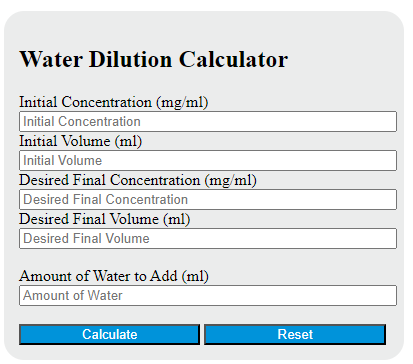
Calculate how much concentrate and water to mix for a target concentration, dilute an existing solution, or scale a 1:N ratio in metric and US volume units.
- All Chemistry Calculators
- HCl Dilution Calculator
- ng/uL Dilution Calculator
- Liquid Dilution Ratio Calculator
Water Dilution Formula
A water dilution reduces concentration by increasing total volume while keeping the amount of dissolved solute constant. This is the core idea behind stock-solution preparation, reagent mixing, cleaner dilution, nutrient adjustment, and many other everyday liquid calculations.
In this calculator, the final volume is the total amount after dilution, and the water added is only the extra water poured into the original solution.
Variable Definitions
| Symbol | Meaning | Unit Guidance |
|---|---|---|
| C1 | Initial concentration of the starting solution | Use the same concentration basis as the target concentration |
| V1 | Initial volume of the starting solution | Use the same volume unit as final volume and water added |
| C2 | Desired final concentration after adding water | Must match the unit style used for the initial concentration |
| V2 | Final total volume after dilution | Includes the original solution plus added water |
| W | Amount of water to add | Measured in the same volume unit as the other volumes |
How to Use the Water Dilution Calculator
- Enter the starting concentration.
- Enter the starting volume.
- Enter either the target concentration or the desired final total volume.
- Leave one field unknown so the calculator can solve for it.
- Review the output for final volume and water to add.
The most important rule is unit consistency. Concentration must be compared using the same basis on both sides, and volume must stay in matching units. Common valid combinations include mg/mL with mg/mL, g/L with g/L, percent with percent, and mL with mL or L with L.
Quick Reference Formulas
| Goal | Formula |
|---|---|
| Find the final total volume needed to hit a target concentration | V₂ = (C₁ V₁) / (C₂) |
| Find how much water must be added | W = V₂ - V₁ |
| Find the resulting concentration from a chosen final volume | C₂ = (C₁ V₁) / (V₂) |
| Find the original concentration when final conditions are known | C₁ = (C₂ V₂) / (V₁) |
| Relate starting volume, final volume, and added water | V₂ = V₁ + W |
| Compute dilution factor | DF = (C₁) / (C₂) = (V₂) / (V₁) |
Example
Suppose you have 250 mL of a 12 mg/mL solution and want to dilute it to 3 mg/mL.
You would add 750 mL of water, giving a final total volume of 1000 mL.
What the Calculator Assumes
- Only water is added to the system.
- The dissolved solute is conserved during mixing.
- No chemical reaction, evaporation, precipitation, or spillage changes the solute amount.
- Volume change is treated in the usual practical way for dilution calculations.
These assumptions make the calculator ideal for standard dilution planning. If the mixture reacts, separates, or loses material, the simple dilution relationship may no longer be exact.
Common Input Checks
- If the desired concentration equals the starting concentration, no dilution is needed.
- If the desired concentration is greater than the starting concentration, adding water alone cannot achieve that result.
- The water-to-add value should be zero or positive in a valid water-only dilution.
- Percent solutions should stay on the same basis throughout the calculation.
- If units do not match, convert before calculating.
Where Water Dilution Calculations Are Useful
- Preparing laboratory solutions from concentrated stock.
- Making lower-strength cleaning or sanitizing mixtures.
- Adjusting fertilizers, additives, or nutrient concentrates.
- Scaling beverages, extracts, syrups, and liquid blends.
- Planning process water additions in small production or batch mixing.
Frequently Asked Questions
Does dilution reduce the amount of solute?
No. Dilution reduces concentration by increasing total volume. The amount of dissolved material is treated as unchanged.
Can I use any units in the calculator?
Yes. The calculation works with many unit systems as long as concentration units match each other and volume units match each other.
What is the difference between final volume and water added?
Final volume is the full amount of solution after mixing. Water added is only the extra water introduced during dilution.
Why is the target concentration usually lower than the initial concentration?
Because adding water spreads the same solute across a larger total volume. That lowers strength rather than increasing it.
What does dilution factor tell me?
Dilution factor shows how much the solution has been expanded. A dilution factor of 4 means the final total volume is four times the starting volume, and the final concentration is one-fourth of the original concentration.