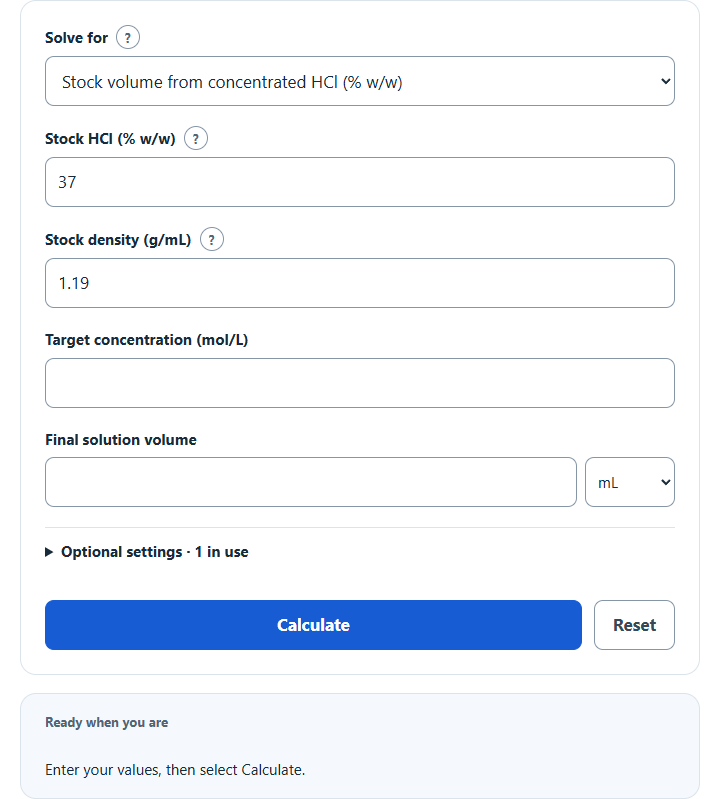
Calculate how much concentrated HCl (such as 37%) or molar stock to dilute to a target molarity and volume, or find the final concentration or volume.
HCl Dilution Formula
The following formula is used to calculate the final concentration of a diluted Hydrochloric Acid (HCl) solution.
Variables:
- C2 is the final concentration of the HCl solution (M)
- C1 is the initial concentration of the HCl solution (M)
- V1 is the initial volume of the HCl solution (L)
- V2 is the final volume of the solution after dilution (L)
To calculate the final concentration of a diluted HCl solution, multiply the initial concentration by the initial volume. Then divide by the final solution volume, using matching volume units. For preparation, follow a safe laboratory procedure: add acid slowly to water, allow the mixture to cool, then adjust to final volume. The displayed nominal volume difference is not an exact water-addition measurement.
HCl targets in normality or mass percent
For HCl acid–base neutralization, one mole supplies one equivalent, so normality in eq/L (N) has the same numerical value as molarity in mol/L (M). For example, 6 N HCl is 6 mol/L for this reaction. Select eq/L (N) beside a stock or target concentration to enter normality directly. The calculator also displays the target normality. This equivalence does not apply to every acid or reaction.
For a mass-percent target, select the % w/w stock mode and choose Mass percent (% w/w) as the target basis. Enter the target percentage, its solution density and the final volume. A 5% w/w solution contains 5 grams of HCl per 100 grams of solution; it is different from 5% w/v or 5% v/v. Use a measured or reliable published density for that target concentration and temperature. The concentrated-stock density cannot stand in for the target density.
C₂ = 10 × p₂ × ρ₂ / 36.46, where p₂ is the target mass percentage and ρ₂ is the target solution density in g/mL. This gives C₂ in mol/L. Convert the stock percentage with its own density in the same way, then calculate V₁ = C₂V₂ / C₁. Final solution mass is ρ₂ × V₂ when V₂ is in mL.
For example, if the specified final density is 1.10 g/mL for 20% w/w HCl, 1,000 mL contains 220 g of HCl. Stock assayed at 37% w/w with density 1.19 g/mL supplies 0.4403 g HCl per mL, so the calculated stock volume is 220 / 0.4403 = 499.66 mL. This is a concentration calculation, not a validated preparation procedure. Mixing volumes are not additive; follow the applicable laboratory procedure and any required standardization. The calculator does not certify a USP preparation.
Concentration basis: FUJIFILM Wako’s mass-percent and density conversion; equivalent concentration: Thermo Scientific’s molarity and normality reference.
What is an HCl Dilution?
An HCl dilution refers to the process of reducing the concentration of hydrochloric acid (HCl) in a solution. This is typically done by adding more solvent (usually water) to the solution, which decreases the amount of HCl per unit volume. The process is often used in laboratories to create less concentrated solutions for experiments, as concentrated HCl can be dangerous to handle due to its corrosiveness and reactivity.
How to Calculate HCl Dilution?
The following steps outline how to calculate the HCl Dilution using the formula: C2 = C1 * (V1 / V2).
- First, determine the initial concentration of the HCl solution (C1) in moles per liter (M).
- Next, determine the initial volume of the HCl solution (V1) in liters (L).
- Next, determine the final volume of the solution after dilution (V2) in liters (L).
- Using the formula C2 = C1 * (V1 / V2), calculate the final concentration of the HCl solution (C2) in moles per liter (M).
- After inserting the values into the formula and calculating the result, check your answer with the calculator above.
Example Problem:
Use the following variables as an example problem to test your knowledge.
Initial concentration of the HCl solution (C1) = 0.5 M
Initial volume of the HCl solution (V1) = 2 L
Final volume of the solution after dilution (V2) = 5 L
The final concentration is 0.5 × 2 / 5 = 0.2 mol/L.