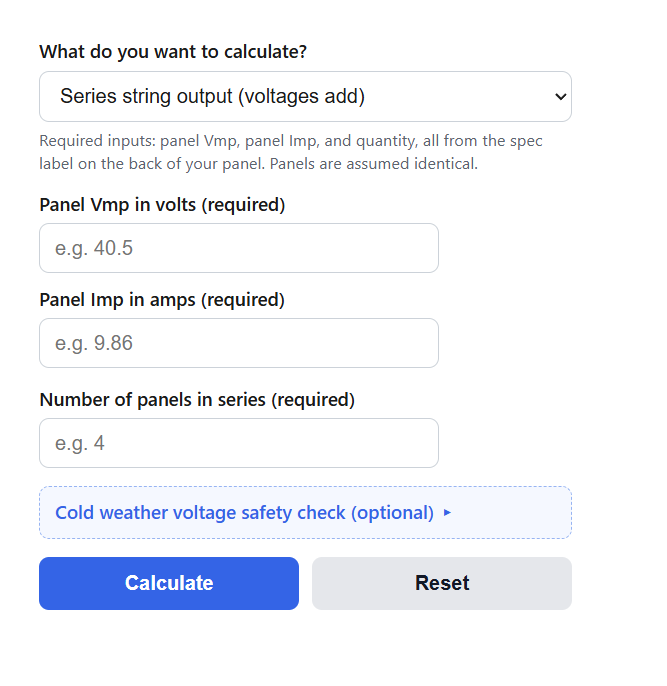
Calculate the voltage, current, and total wattage of solar panels wired in series, parallel, or series-parallel arrays, plus the cold weather max Voc for safe charge controller sizing.
Solar Panel Series and Parallel Array Formula
Wiring determines how the voltage and current of individual panels combine into array totals. For identical panels connected in series, the voltages add and the current stays the same:
V(array) = Vmp * Ns
 I(array) = Imp
For identical panels connected in parallel, the currents add and the voltage stays the same:
V(array) = Vmp
 I(array) = Imp * Np
A series-parallel array combines both rules. Panels are wired into series strings, and the strings are wired together in parallel:
V(array) = Vmp * Ns
 I(array) = Imp * Np
 P(array) = Vmp * Imp * Ns * Np
The cold weather safety check uses the open circuit voltage corrected for the lowest temperature the array will see:
Voc(max) = Voc * Ns * (1 + B/100 * (Tmin - 25))
Variables:
- Vmp is the maximum power voltage of one panel, in volts, from the spec label on the back of the panel
- Imp is the maximum power current of one panel, in amps
- Ns is the number of panels wired in series in each string
- Np is the number of strings wired in parallel
- P(array) is the total array power at the maximum power point, in watts
- Voc is the open circuit voltage of one panel at 25°C
- B is the temperature coefficient of Voc in percent per °C, typically between -0.25 and -0.35 for crystalline panels
- Tmin is the coldest expected ambient temperature, in °C
Each calculator mode maps directly to these formulas. Series mode sets Np to 1, so voltage multiplies and current does not. Parallel mode sets Ns to 1, so current multiplies and voltage does not. Series-parallel mode applies both multipliers from the string count and panels per string you enter. Compare mode runs the series-parallel formula for every way your panel count divides into equal strings and lists the voltage and current of each layout side by side. The optional cold weather check applies the Voc formula and, if you enter a controller limit, reports whether the array stays under it and by how many volts.
These rules assume identical panels. If you mix different panels, a series string is pulled down to the lowest panel current and a parallel group is pulled down to the lowest panel voltage, so the formulas above become best-case values.
Cold Weather Voltage Correction Factors
The highest voltage your array will ever produce occurs on a cold, clear morning before the panels warm up, because open circuit voltage rises as temperature falls. A string sized only from the label Voc can exceed a charge controller or inverter input limit in winter and destroy it. If you do not know your panel’s temperature coefficient, the National Electrical Code (Table 690.7(A)) provides standard correction factors for crystalline silicon modules. Multiply the total string Voc at 25°C by the factor for your lowest expected ambient temperature.
| Lowest expected temperature (°C) | Same range (°F) | Multiply string Voc by |
|---|---|---|
| 24 to 20 | 75 to 68 | 1.02 |
| 19 to 15 | 66 to 59 | 1.04 |
| 14 to 10 | 57 to 50 | 1.06 |
| 9 to 5 | 48 to 41 | 1.08 |
| 4 to 0 | 39 to 32 | 1.10 |
| -1 to -5 | 30 to 23 | 1.12 |
| -6 to -10 | 21 to 14 | 1.14 |
| -11 to -15 | 12 to 5 | 1.16 |
| -16 to -20 | 3 to -4 | 1.18 |
| -21 to -25 | -6 to -13 | 1.20 |
| -26 to -30 | -15 to -22 | 1.21 |
| -31 to -35 | -24 to -31 | 1.23 |
| -36 to -40 | -33 to -40 | 1.25 |
For example, a string of three panels rated 24.3 V Voc totals 72.9 V at 25°C. In a climate that reaches -12°C, the factor is 1.16, so the controller must handle at least 72.9 * 1.16 = 84.6 V. The table method is slightly more conservative than the coefficient formula, which makes it a safe fallback when the datasheet is missing.
The second table summarizes the practical trade-offs between the two wiring directions.
| Factor | Series | Parallel |
|---|---|---|
| Voltage | Adds with each panel | Stays at one panel |
| Current | Stays at one panel | Adds with each panel |
| Partial shade | One shaded panel drags down the whole string | Unshaded panels keep producing |
| Wire cost | Low, thin wire carries the low current | Higher, thick wire needed for summed current |
| Extra hardware | None | Branch connectors, string fuses at 3 or more strings |
| Cold weather risk | Voc stacks and can exceed the controller limit | Voc stays at one panel |
| Best paired with | MPPT controllers with a wide input window | PWM controllers or shaded sites |
Solar Panel Series and Parallel Array Example
Example 1: You have four 100 W panels, each rated 18.6 V Vmp and 5.38 A Imp, and you wire them as two parallel strings of two panels in series. The array voltage is 18.6 * 2 = 37.2 V, the array current is 5.38 * 2 = 10.76 A, and the total power is 18.6 * 5.38 * 4 = 400.3 W. Wiring all four in series instead would give 74.4 V at 5.38 A, and all four in parallel would give 18.6 V at 21.52 A. The power is the same in every layout; only the voltage and current mix changes.
Example 2: You plan a string of three panels rated 24.3 V Voc with a coefficient of -0.30 %/°C, and your controller accepts up to 100 V. The string Voc at 25°C is 72.9 V. At a winter low of -15°C, the correction factor is 1 + (-0.30/100) * (-15 – 25) = 1.12, so the maximum expected Voc is 72.9 * 1.12 = 81.65 V. The string fits with about 18 V of headroom. A fourth panel in series would raise the cold Voc to 108.9 V and exceed the limit, so it would need to go in a second parallel string instead.
Frequently Asked Questions
Do parallel strings need fuses?
With one or two strings, fuses are generally not required because a faulted string cannot receive more current than one healthy string can supply. With three or more parallel strings, the healthy strings can all backfeed into a fault, so each string needs a series fuse. Size it at 1.25 times the panel Isc, rounded up to the next standard fuse size, and never larger than the maximum series fuse rating printed on the panel label.
What happens if I mix panels with different specs?
Mismatched panels waste power. In a series string, every panel is forced to the current of the weakest panel, so a 9 A panel in a string with a 6 A panel only delivers 6 A. In parallel, every string is pulled to the lowest string voltage. Keep each series string identical, and if you must combine different panel models, group each model into its own string or its own controller input so the mismatch losses stay small.
Why does the calculator check Voc instead of Vmp against the controller limit?
Your charge controller sees the full open circuit voltage whenever it is not drawing power, such as at first light, when the battery is full, or during a disconnect. Voc is always higher than Vmp, and it climbs further in cold weather. Controller input limits are absolute maximums, so the safe design number is the cold-corrected Voc, not the operating voltage.