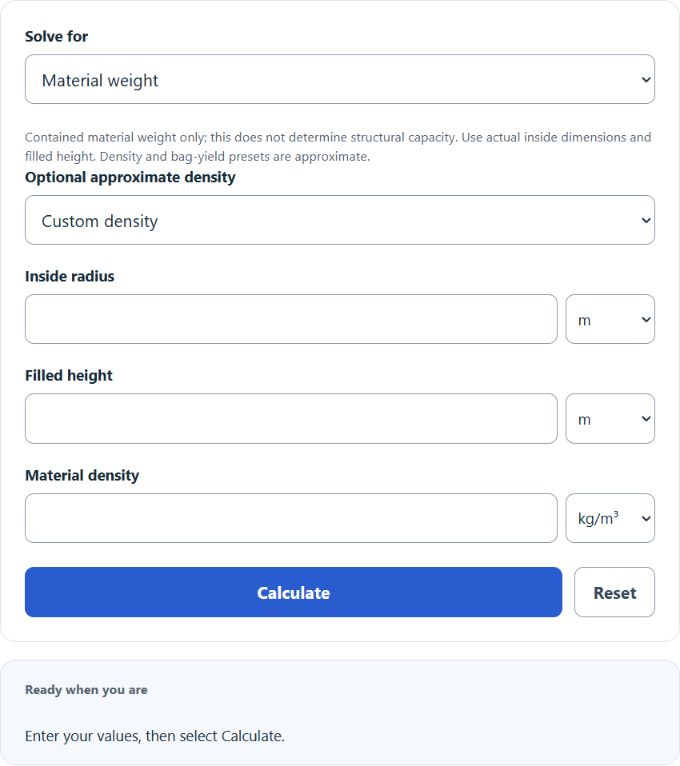
Calculate sonotube load weight from radius, height and material density, or estimate concrete volume and 60 lb or 80 lb bags needed.
Sonotube Material Load (Weight) Formula
The following formula is used to calculate the weight (force) of material filling a Sonotube-shaped cylinder (for example, wet concrete). It does not represent the structural load-bearing capacity of a Sonotube form or finished concrete column.
Variables:
- L is the load (weight/force) of the contained material (kN)
- π is a constant (approximately 3.14159)
- r is the radius of the filled cylinder (m)
- h is the height of the filled cylinder (m)
- d is the density of the material (kg/m^3)
- g is the acceleration due to gravity (≈ 9.80665 m/s^2)
To calculate the load (weight) of material in a Sonotube, multiply the square of the radius by the height and the density. Multiply this result by π to get the mass of the material (in kg). Multiply by g to convert mass to force in newtons (N). Finally, divide by 1000 to convert newtons to kilonewtons (kN).
What is a Sonotube Load?
In this context, a “Sonotube load” means the weight (force) of the material inside a Sonotube form (commonly fresh concrete) based on its volume and density. A Sonotube itself is a cylindrical form used to shape concrete; the true structural capacity of a finished concrete column depends on concrete strength, reinforcement, column slenderness/buckling, end conditions, and bearing/soil conditions, and is not determined by the simple volume × density calculation.
How to Calculate Sonotube Load?
The following steps outline how to calculate the Sonotube material load (weight):
- First, determine the actual inside radius of the filled cylinder (r), not its diameter. Select the matching unit in the calculator.
- Next, determine the height of the filled cylinder (h) in meters.
- Next, determine the fresh or bulk density of the material (d). Approximate presets are planning values; supplier or measured density is preferable.
- Next, use the formula from above: L = (π * r^2 * h * d * g) / 1000.
- Finally, calculate the material load (L) in kN.
- After inserting the variables and calculating the result, check your answer with the calculator above.
Example Problem :
Use the following variables as an example problem to test your knowledge.
radius of the Sonotube (r) = 0.5 m
height of the Sonotube (h) = 2 m
density of the material (d) = 1500 kg/m^3
Using g = 9.80665 m/s^2: Volume = π(0.5)^2(2) ≈ 1.5708 m^3, mass ≈ 2356.2 kg, so load L ≈ 23.11 kN.