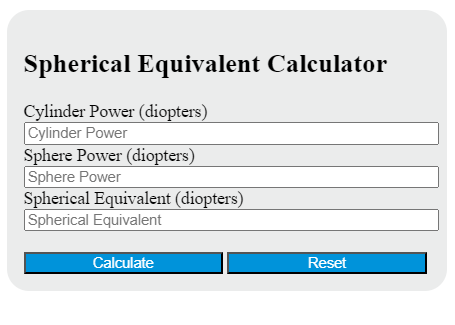
Calculate spherical equivalent, sphere power, or cylinder power from any two prescription values, with results in diopters or centidiopters.
- All Health and Medical Calculators
- Lens Thickness Calculator
- Contact Lens Vertex Calculator
- Exit Pupil Calculator
Spherical Equivalent Formula
The spherical equivalent turns a sphere and cylinder prescription into a single sphere power. Take the cylinder with its sign, divide it by two, and add it to the sphere:
SE = SPH + CYL / 2
The calculator can also work backward. To find the sphere from a known spherical equivalent and cylinder, rearrange the formula to:
SPH = SE - CYL / 2
To find the cylinder from a known spherical equivalent and sphere, rearrange it to:
CYL = 2 * (SE - SPH)
Variables:
- SE is the spherical equivalent in diopters (D)
- SPH is the sphere power in diopters, negative for nearsighted and positive for farsighted
- CYL is the cylinder power in diopters, entered with its own sign
Pick what you want to solve for at the top of the calculator. In the default mode you enter the sphere and the cylinder and the tool returns the spherical equivalent. The two other modes solve back for the sphere or the cylinder when you already know the spherical equivalent and one of the other two values.
The cylinder sign is the part that trips people up. A minus cylinder stays minus after you divide by two, so you are adding a negative number and the result drops below the sphere. A plus cylinder raises it instead. The axis of the prescription plays no part in this calculation, which is why the calculator treats the axis as an optional note rather than a value in the math. The optional vertex setting adjusts the answer for the shorter distance between a contact lens and the eye, which begins to matter at about 4.00 D.
Cylinder Contribution and Common Prescription Values
The first table shows how much a given cylinder adds to the sphere, since the cylinder is always halved. The second table lists full prescriptions and the spherical equivalent each one reduces to.
| Cylinder (D) | Added to the sphere (CYL / 2) |
|---|---|
| -0.50 | -0.25 |
| -0.75 | -0.38 |
| -1.00 | -0.50 |
| -1.25 | -0.63 |
| -1.50 | -0.75 |
| -2.00 | -1.00 |
| -2.50 | -1.25 |
| -3.00 | -1.50 |
A plus cylinder adds the same amounts with a positive sign. The values below assume the cylinder is halved and added to the sphere shown.
| Sphere (D) | Cylinder (D) | Spherical equivalent (D) |
|---|---|---|
| +2.00 | -1.00 | +1.50 |
| -3.00 | +2.00 | -2.00 |
| +1.00 | -2.00 | 0.00 (plano) |
| 0.00 | -1.50 | -0.75 |
| +0.50 | +1.00 | +1.00 |
| -5.00 | -2.00 | -6.00 |
| -3.00 | -1.50 | -3.75 |
Example Problems
Example 1: Find the spherical equivalent of a myopic prescription.
The prescription is -3.00 -1.50 x 180. Halve the cylinder and add it to the sphere:
SE = -3.00 + (-1.50 / 2) = -3.00 + (-0.75) = -3.75 D.
Example 2: Watch the cylinder sign.
The prescription is +2.00 -3.00 x 120. The minus cylinder stays negative after halving:
SE = +2.00 + (-3.00 / 2) = +2.00 + (-1.50) = +0.50 D. Dropping the minus sign would wrongly give +3.50 D.
Frequently Asked Questions
What is the spherical equivalent formula?
The spherical equivalent is the sphere plus half of the cylinder, written SE = SPH + CYL / 2. You keep the cylinder sign when you halve it, so a minus cylinder lowers the sphere and a plus cylinder raises it. For +2.00 -1.50 x 180 the result is +2.00 + (-0.75) = +1.25 D. The axis is never used.
Does the axis affect the spherical equivalent?
No. The axis only tells you the orientation of the astigmatism, not its power, so it drops out of the average entirely. Two prescriptions with the same sphere and cylinder but different axes share the same spherical equivalent. The calculator lets you record the axis for reference, but it does not change the result.
Can you use the spherical equivalent instead of the full prescription?
It works as an estimate, not a replacement. The spherical equivalent is the average power across both meridians, so it ignores the astigmatism that the cylinder corrects. It is useful as a first contact lens power before an over-refraction, or for a quick sense of how strong a prescription is, but anyone with meaningful astigmatism still needs the full sphere, cylinder, and axis for the sharpest vision.