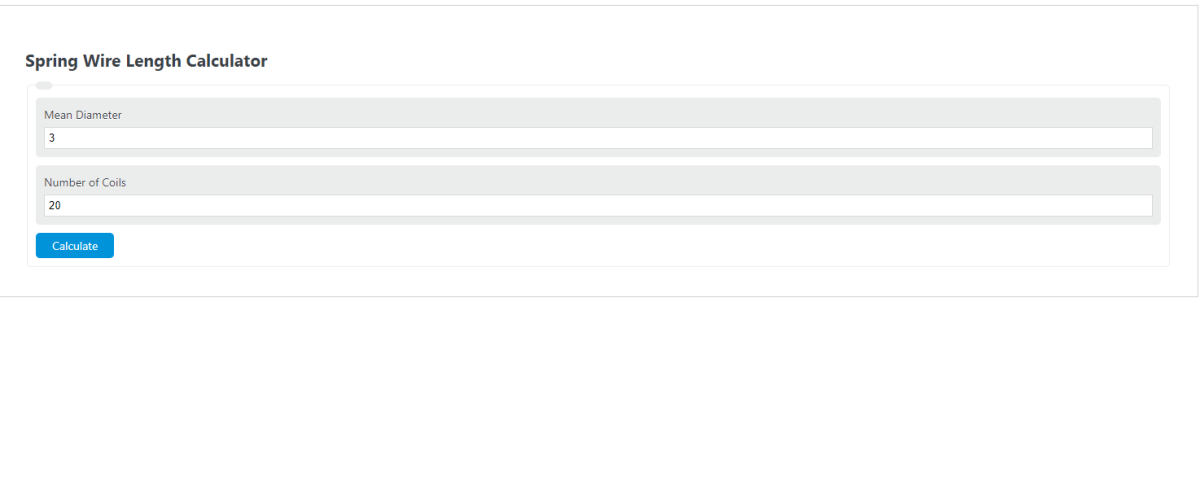
Calculate spring wire length, mean diameter, or number of coils from any two values in inches, feet, centimeters, or meters using a close-coiled formula.
Spring Wire Length Formula
Spring wire length is the developed length of material in the coiled body of a spring after the wire is conceptually straightened. For a close-coiled helical spring, where the pitch is small relative to the circumference of each turn, the wire length is estimated from the mean coil diameter and the number of coils.
If the spring is more open and the pitch per turn is not negligible, the wire follows a helix rather than a near-circle. In that case, the coiled-body length is better estimated with:
| Variable | Meaning |
|---|---|
| SWL | Spring wire length in the coiled portion |
| D | Mean coil diameter, measured to the centerline of the wire |
| N | Total number of coils in the coiled section |
| p | Pitch per turn, or axial advance of one full coil |
When This Calculator Is Most Accurate
This calculator is intended for close-coiled springs. That means the spacing between turns is small enough that each turn can be treated as a circle for estimation purposes.
That assumption works well for many tightly wound compression and extension spring bodies. It does not include additional wire used in hooks, loops, straight legs, tangs, bent ends, or other special end features.
How to Find Mean Coil Diameter
The most common input mistake is using outside diameter or inside diameter directly. The formula needs the mean diameter, which follows the centerline of the wire.
If you know the outside diameter and wire diameter:
If you know the inside diameter and wire diameter:
Use one consistent unit system throughout. If the mean diameter is entered in inches, the resulting wire length will be in inches. If the mean diameter is entered in centimeters, the output will be in centimeters.
How to Calculate Spring Wire Length
- Determine the mean coil diameter.
- Count the total number of coils in the coiled body.
- Apply the close-coiled relation if the pitch is very small.
- If the spring is open-coiled, use the helix relation instead.
- Add any extra end length separately if you need total cut length.
For manufacturing or material planning, the total cut length can be greater than the calculator result whenever the spring includes non-coiled end geometry.
Example
A spring body has a mean diameter of 3 in and 20 total coils. Using the close-coiled approximation:
This value represents the developed length of the coiled body only. If the spring also has hooks or straight ends, those lengths should be added separately.
If the same spring had a pitch of 0.25 in per turn and you wanted the helical-body estimate instead:
The difference is small here because the circumference of each turn is much larger than the pitch, which is exactly when the close-coiled approximation performs well.
What Changes the Wire Length?
- Larger mean diameter: each turn uses more wire.
- More coils: wire length increases in direct proportion to the number of turns.
- Greater pitch: the true helical path becomes longer than the circular approximation.
- End features: hooks, loops, legs, and special ends add material beyond the coiled section.
Common Mistakes
- Using outside diameter instead of mean diameter.
- Using active coils when the goal is total wire in the coiled body.
- Mixing units, such as inches for diameter and centimeters for the result.
- Ignoring pitch for open-coiled springs.
- Assuming the result includes hooks, legs, or other end geometry.
Practical Notes
In spring design, wire length is useful for estimating raw material usage, checking manufacturability, comparing alternate geometries, and approximating finished part weight when wire diameter and material density are known. It is also a convenient first-pass value when reviewing drawings or validating whether a spring body dimension is reasonable.
Because this calculator is based on the close-coiled spring body, it is best used as a fast estimation tool. For highly precise fabrication, open pitch, variable pitch, tapered bodies, and detailed end forms should be evaluated from the actual spring geometry.
Frequently Asked Questions
Does the result include hooks or legs?
No. The calculation applies to the coiled section unless those additional lengths are manually added.
Should I use total coils or active coils?
Use the number of coils in the wire path you are trying to measure. For total material in the coiled body, use total coils in that body section. If only active coils are entered, the result will be shorter than the full developed body length.
Why does the output use the same unit as diameter?
The number of coils is a count and has no unit. As a result, the output retains the same linear unit used for the mean diameter.