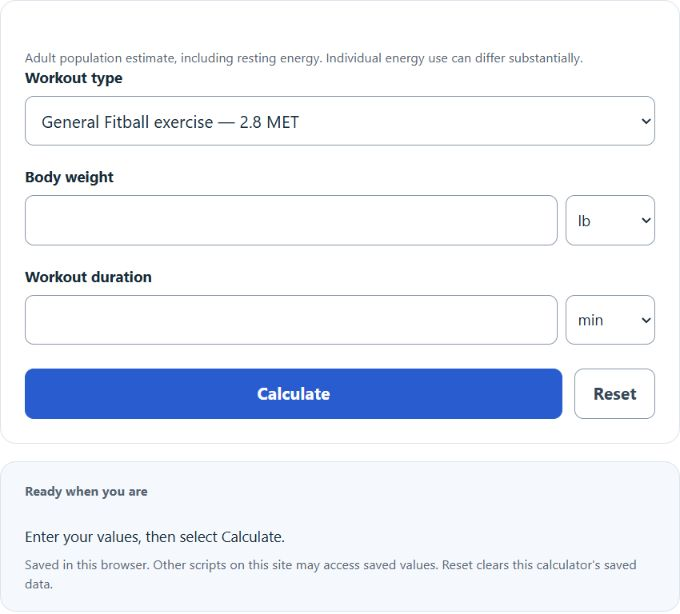
Estimate total energy during a stability ball workout from body weight, duration, and the general or high-intensity Fitball category in the 2024 Adult Compendium.
Stability Ball Workout Calorie Formula
This population estimate includes resting energy. Individual expenditure can differ substantially; it is not a measurement of a specific exercise or session.
Calories (kcal) = MET × Body Weight (kg) × Duration (hours)
- Body Weight (kg) is your body weight in kilograms
- Duration (hours) is workout time in minutes divided by 60
- MET is the published activity-category value; this calculation uses 1 MET = 1 kcal/kg/hour
| Workout category | MET | Basis |
|---|---|---|
| General Fitball exercise | 2.8 | 2024 Adult Compendium code 02112 |
| High-intensity Fitball exercise | 9.5 | 2024 Adult Compendium code 02114 |
Illustrative Total Energy During General Fitball Exercise
| Body Weight | 15 Minutes | 30 Minutes | 45 Minutes |
|---|---|---|---|
| 120 lb | 38 kcal | 76 kcal | 114 kcal |
| 150 lb | 48 kcal | 95 kcal | 143 kcal |
| 180 lb | 57 kcal | 114 kcal | 171 kcal |
What Is a Stability Ball Workout?
A stability ball workout uses an inflatable exercise ball to make movements less stable and more demanding on the core. Common exercises include ball crunches, planks, bridges, hamstring curls, wall squats, push-ups, and mobility drills. Because the ball challenges balance, the trunk, hips, shoulders, and legs often work together throughout the session.
Example Calculation
For a 150 lb person doing 30 minutes of general Fitball exercise (2.8 MET):
- Convert body weight to kilograms: 150 × 0.45359237 = 68.0388555 kg
- Convert 30 minutes to 0.5 hours; use the general Fitball value of 2.8 MET
- Total energy ≈ 2.8 × 68.0388555 × 0.5 = 95.3 kcal