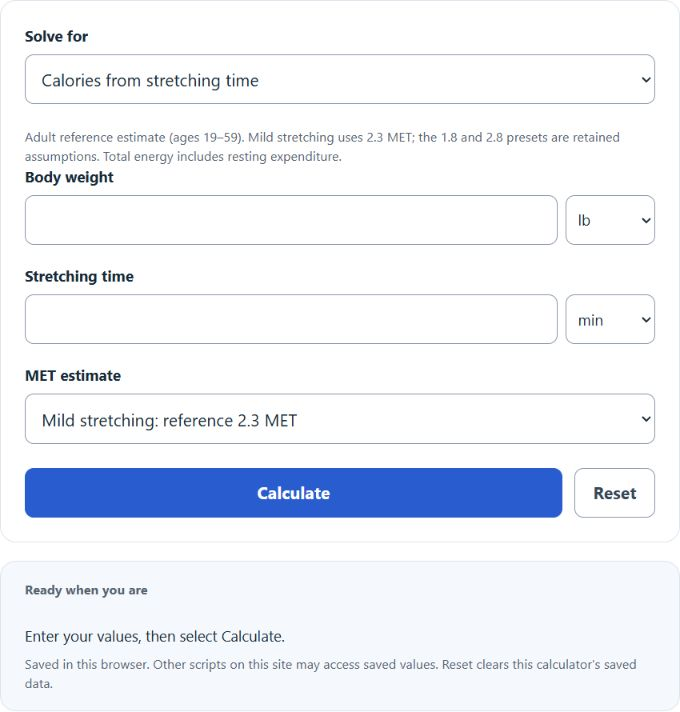
Estimate total energy during static stretching, or calculate time for a supplied calorie amount, using body weight and a MET estimate. The time calculation is not a recommended stretching duration.
- Stretching Calories Burned Calculator
- Pilates Calorie Calculator
- Hatha Yoga Calories Burned Calculator
- Yoga Inversion Calorie Calculator
Static Stretching Calories Burned Formula
The calculator uses the standard MET equation for total energy expenditure. The 2024 Adult Compendium lists mild stretching at 2.3 MET for adults aged 19–59. The retained 1.8- and 2.8-MET presets are assumptions, not separately validated static-stretching categories.
Calories burned mode:
Time for goal mode:
- MET: metabolic equivalent of the activity (1 MET equals resting energy use)
- weight(kg): body weight in kilograms (pounds are converted by multiplying by 0.45359237)
- minutes: total stretching time
- 3.5: oxygen uptake at rest in mL/kg/min
- 200: conversion factor that turns oxygen use into kcal per minute
The result is an estimate. Real calorie burn varies with age, body composition, fitness level, and how actively you hold each stretch. Static stretching is a low-intensity activity, so totals are small compared with cardio or strength work.
Calories-from-time mode solves the first equation; time-for-calorie-amount mode rearranges it. The custom option accepts a positive activity-specific MET from a reliable source. Neither the presets nor the time result measure personal expenditure or prescribe exercise.
Reference Tables
Reference values and retained assumptions (the 1.8 and 2.8 stretching presets are not established Compendium stretching categories):
| Activity | MET | Notes |
|---|---|---|
| Standard 1-MET rest reference | 1.0 | Baseline reference |
| Very gentle stretching | 1.8 | Retained 1.8-MET assumption |
| Mild static stretching | 2.3 | Compendium: mild stretching, activity 02101 |
| Deep or active holds | 2.8 | Retained 2.8-MET assumption; no PNF validation claimed |
| Hatha yoga | 2.5 | For comparison |
| Power yoga | 4.0 | No longer purely static |
Estimated calories burned during 20 minutes of mild static stretching (2.3 MET):
| Body weight | Per minute | 20 minutes | 60 minutes |
|---|---|---|---|
| 120 lb (54 kg) | 2.2 | 44 | 131 |
| 150 lb (68 kg) | 2.7 | 55 | 164 |
| 180 lb (82 kg) | 3.3 | 66 | 197 |
| 200 lb (91 kg) | 3.7 | 73 | 219 |
| 250 lb (113 kg) | 4.6 | 91 | 274 |
Example and Common Questions
Example. A 165 lb person does 30 minutes at 2.3 MET. Weight = 165 × 0.45359237 = 74.84274105 kg. Rate = 2.3 × 74.84274105 × 3.5 ÷ 200 = 3.012420327 kcal/min. Total = 90.37260982 kcal, displayed as 90.4 kcal.
Why is the number so low? Static stretching keeps your heart rate near rest. Most positions involve isolated muscle tension rather than continuous large-muscle work, so energy use stays close to sitting.
Does holding longer burn more? Burn scales linearly with time at a given MET. A 60-second hold burns twice what a 30-second hold burns, but the difference is small in absolute terms.
Will deeper stretches push the MET higher? The retained 2.8-MET option is an assumption, not a verified PNF energy value. Choose an activity-specific reference if the routine includes substantial contraction, flow or movement; do not infer energy expenditure from stretch depth alone.
Should I stretch to lose weight? Stretching is best treated as recovery and mobility work. Pair it with cardio or strength training if calorie burn is your main goal.
Why convert pounds to kilograms? The MET formula is defined in metric units. The calculator handles the conversion automatically when you select lb.