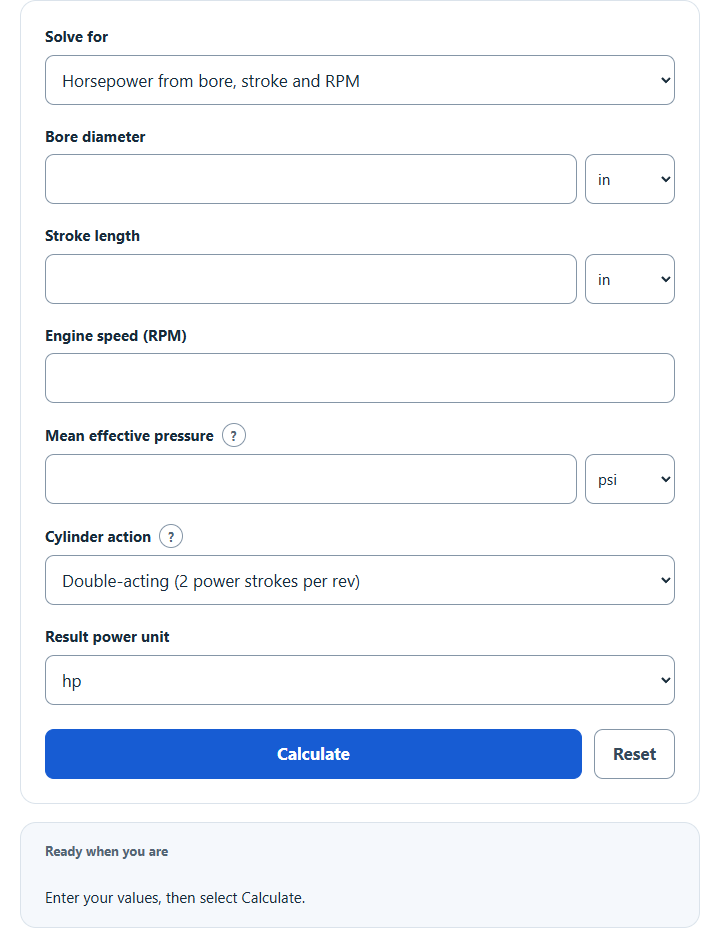
Calculate steam engine horsepower from bore, stroke, RPM and mean effective pressure, or solve for piston area, piston speed or pressure from known power.
- All Physics Calculators
- All Electrical Calculators
- Engine kW to Wheel kW Calculator
- Steam Velocity Calculator
- Indicated Power Calculator
- Steam Turbine Efficiency Calculator
Calculator Functions
| Function | What it does | What it requires |
|---|---|---|
| Horsepower from bore, stroke and RPM | Finds the indicated horsepower of one steam cylinder from its dimensions and speed | Requires the bore diameter, stroke length, engine speed in RPM, mean effective pressure, cylinder action and a result power unit |
| Indicated power from area and piston speed | Finds indicated power when the piston area and working-stroke speed are already known | Requires the effective piston area, equivalent working-stroke speed, mean effective pressure and a result power unit |
| Piston area | Finds the piston area needed for a target power | Requires the indicated power, equivalent working-stroke speed, mean effective pressure and a result area unit |
| Equivalent working-stroke speed | Finds the working-stroke speed needed for a target power | Requires the indicated power, effective piston area, mean effective pressure and a result speed unit |
| Mean effective pressure | Finds the mean effective pressure needed for a target power | Requires the indicated power, effective piston area, equivalent working-stroke speed and a result pressure unit |
| Mean piston speed from stroke and RPM | Finds how far the piston travels each minute | Requires the stroke length, engine speed in RPM and a result speed unit |
| Cylinder area from bore | Finds the area of the cylinder bore | Requires the bore diameter and a result area unit |
Lengths go in as inches, feet, millimetres, centimetres or metres, pressure as psi, kPa, bar or Pa, and power as hp, kW or W. Cylinder action is double-acting, with two power strokes per revolution, or single-acting, with one. Mean effective pressure is the average pressure on the piston over the stroke, which is lower than boiler pressure.
Steam Engine Power Formulas
33,000 [1]
| ihp | Indicated horsepower |
| P | Mean effective pressure (psi) |
| L | Length of stroke (ft) |
| A | Area of the piston (in²) |
| N | Number of power strokes per minute |
The pressure times the area is the force on the piston in pounds, and the stroke times the strokes per minute is the distance that force moves each minute. Dividing by 33,000, the foot-pounds per minute in one horsepower, gives power [1]. Indicated horsepower is the power developed inside the cylinder, and friction losses are not taken off [1], so the power at the shaft is lower.
Horsepower from bore, stroke and RPM
The calculator finds A from the bore and sets N to RPM × 2 for a double-acting cylinder or RPM × 1 for a single-acting one. A double-acting engine with a 6 in bore and an 8 in stroke at 300 RPM and 60 psi has A = 28.27 in², L = 0.667 ft and N = 600, so ihp = 60 × 0.667 × 28.27 × 600 ÷ 33,000 = 20.56 hp. Single-acting, the same cylinder gives 10.28 hp. The result is for one cylinder, and the kW figure uses 1 hp = 745.7 W [2].
Indicated power from area and piston speed
S is the equivalent working-stroke speed in ft/min, which is L × N from the main formula. For a double-acting cylinder it equals the mean piston speed, and for a single-acting one it is stroke × RPM. At 60 psi with a 16 in² piston and 71 ft/min, the power is 60 × 16 × 71 ÷ 33,000 = 2.065 hp.
Piston area
A target of 5 hp at 60 psi and 1,000 ft/min needs 33,000 × 5 ÷ (60 × 1,000) = 2.75 in² of piston area.
Equivalent working-stroke speed
A target of 5 hp from a 3 in² piston at 60 psi needs 33,000 × 5 ÷ (60 × 3) = 916.7 ft/min.
Mean effective pressure
A target of 5 hp from a 3 in² piston at 1,000 ft/min needs 33,000 × 5 ÷ (3 × 1,000) = 55 psi.
Mean piston speed from stroke and RPM
With the stroke in inches the result is in ft/min. The piston covers the stroke twice in each revolution, out and back, so an 8 in stroke at 300 RPM gives 2 × 8 × 300 ÷ 12 = 400 ft/min.
Cylinder area from bore
A 6 in bore has an area of 3.1416 × 36 ÷ 4 = 28.27 in². This is the full bore. On the side of the piston that carries the piston rod, the working area is smaller by the rod’s cross-section.
Limits of This Estimate
- The result is indicated power. It does not include friction, and it says nothing about shaft power, steam consumption or safe working limits.
- The double-acting setting uses the full bore area on both strokes and ignores the piston rod, so it slightly overstates the power. For unequal areas or pressures on the two ends, work out each end separately and add them.
- The cited manual gives the formula for engines in general and does not cover the double-acting steam cylinder. These estimates are based on the best available data and estimations. The suggested pressures of 20, 60 and 100 psi are examples, not measured values, and the real figure comes from an indicator diagram.
Sources
- U.S. Navy, Engineman 1 & C training manual, Chapter 5, Horsepower Computation: indicated horsepower formula, its terms and the 33,000 ft-lb per minute in one horsepower
- NIST, Guide to the SI (Special Publication 811), Appendix B.8: horsepower to watts