Calculate steel thermal shrinkage, original length, or target final temperature with carbon, alloy, stainless, custom coefficient, metric, imperial, strain, and gap outputs.
- All Construction Calculators
- Rebar Calculator
- Casting Shrinkage Calculator
- Steel Deflection Calculator
- Steel Tape Temperature Correction Calculator
- Thermal Expansion Force Calculator
- Concrete Shrinkage Calculator
Steel Shrinkage Formula
Steel shrinkage from cooling is calculated with the standard linear thermal expansion relationship. For contraction problems, the temperature change is negative, which produces a negative change in length. In practice, the absolute value is the physical amount of shrinkage.
Variable Definitions
| Symbol | Description | Common Units |
|---|---|---|
| S | Change in length of the steel member. | in, ft, mm, cm, m |
| L | Original length before the temperature change. | in, ft, mm, cm, m |
| C | Coefficient of thermal expansion for the steel being analyzed. | in/in/°F, mm/mm/°C |
| ΔT | Temperature change from initial condition to final condition. | °F, °C |
Rearranged Forms
If you know any three inputs, the missing value can be solved directly.
Relationship to Thermal Strain
The calculation can also be viewed as thermal strain multiplied by original length. This is helpful when comparing shrinkage across members of different sizes.
How to Use the Calculator
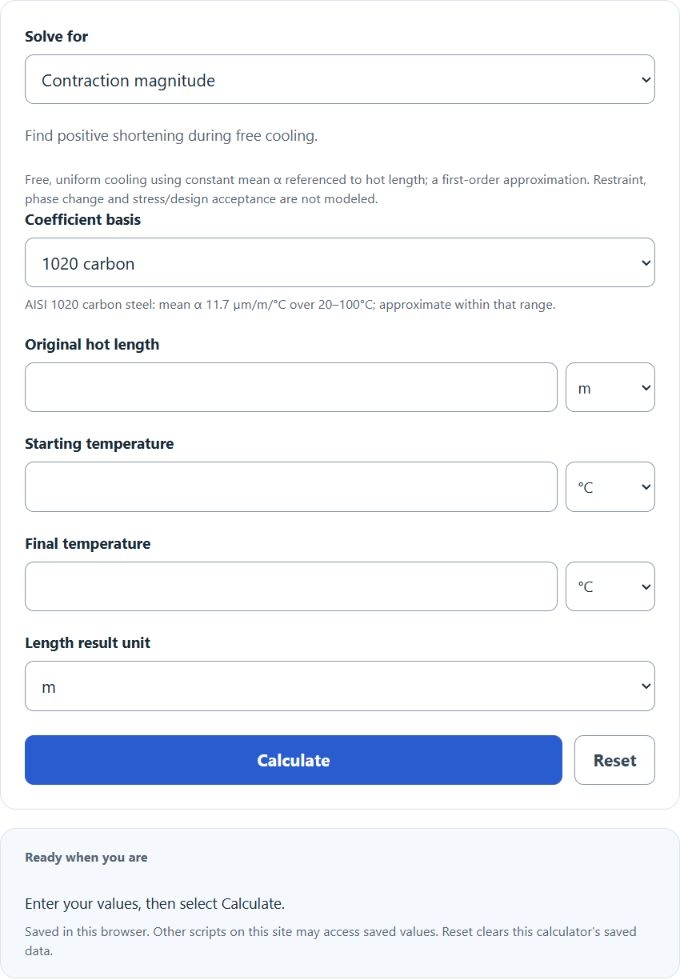
- Choose contraction magnitude, original hot length or final temperature, then enter the known length and contraction quantities for that solve.
- Select a grade-specific reference coefficient or enter a sourced effective average coefficient for the grade and entire cooling interval; match its Celsius or Fahrenheit basis.
- Enter starting and final temperatures for a known cooling interval. To solve for final temperature, enter the starting temperature and target contraction instead.
- Keep all units consistent so the output length is meaningful.
- The article uses signed S and ΔT = Tfinal − Tstart. The widget reports positive contraction magnitude using the nonnegative cooling drop Tstart − Tfinal; final free length is hot length minus contraction.
Sign Convention
- A cooling event produces a negative temperature change.
- A negative result means the steel became shorter.
- If you only need the amount of contraction, use the absolute value.
Example Calculation
For a steel member with an original length of 100 inches, a coefficient of 0.00000645 in/in/°F, and a temperature drop of 50°F, the change in length is:
The member shortens by 0.03225 inches.
Why This Calculation Matters
- Checking fit-up tolerances in fabrication and erection.
- Estimating thermal movement in frames, rails, beams, and pipe runs.
- Sizing gaps, slots, shims, and expansion allowances.
- Reviewing cold-weather dimensional changes before assembly.
- Comparing expected movement between members of different lengths.
Common Input Mistakes
- Mixing Fahrenheit-based coefficients with Celsius temperature changes.
- Using feet for length while expecting an output in inches without converting.
- Confusing absolute temperatures with intervals: the widget accepts starting and final temperature readings, while the article equations use their signed difference.
- Forgetting that cooling should produce a negative temperature change.
- Using a generic coefficient when a project-specific alloy value is required.
Engineering Notes
- This method assumes uniform temperature change along the member.
- The widget applies a constant effective mean coefficient against the entered hot length as a first-order approximation. Its AISI 1020, 42CrMo4 and SUS304 presets use grade-specific mean reference values of 11.7, 12.1 and 17.3 µm/m/°C over 20–100°C. For other grades or temperature ranges, use appropriate sourced custom data; these presets are not universal steel coefficients or a phase-change model.
- If the steel is restrained, thermal stress may develop even when free shrinkage is small.
- For large gradients, complex restraint, or high-temperature applications, a more detailed analysis may be needed.