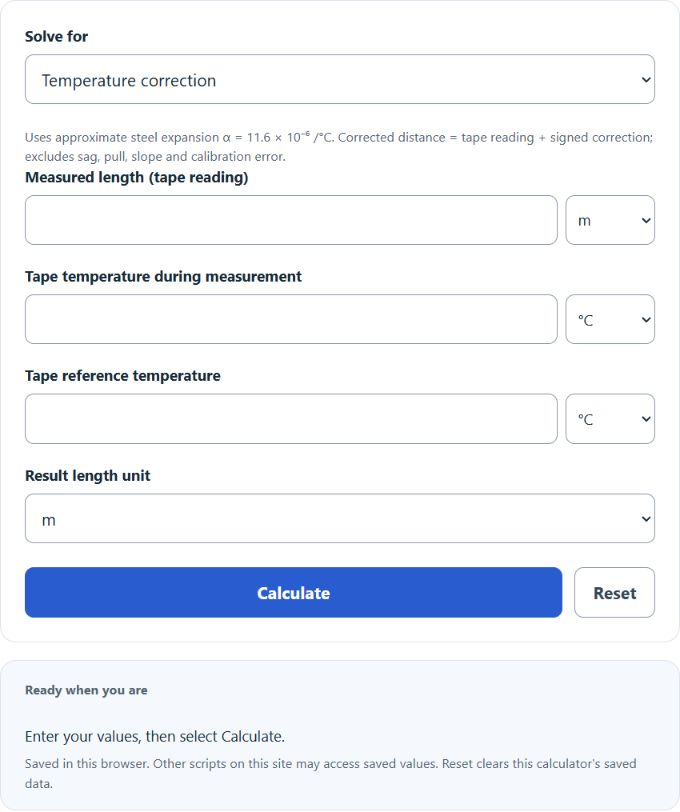
Choose temperature correction, measured length, tape temperature or reference temperature, then enter the displayed inputs. Lengths support meters, feet, inches or cm; temperatures support °C or °F.
- All Construction Calculators
- All Temperature Calculators
- Rebar Calculator
- Compressed Air Temperature Calculator
- Annual Temperature Range Calculator
Steel Tape Temperature Correction Formula
Steel tapes are standardized at a reference temperature. When the tape is used at a different temperature, it expands or contracts slightly, which changes the true distance represented by each graduation. This calculator estimates that temperature-based difference so you can correct long measurements with better precision.
Using an approximate coefficient of linear expansion for steel of 11.6 × 10⁻⁶ per °C, the practical form is:
If you want the corrected distance rather than just the correction amount, use:
Variable Definitions
| Variable | Meaning | Typical Unit |
|---|---|---|
| TC | Temperature correction applied to the measured length | m, ft, in, or cm |
| L | Measured length from the tape reading | m, ft, in, or cm |
| TF | Tape temperature during measurement | °C or °F |
| TI | Reference or standard temperature of the tape | °C or °F |
| α | Coefficient of linear expansion for steel | per degree |
How to Interpret the Result
The sign of the correction matters just as much as the size of the correction.
| Condition | What Happens to the Tape | Correction Sign | Effect on Measured Length |
|---|---|---|---|
| Tape temperature above reference | The tape expands | Positive | Add the correction to the measured length |
| Tape temperature below reference | The tape contracts | Negative | Subtract the correction from the measured length |
| Tape temperature equals reference | No thermal expansion effect | Zero | No temperature correction needed |
How to Calculate Steel Tape Temperature Correction
- Measure the distance with the steel tape and record the observed length.
- Determine the tape temperature during the measurement, not just the general weather conditions.
- Identify the tape’s reference temperature, commonly 20°C or 68°F unless otherwise specified.
- Find the temperature difference by comparing field temperature to reference temperature.
- Multiply the measured length by the steel expansion coefficient and the temperature difference.
- Use the sign of the result to decide whether the correction is added to or subtracted from the measured length.
Example
A 30 m steel tape is standardized at 20°C and used when the tape temperature is 35°C.
The correction is positive 0.00522 m, which is 5.22 mm. Because the tape was warmer than its standard temperature, the tape expanded and the true distance is slightly longer than the raw reading.
Why This Correction Matters
- Surveying: Small thermal changes can accumulate over long distances.
- Construction layout: Precision alignment and spacing can be affected by a few millimeters.
- Quality control: Repeated measurements become more consistent when reference conditions are considered.
- Field verification: Helps separate true dimensional change from tape-related measurement error.
Practical Notes
- Use the temperature of the tape itself whenever possible. A tape exposed to sun can be warmer than the surrounding air.
- The reference temperature should match the tape’s calibration or standardization temperature.
- This correction only accounts for thermal expansion of the tape. It does not include sag, pull, slope, alignment, or calibration error.
- Longer measurements produce larger corrections because the thermal effect scales directly with length.
- If you are working in Fahrenheit, the calculator can still be used, but the temperature difference must be handled consistently.
Common Mistakes
- Reversing the two temperatures and accidentally changing the sign of the correction.
- Using object or ambient temperature instead of the actual tape temperature.
- Applying the correction magnitude without considering whether it should be added or subtracted.
- Assuming the correction is negligible on long runs where even small expansion can become meaningful.
Frequently Asked Questions
- When is the correction positive?
- The correction is positive when the tape is warmer than its reference temperature.
- What reference temperature should be used?
- Use the temperature at which the tape was standardized or calibrated. Many tapes use 20°C or 68°F, but the tape specification is the correct reference.
- Does this formula correct for tape tension or sag?
- No. Temperature correction only addresses length change caused by thermal expansion or contraction of the steel tape.
- Why can such a small coefficient still matter?
- Because the effect grows with both temperature difference and measured length. Over long distances, a very small expansion rate can still produce a noticeable correction.