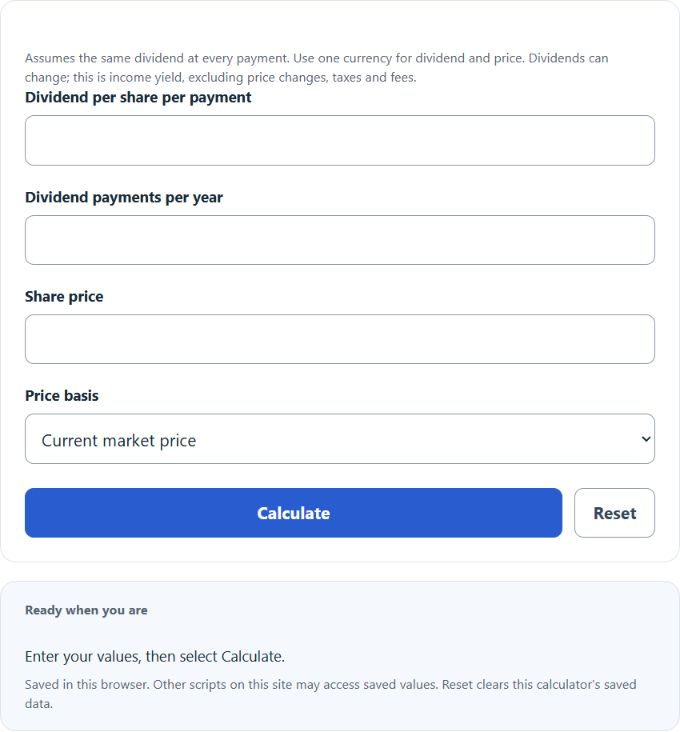
Calculate stock yield as a decimal and percent from dividend per share, annual payment frequency, and current or purchase share price.
Stock Yield Formula
The stock yield formula estimates the annual dividend yield of a stock based on its dividend payment amount, dividend payment frequency, and share price.
To show the result as a percentage:
- SY = stock yield as a decimal
- SY% = stock yield as a percentage
- DA = dividend payment amount per share per payment
- DPY = dividend payments per year
- SP = share price
The calculator multiplies the dividend amount by the number of dividend payments per year to estimate the annual dividend per share. It then divides that annual dividend by the share price. This assumes equal recurring dividends; a special dividend should not be repeated across the year. Dividends are not guaranteed, and this income yield excludes share-price gains or losses, taxes and fees.
If you enter the current share price, the result is the current dividend yield. If you enter your purchase price, the result is your yield on cost.
Common Dividend Payment Frequencies
Use the dividend payments per year value that matches how often the stock pays dividends.
| Dividend Schedule | Payments Per Year | Example |
|---|---|---|
| Monthly | 12 | $0.10 paid every month |
| Quarterly | 4 | $0.50 paid every quarter |
| Semiannual | 2 | $1.00 paid twice per year |
| Annual | 1 | $2.00 paid once per year |
Stock Yield Result Guide
| Stock Yield | General Meaning |
|---|---|
| 0% to 2% | Low dividend yield. The stock may focus more on growth than income. |
| 2% to 5% | Illustrative 2% to 5% band; appropriate yields depend on the security, sector and conditions. |
| 5% to 8% | Higher dividend yield. Review dividend stability and company fundamentals. |
| Above 8% | Very high yield. This can signal higher risk, a falling share price, or a possible dividend cut. |
Example Calculations
Example 1: Quarterly Dividend Stock
A stock pays $0.50 per share each quarter. The current share price is $40.
The stock yield is 0.0500, or 5.00%.
Example 2: Monthly Dividend Stock
A stock pays $0.08 per share each month. The share price is $24.
The stock yield is 0.0400, or 4.00%.
FAQ
What is stock yield?
Stock yield is the annual dividend income from a stock divided by the share price. It shows how much dividend income you receive relative to the stock price. For example, a 4% stock yield means the annual dividend equals 4% of the share price.
Should you use current price or purchase price?
Use the current share price if you want the current dividend yield. Use your purchase price if you want yield on cost. Current yield helps compare the stock to other investments today. Yield on cost compares annualized dividend income with the purchase price; it does not measure total return.
Does a higher stock yield always mean a better stock?
No. A high yield can be attractive, but it can also be a warning sign. The yield rises when the share price falls. If the company cannot support the dividend, the dividend may be reduced or stopped. You should also review earnings, cash flow, debt, and dividend history.